
For the past three years, you’ve played by the rules. You watched for door dings, tracked your mileage, and kept the vehicle exactly as the lease agreement demanded. Now, it’s officially yours. The restrictions are gone, and the freedom to make it truly your own is exhilarating. But this new freedom brings new questions. How do you personalize your car without tanking its resale value or accidentally voiding your warranty?
This isn’t about extreme modifications. It’s about strategic personalization. While the global vehicle modification market shows explosive growth, with some regions projected to reach nearly $9 billion, the smartest owners aren’t just chasing trends. They are making calculated upgrades that enhance their daily drive while protecting their long-term investment.
What Can You Change After a Lease Buyout?
After a completed lease buyout, the lease-return restrictions that previously limited modifications generally no longer control what you can do to the vehicle. You can usually change wheels, add protection products, modify the interior, install accessories, or consider performance upgrades because you are now the owner rather than the lessee.
However, “you own it” does not mean “anything goes.” If the buyout is financed, your lender retains a secured financial interest in the vehicle until the loan is repaid. Major alterations that materially affect collateral value may therefore deserve a review of your financing agreement.
Your factory warranty also remains subject to its terms. An aftermarket part does not automatically void the entire warranty, but warranty coverage can be denied for damage caused by an aftermarket component or improper installation. Likewise, emissions equipment, lighting, tint, exhaust noise, suspension height, and other modifications remain subject to federal, state, and local law.
The practical rule is simple: the more permanent, performance-oriented, or difficult to reverse a modification becomes, the more carefully you should check warranty, lender, insurance, legal, and resale implications before installing it.
The ownership milestone: your roadmap for the first year
The shift from lessee to owner is significant. You’re no longer just a temporary user; you’re building equity and a relationship with your vehicle. Instead of jumping into major changes, a phased approach allows you to enjoy the freedom of ownership while making smart, reversible decisions first. This roadmap helps you navigate that transition confidently.
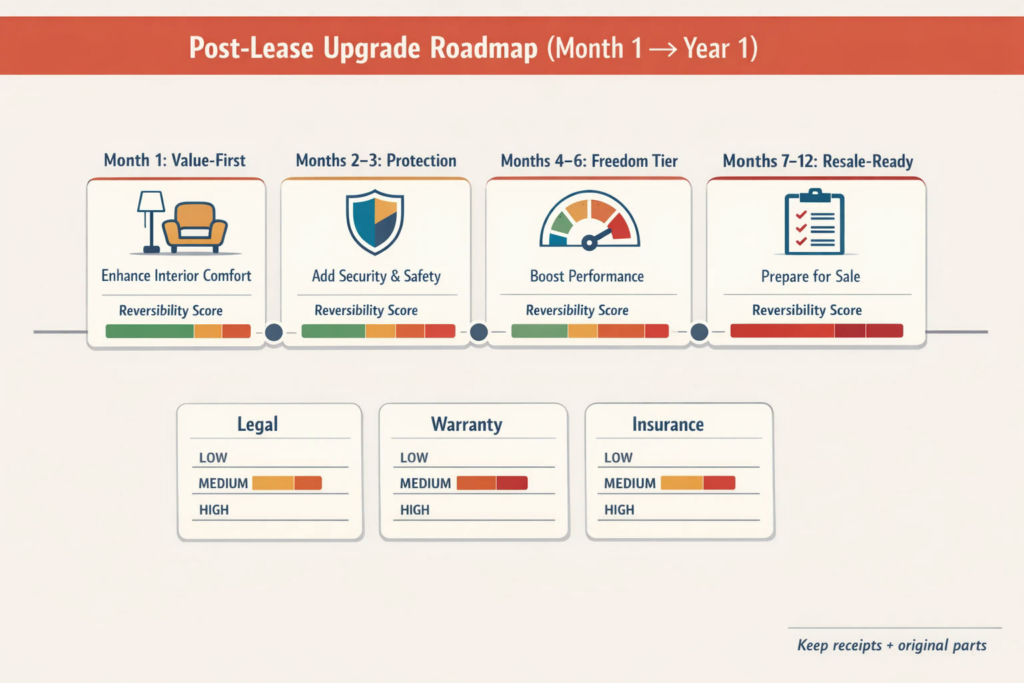
A simple year-one sequence helps you personalize confidently: start with reversible, value-protecting upgrades, then add freedom-tier mods only after legal, warranty, and insurance checks.
Tier 1: Value-first upgrades with a high reversibility score
The best initial modifications are those that improve your experience, protect your car’s condition, and can be easily removed before you sell it. Think of these as high-ROI upgrades that add daily value without long-term risk.
Interior enhancements
You spend hours inside your car, so start there. These subtle changes make a huge difference in comfort and convenience.
- Wireless Connectivity: If your infotainment system requires a cable for Apple CarPlay or Android Auto, a simple wireless adapter is a game-changer. It’s a plug-and-play upgrade that declutters your console and modernizes your driving experience.
- Custom-Fit Liners: All-weather floor and cargo liners from brands like WeatherTech or Husky are perfectly molded to your vehicle. They offer serious protection against spills, dirt, and wear, preserving the original carpets underneath. When it’s time to sell, pull them out to reveal a factory-fresh interior.
- Subtle Ambient Lighting: Professional-grade ambient lighting kits can add a touch of luxury found in high-end trims. These systems integrate cleanly and can be set to a single, sophisticated color, elevating the cabin’s atmosphere.
Essential protection
Protecting your vehicle’s exterior is one of the smartest investments an owner can make. This is especially true depending on your climate, from the intense sun in southern states to the salted winter roads in the north.
- Paint Protection Film (PPF): A clear, self-healing film applied to high-impact areas like the front bumper, hood, and side mirrors. PPF is the most effective way to guard against rock chips, scratches, and bug stains that degrade your paint over time.
- Ceramic Coating: This liquid polymer bonds with your vehicle’s paint, creating a durable, hydrophobic layer of protection. It makes washing easier, enhances gloss, and provides a strong defense against UV rays and chemical contaminants.
Best Resale-Friendly Car Modifications
The safest personalization choices generally improve protection, convenience, or appearance without permanently changing the vehicle’s factory configuration.
Examples include high-quality floor and cargo liners, removable infotainment adapters, PPF, professionally applied ceramic coatings, OEM-style wheels that remain close to factory dimensions, legal window tint, and bolt-on cosmetic accessories that can be removed without leaving permanent damage.
Keeping the original factory parts increases the value of reversibility. If you replace wheels, trim, exhaust components, or other removable equipment, storing the original parts gives you the option to return the vehicle to stock before selling or trading it.
The goal is not to find modifications that “pay for themselves.” Instead, prioritize changes that provide daily value while preserving broad buyer appeal and making a factory-style resale possible.
Tier 2: The freedom upgrades (aesthetics and performance)
Once you’ve covered the essentials, you can explore modifications that align more with personal expression and driving enjoyment. The key here is to choose reputable products that are legally compliant and well-regarded in the owner community.
Performance that plays by the rules
Many owners want their car to feel a little more responsive or sound a bit better. You can achieve this without going to extremes.
- ECU “Safe-Tunes”: Reputable tuning companies offer software calibrations that can improve throttle response and modestly increase power while staying within the engine’s safety parameters. Look for tuners who offer a warranty-matching program or an easy way to revert to the stock file.
- Cat-Back Exhaust Systems: This type of exhaust modification replaces components from the catalytic converter back. It can provide a more refined exhaust note without violating federal emissions laws. Always check your local noise ordinances before installing.
Smart visuals
- Wheels and Tires: A new set of wheels is one of the most transformative visual changes you can make. Stick to sizes and offsets close to the original equipment specifications to avoid rubbing issues or premature suspension wear. A quality set of tires not only improves the look but can also enhance handling and safety.
- Window Tinting: A professional tint job offers privacy, style, and significant heat rejection, protecting your interior from sun damage. However, laws on tint darkness vary drastically by state. A 35-50% tint is often a safe bet for side and rear windows, but always verify your local regulations to avoid fines.
What Modifications Can Hurt Resale Value?
The modifications most likely to hurt resale are those that substantially narrow the buyer pool, introduce uncertainty about reliability, or make the vehicle difficult or expensive to return to factory condition.
Examples can include irreversible bodywork, extreme suspension lowering, poorly installed electrical accessories, aggressive ECU tuning, emissions modifications, unusually loud exhaust systems, unconventional paint or wrap choices, oversized wheels that compromise ride quality, and the removal of original safety or emissions equipment.
The core principle is straightforward: the narrower the buyer pool created by a modification, the greater the potential resale risk.
A future buyer may appreciate upgraded wheels or a subtle exhaust, but another buyer may immediately budget for the cost of returning the car to stock. Dealerships can be even more conservative because heavily modified vehicles may be harder to certify, finance, warranty, or resell through mainstream channels.
The critical checkpoints: warranty, insurance, and legal compliance
Modifying a vehicle introduces new variables. Before making any changes, especially performance-related ones, it’s vital to understand the potential impact on your vehicle’s key protections. Some upgrades are perfectly safe, while others can create expensive headaches.
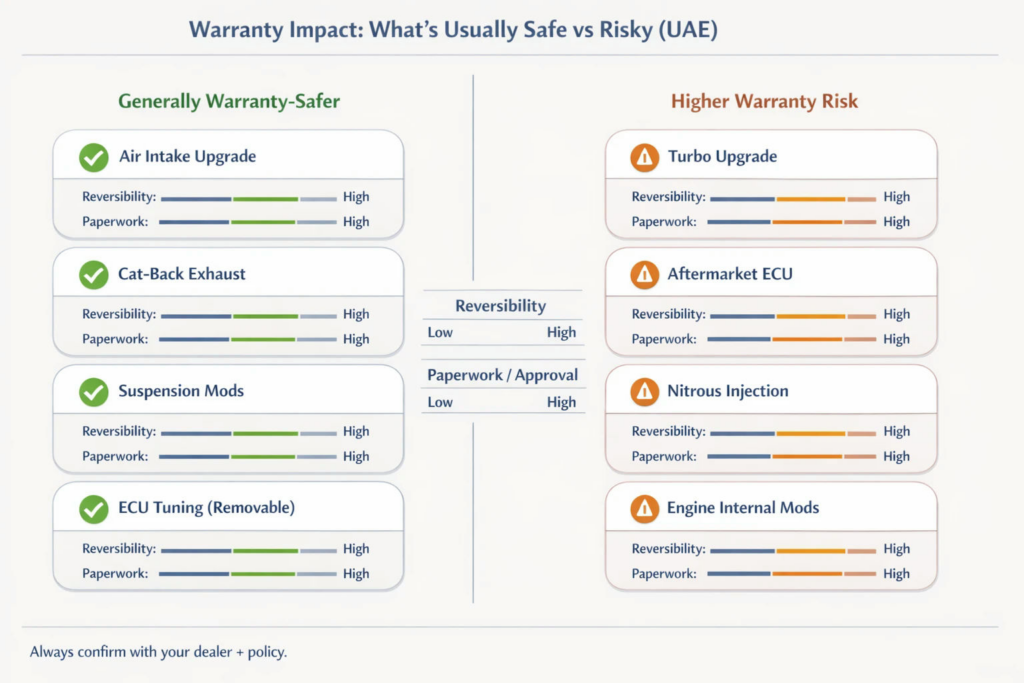
Use this checklist-style comparison to pick upgrades that feel meaningful without accidental warranty headaches—favor reversible changes and know when approvals and documentation matter.
In the U.S., the Magnuson-Moss Warranty Act protects you. A manufacturer cannot void your entire warranty just because you installed an aftermarket part. They must prove that your specific modification caused the specific failure you’re claiming. However, dealing with a denied claim can still be a hassle. That’s why understanding which extended warranty options are mod-friendly is a crucial step.
Always inform your insurance provider of any significant modifications. Failing to do so could lead to a denied claim in the event of an accident.
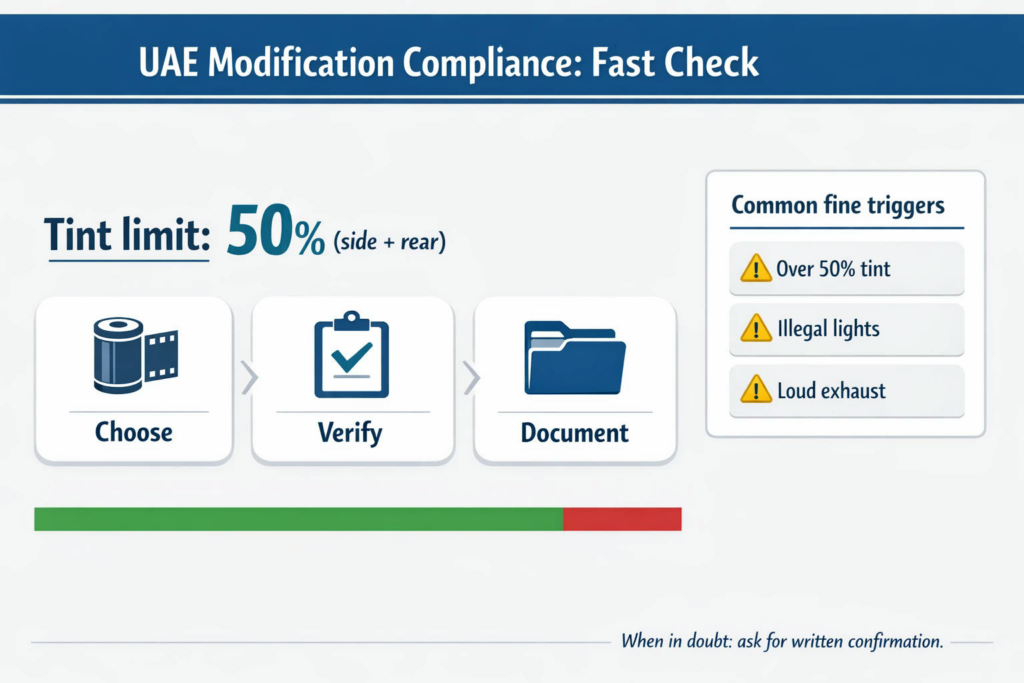
A quick compliance workflow turns ‘Can I do this?’ into a repeatable habit—especially for high-frequency issues like tint limits and documentation checks.
How to Personalize Your Car Without Hurting Resale Value
The strongest strategy is to treat reversibility as an asset. Before installing a modification, ask how easily the car can be returned to factory condition and how much evidence you can preserve showing that the work was done correctly.
Favor bolt-on or plug-in upgrades when they meet your goals. Use reputable installers for tint, PPF, electrical accessories, suspension, exhaust, or performance work. Keep receipts, product documentation, alignment sheets, tuning information, and maintenance history together with the vehicle records.
If an original component is removed, label and store it safely. Factory wheels, trim, exhaust parts, suspension components, and other original equipment can be surprisingly valuable when it is time to sell or trade the vehicle.
Finally, distinguish personal value from resale value. A modification can be completely worthwhile because you enjoy it every day even if you never recover the purchase price. The important thing is to understand that trade-off before spending the money.
Protect your investment: a resale strategy for the modified car
When it comes time to sell, modifications can be a double-edged sword. While you may love them, a potential buyer might not. In some markets, heavy modifications can reduce the resale value of popular vehicles by tens of thousands of dollars.
The key is to make it easy for the next owner to appreciate your changes or for you to return the car to stock.
- Keep all original parts. Store the factory wheels, exhaust, and suspension in a safe place. Being able to offer the car in its original state is your biggest asset.
- Maintain meticulous records. Keep a binder with receipts and documentation for every upgrade, from the PPF installation to the oil changes. This demonstrates quality and care.
- Quantify the trade-offs. Think like a buyer. An expensive audio system might not add much value, but a professionally installed ceramic coat will. Weigh your daily enjoyment against the potential impact on resale.
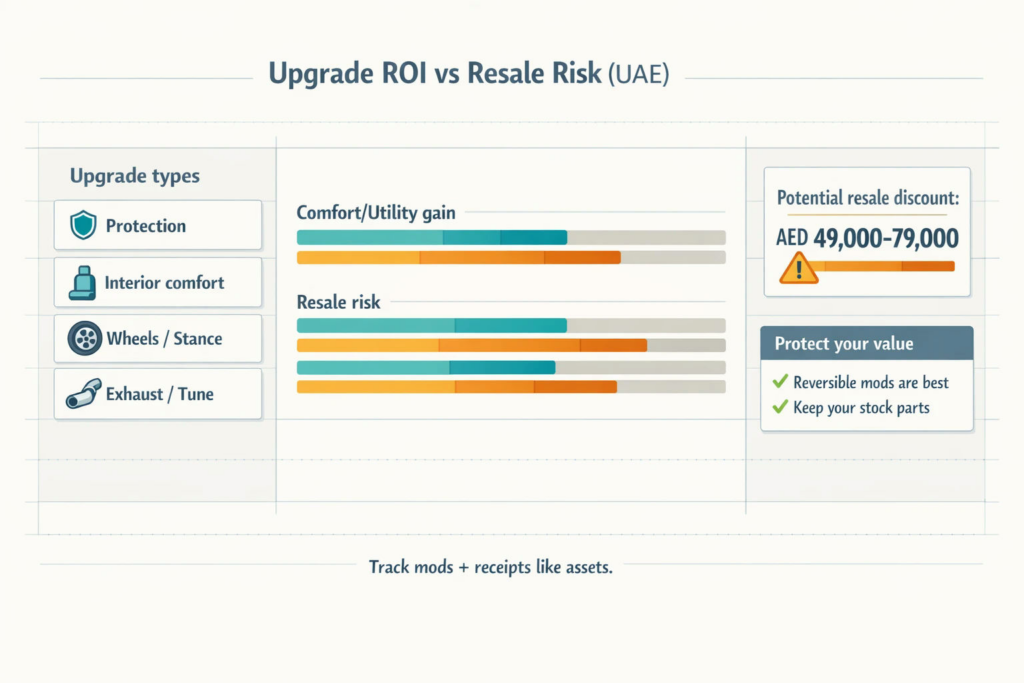
Not every upgrade pays back. This visual helps you weigh daily benefits against resale risk—so you can choose mods that feel better now without a painful discount later.
Making a car your own is one of the great joys of ownership. By approaching it with a strategy that balances personal taste with practical considerations, you can enjoy the freedom you’ve earned while protecting the asset you’ve acquired.
The first step to smart ownership is a seamless transition. At Lease Maturity Services, we specialize in simplifying the lease buyout process. We handle the complex financing, titling, and registration, empowering you to focus on the road ahead.
