
The moment you decide to buy your leased car is significant. You’re transitioning from being a temporary user to a full owner. But in the administrative gray area between the leasing company’s ownership and yours, a critical handover of legal and financial responsibility occurs. That transition affects your auto insurance, lienholder information, GAP protection, title, registration, and the coverage requirements attached to the vehicle.
Lease buyout insurance refers to the insurance changes that occur when you purchase your leased vehicle and move from lessee to owner. In many cases, you may be able to keep your existing auto policy, but the policy details must be updated to reflect the new ownership and financing structure.
This isn’t just about updating a document; it’s about closing potential liability gaps that can complicate a claim or leave your policy information out of sync with the vehicle’s legal and financial ownership. Many drivers assume their existing insurance policy simply rolls over. Sometimes it can remain in force, but the lessor, lienholder, physical-damage requirements, GAP coverage, and policy endorsements may all need to change.
This guide provides the legal handover blueprint you need, covering what happens to insurance after a lease buyout, when to update your insurer, how financed and cash buyouts differ, what happens to GAP insurance, and how title and registration fit into the ownership transition.
What Happens to Insurance After a Lease Buyout?
When you buy your leased vehicle, you do not necessarily need to cancel your existing policy and start from scratch. In many cases, your insurer can update the same policy to reflect the change from leased vehicle to owned vehicle.
The most important changes involve the financial interest attached to the car. During the lease, the leasing company is typically identified on the policy because it owns the vehicle. After the buyout, that interest must be removed or replaced.
If you finance the lease buyout, your new lender will generally need to be listed on the policy as the lienholder or loss payee according to its instructions. If you purchase the vehicle with cash, there is no new lender to add, and you become the sole owner once the title transfer is completed under the applicable state process.
Your state’s legally required liability coverage still applies either way. Comprehensive and collision coverage may become optional after a cash purchase, depending on state law and your own risk tolerance, but a lender financing the buyout will often require those coverages until the loan is repaid.
The critical handover: Pinpointing the exact moment liability shifts
The most common point of confusion in a lease buyout is knowing when you become fully responsible for the vehicle. Does it happen when you agree to the purchase, when the check clears, or when you get the new title in the mail?
There is no single nationwide rule establishing one universal moment when ownership and insurance responsibility shift in every lease buyout. The exact transfer can depend on the lease agreement, state title law, payoff processing, lien release, title reassignment, and whether the purchase is financed.
A typical transaction may involve several connected events: the lessor receives the payoff, the leasing interest is released, title documents are reassigned or electronically updated, the new lender is recorded if applicable, and the registration is updated. Those events do not always happen at exactly the same moment.
The safest approach is to coordinate the effective date of your insurance update with your lessor, lender, and insurer before the buyout closes. Do not cancel or remove existing coverage until your insurer confirms when the ownership and lienholder changes should become effective.
Rather than relying on a fixed “24–48 hour overlap” rule, make sure continuous coverage is confirmed in writing or in your policy documents. The objective is simple: there should be no gap between the coverage required under the lease and the coverage required once you become the owner or borrower.
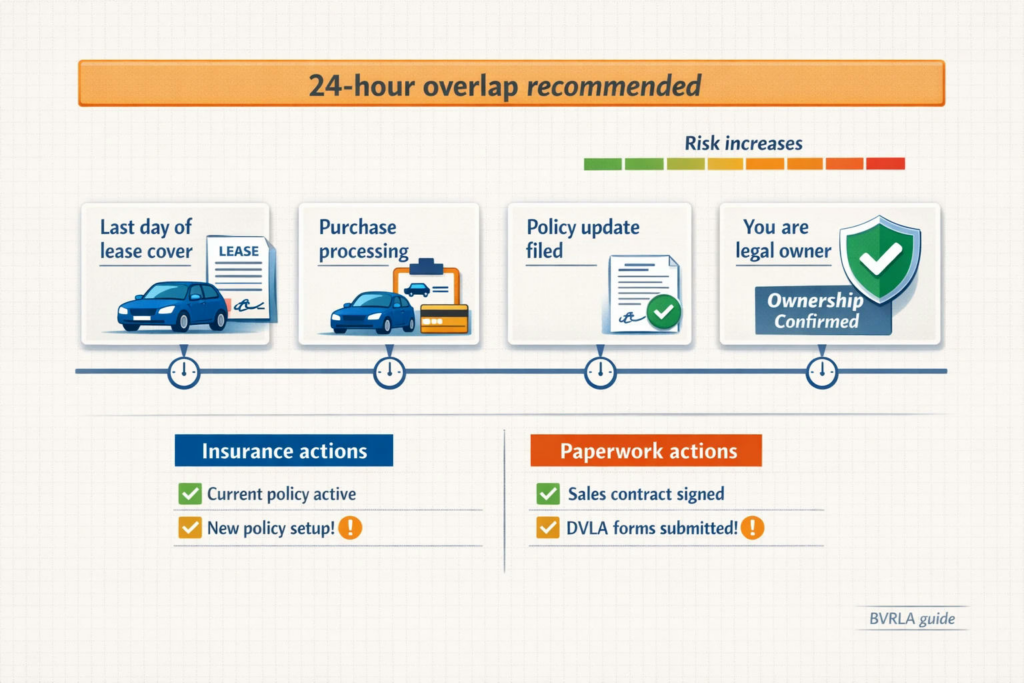
A practical handover roadmap showing when liability shifts and why a short overlap in cover can prevent a costly gap if an accident happens during processing.
Adjusting your insurance policy: A step-by-step guide
Once the buyout is initiated, your insurance needs a significant update. Your policy was structured to protect the leasing company’s asset; now, it must be structured to protect yours.
Step 1: Notify your insurer before the buyout is final
Contact your insurance agent as soon as you begin the buyout process. Inform them you are purchasing your leased vehicle. This gives them time to prepare the necessary endorsements and advise you on the best date to make the policy changes effective. This proactive step prevents last-minute scrambles and potential lapses in coverage.
Step 2: Update the lienholder and coverage details
Your lease agreement required the leasing company to be listed as the “additional insured” and “loss payee.” This directed any insurance payouts to them first. Now, this must change.
- If you financed the buyout: Your new lender will become the lienholder and must be listed as the new loss payee.
- If you paid in cash: You can remove the loss payee designation entirely, as you are the sole owner.
This is also the perfect time to review your coverage. Leases often mandate high liability limits and low deductibles. As an owner, you have more flexibility. You might adjust comprehensive and collision deductibles to lower your premium, but be careful not to underinsure your new asset. Now that you’re building equity, you may also want to consider an extended warranty for long-term peace of mind.
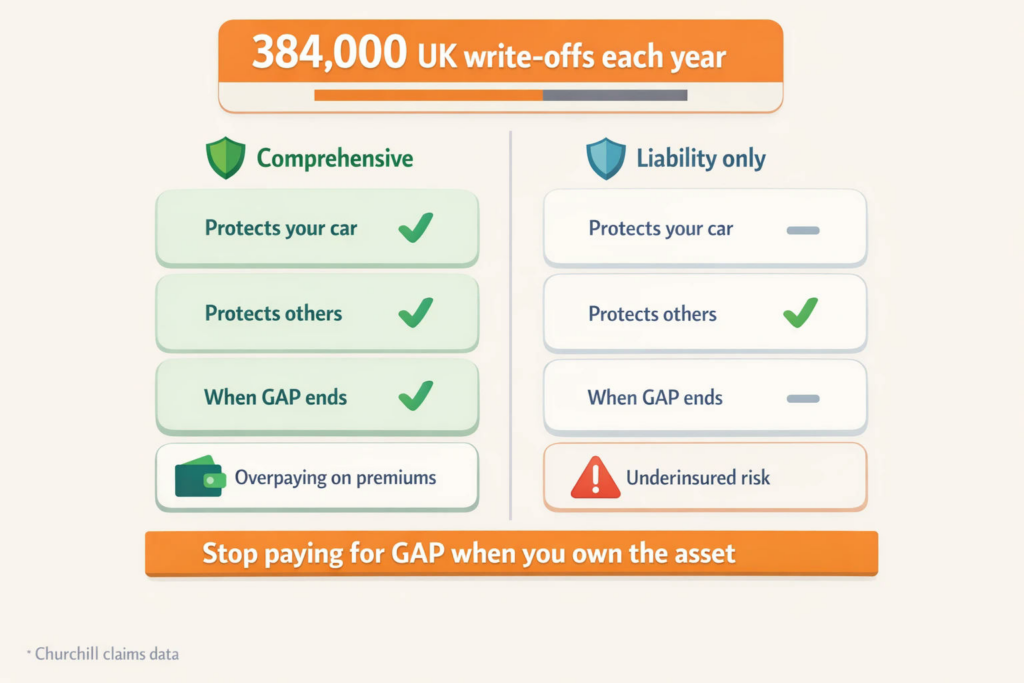
Compare protection levels and avoid paying for coverage you no longer need—this matrix clarifies what changes once the vehicle becomes your asset.
What Insurance Coverage Can Change After a Lease Buyout?
A lease buyout does not eliminate your normal auto-insurance obligations. Instead, it changes who has a financial interest in the vehicle and which coverages are contractually required.
Liability coverage remains governed primarily by state law and the limits you choose. A buyout does not remove those statutory obligations.
Collision and comprehensive coverage may be required by the leasing company before the buyout and by the new lender after the buyout. If you pay cash and own the vehicle free and clear, those coverages may become optional, although dropping them means accepting the financial risk of damage or total loss yourself.
Deductibles may also become more flexible once the lease ends, but a new lender can still impose maximum deductible requirements.
Optional protections such as rental reimbursement, roadside assistance, uninsured/underinsured motorist coverage where optional, and other endorsements should also be reviewed rather than automatically carried forward or removed.
A lease buyout is therefore a good point to reassess the entire policy based on the car’s current value, your financial exposure, and any lender requirements.
Cash vs. Financed Lease Buyout Insurance
How you pay for the vehicle changes the insurance structure after the lease ends.
| Insurance / Ownership Issue | Cash Buyout | Financed Buyout |
|---|---|---|
| Leasing company removed from policy | Yes, after the transfer is processed | Yes, after the transfer is processed |
| New lienholder added | No | Usually yes |
| Comprehensive/collision lender requirement | No lender requirement | Often required |
| GAP relevance | Usually lower because no auto loan remains | May still matter if the loan exceeds vehicle value |
| Title lien | None once ownership is transferred | New lender generally recorded according to state procedure |
| Coverage flexibility | Greater, subject to state law | Subject to lender requirements |
This distinction is one of the most important parts of lease buyout insurance. Ending a lease does not automatically mean that “full coverage” requirements disappear. If the lease is replaced with an auto loan, the party requiring physical-damage protection simply changes from the lessor to the new lienholder.
The end of GAP insurance: When and how to cancel
Guaranteed Asset Protection (GAP) insurance is essential for a lease, covering the difference between an insurance payout and the remaining lease balance if the car is totaled.
Once you buy the vehicle, GAP insurance becomes obsolete. Its purpose is tied directly to the lease contract. As soon as your buyout is complete, you should contact your GAP insurance provider to cancel the policy. In most cases, you are entitled to a prorated refund for the unused portion of the policy premium. Don’t leave money on the table; this is a cost-optimization step many new owners forget.
Do You Need GAP Insurance After a Lease Buyout?
The key question is the relationship between your new loan balance and the vehicle’s actual cash value.
If you owe substantially more than the car is worth, GAP coverage may help address that exposure after a qualifying total loss. If the loan balance is at or below the vehicle’s value, the financial need for GAP is generally reduced.
For example, if your financed lease buyout creates a $28,000 loan on a vehicle currently worth $23,000, you begin ownership with roughly $5,000 of negative equity before considering policy deductibles or contractual limitations. That is the type of situation in which GAP may deserve serious consideration.
If you pay $23,000 in cash for a vehicle worth approximately the same amount, there is no auto-loan balance and therefore no lender shortfall for GAP to address.
Mastering the paper trail: Title, registration, and legal ownership
During a lease, you were the “registered keeper” or driver, but the leasing company was the “legal owner” listed on the vehicle’s title. The buyout process merges these two roles.
Understanding this distinction is key to a smooth administrative transition. The title is the official proof of ownership, while the registration allows you to operate the vehicle legally on public roads. After the buyout, the title must be transferred into your name, with your new lender listed as the lienholder if you financed the purchase.

This diagram separates identity from paperwork so you can file the right documents at the right time—and avoid compliance mistakes during the handover.
This process involves coordinating with the seller (your former leasing company), your new lender, and your local DMV. It can be cumbersome and time-consuming. At Lease Maturity Services, we handle this entire process for you. Our team simplifies the entire titling and registration process, ensuring all paperwork is filed correctly and you receive your new plates and registration without ever stepping foot in a DMV.
Your lienholder compliance checklist
When updating your insurance policy, providing incorrect information for your new lienholder can cause payment delays or even be considered a breach of your loan agreement. Lenders have very specific requirements for how they must be listed on your policy.
For example, a lender like Honda Lease Trust (HVT, Inc.) often requires being listed precisely as both “Additional Insured” and “Loss Payee.” Getting these details right is not optional. Use the following as a guide when speaking with your insurer.
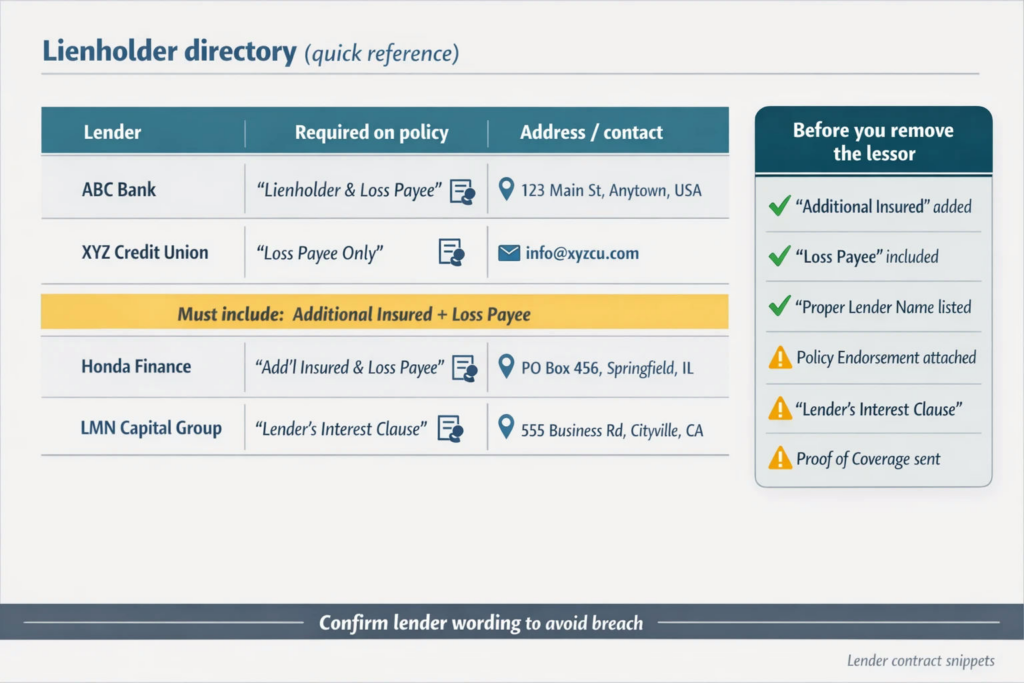
A practical compliance tool: confirm lienholder wording and keep key contact details handy so policy updates don’t accidentally trigger a contract breach.
Lease Buyout Insurance Checklist
Before the transaction closes, contact your insurer and explain that you are purchasing the leased vehicle. Confirm the effective date of any policy changes and ask what documentation the insurer requires.
Next, determine whether the buyout is being paid in cash or financed. For a financed buyout, obtain the new lender’s exact insurance instructions before removing the leasing company from the policy.
Review your liability, collision, comprehensive, deductibles, and optional coverages. Do not reduce lender-required physical-damage coverage simply because the lease has ended.
Reassess GAP separately. Confirm when any lease-related GAP product ends, whether a refund may be available, and whether your new loan-to-value position creates a need for new GAP or loan-payoff protection.
Finally, complete the title and registration process, verify that any new lien is recorded correctly, and keep updated proof of insurance with your ownership documents.
A smooth transition to ownership
Buying out your lease is a smart financial move that builds equity in an asset you already know and trust. But the administrative details surrounding insurance and legal compliance are where the process can become stressful.
By planning for the liability handover, proactively updating your insurance, and ensuring the title and registration are handled correctly, you can make a seamless transition from lessee to owner. This is our specialty. We manage the complexities behind the scenes, from securing the right financing for your lease buyout to finalizing the paperwork, so you can focus on the drive.
