
The average age of vehicles on U.S. roads has hit a record 12.6 years, according to 2024 data from S&P Global. This means that when you buy out your lease, you’re not just getting a familiar car; you’re stepping into a long-term commitment. The mindset shifts from being a temporary user to a long-term steward of a significant asset.
This transition brings new questions. How do you avoid surprise repair bills? Is this next repair an investment or a sunk cost? And were those extra protection plans you bought worth the price? This guide provides the financial framework and mechanical knowledge you need to protect your investment, maximize its lifespan, and drive with confidence for years to come.
What Should You Do After a Lease Buyout?
After a lease buyout, you should confirm your title and registration, update your insurance information, check your remaining warranty coverage, review the terms of any buyout financing, establish a maintenance baseline, and prepare financially for future repairs.
Completing the buyout changes your relationship with the vehicle. During the lease, the leasing company owned the car and your responsibilities were governed by the lease agreement. After the buyout and ownership transfer, you become responsible for the vehicle’s long-term maintenance, repair costs, insurance decisions, and eventual resale or trade-in value.
If the lease buyout was financed, there is another important distinction: the lease has ended, but you now have an auto loan. Your new lender may hold a lien on the vehicle until the loan is paid off. That affects the title, insurance requirements, and what happens if you later decide to sell or trade the car.
The goal immediately after the buyout is therefore to establish a clear ownership baseline. Confirm who legally owns and has a financial interest in the vehicle, what protection remains in force, what maintenance is due, and what the vehicle is likely to cost you over the next several years.
What Happens After a Lease Buyout?
Once your lease buyout is completed, the vehicle transitions from a leased vehicle to one you own, subject to any lien held by your buyout lender if you financed the purchase. The title and registration must reflect the ownership change, and your insurance information may need to be updated to remove the former leasing company and identify a new lienholder where applicable.
Your financial responsibilities change as well. Instead of preparing for a lease return, mileage limits, or excess wear-and-tear charges, your focus shifts toward maintaining the vehicle, controlling repair costs, managing any outstanding auto loan, preserving resale value, and understanding the protection provided by warranties, service contracts, and insurance.
Buying out a lease does not reset the vehicle’s age, mileage, or maintenance history. You are purchasing the same vehicle you were leasing, which makes its existing service history and current mechanical condition especially important.
That familiarity can be an advantage. Unlike buying an unfamiliar used car, you may already know how the vehicle was driven, maintained, and repaired. The next step is turning that history into a long-term ownership plan.
The day-one buyout audit: your 5-point checklist
The moment you transition from lessee to owner is the perfect time to establish a new baseline for your vehicle. This initial audit helps you confirm paperwork, understand your coverage, and set a maintenance trajectory before any issues arise.
- Confirm Title and Registration: While services like Lease Maturity Services handle the paperwork, it’s crucial to verify you’ve received your official title and registration documents. Store the title in a safe place (not your glove box) and confirm your plates and registration are current.
- Review Your Warranty Status: Is your vehicle still under its original factory warranty? Note the expiration date or mileage. If you purchased an extended warranty during the buyout, review the contract to understand what’s covered, your deductible, and how to file a claim.
- Adjust Your Insurance Policy: Your insurance needs change when you own the vehicle outright. Contact your provider to remove the leasing company as an interested party and adjust your coverage. This is also a good time to shop for better rates, as your status as an owner may qualify you for different discounts.
- Establish a Maintenance Baseline: Your car is no longer on a lease schedule. Get a full multi-point inspection from a trusted mechanic. This gives you a clear picture of your tire life, brake pad thickness, fluid conditions, and any potential issues on the horizon.
- Set Up a Maintenance Fund: Proactive owners are rarely surprised by repair costs. Start setting aside a small amount each month specifically for maintenance and repairs. This transforms unexpected expenses into predictable budget items.
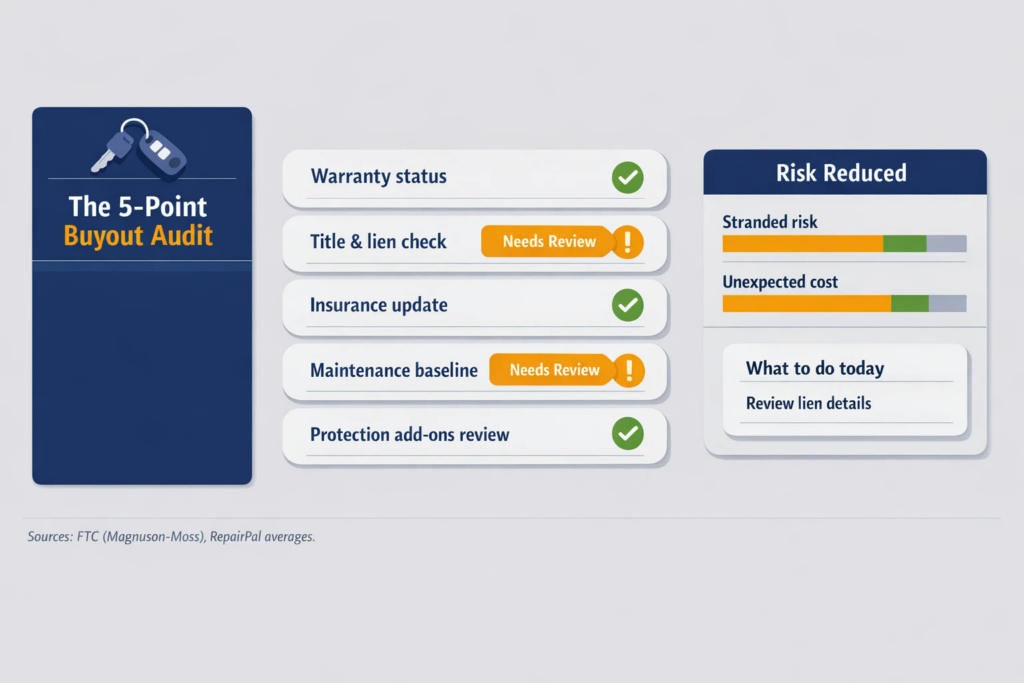
A day-one audit turns a leased/financed car into a long-term asset. Use this checklist to confirm coverage, paperwork, and baseline maintenance before surprises hit.
How Do Title and Registration Work After a Lease Buyout?
After a lease buyout, the vehicle’s title must reflect the transition away from the leasing company. If you paid for the vehicle without financing, the ownership documents should ultimately reflect you as the owner according to your state’s requirements. If you financed the buyout, your lender may be recorded as a lienholder until the loan is repaid.
The exact title-transfer process varies by state. Depending on where the vehicle is registered and how the transaction was structured, the process may involve title-transfer documents, registration updates, taxes, fees, odometer disclosures, and proof of insurance.
If Lease Maturity Services, your lender, or another provider handles the title and registration process, you should still verify that the completed documents contain the correct name, address, vehicle identification number, registration information, and lienholder details. Keep copies of your buyout agreement, payoff documentation, title-related paperwork, and financing documents together.
Title processing can also matter later. If you decide to sell or trade the vehicle, any existing lien generally needs to be satisfied as part of the transaction before clear ownership can transfer to the next buyer.
Does Your Warranty Continue After a Lease Buyout?
Buying out your lease does not generally create a new factory warranty. If the vehicle is still within the manufacturer’s original warranty period or mileage limit, remaining eligible coverage typically continues according to the warranty’s existing terms.
For example, if the factory warranty expires at a specified age or mileage, purchasing the vehicle at lease-end does not ordinarily restart that clock. Your first step should therefore be checking the vehicle’s in-service date, current mileage, and manufacturer warranty information.
An extended warranty or vehicle service contract is different from the original factory warranty. If you purchased additional protection during the buyout, read the actual contract rather than relying on the sales description. Pay particular attention to covered components, exclusions, deductibles, claim procedures, maintenance requirements, cancellation terms, and the repair facilities you are permitted to use.
Understanding the distinction between factory warranty coverage and an optional service contract becomes increasingly important as the vehicle accumulates mileage and the risk of larger repairs grows.
The repair vs. replace decision engine
Sooner or later, you’ll face a major repair estimate and ask the primary question of long-term ownership: “Is my car worth fixing?” The fear of throwing good money after bad is real. While many financial advisors cite the “50% Rule,” which suggests you shouldn’t pay for a repair that costs more than 50% of the vehicle’s value, this rule lacks critical context.
A better decision requires balancing the financial math with the car’s known history and your peace of mind. Use this decision matrix to get a clearer answer.
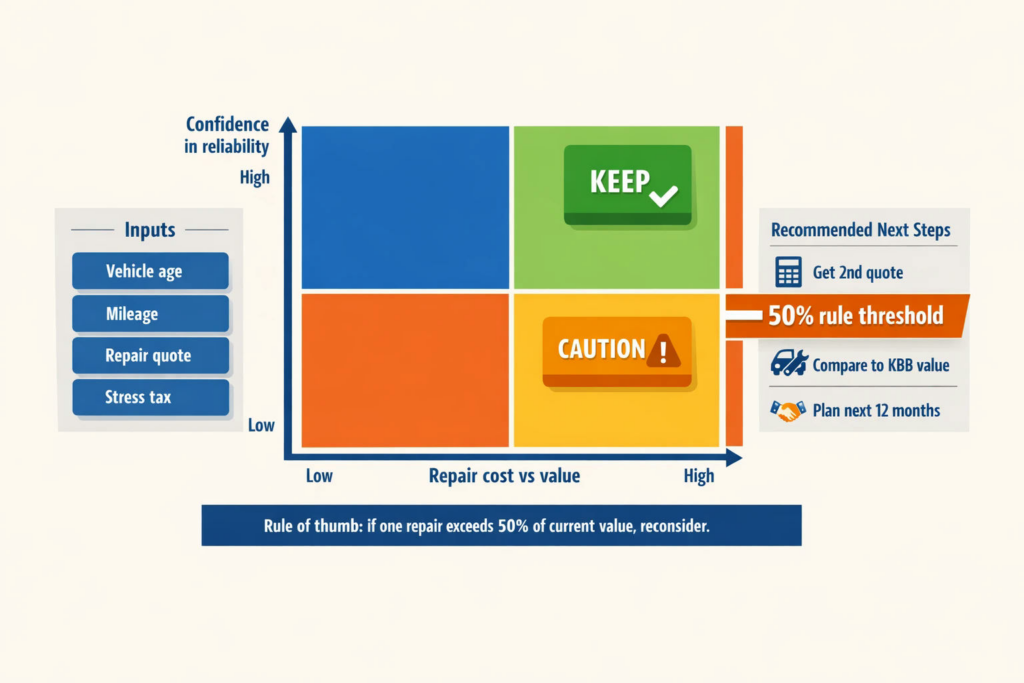
Stop guessing. This matrix combines the 50% rule with real-world reliability confidence so you can decide whether a big repair is an investment—or a warning sign.
This framework helps you move beyond a single data point and make a holistic decision. A $3,000 transmission repair on a reliable car you’ve meticulously maintained is an investment in its future. The same repair on a car that has already stranded you twice is a warning sign.
Is It Worth Repairing a Car After a Lease Buyout?
A repair may be worth making when the vehicle is otherwise reliable, the repair is likely to restore dependable operation, and keeping the car costs less than replacing it with a suitable alternative. The repair estimate alone does not answer the question.
Consider what happens financially if you replace the vehicle. If you still owe money on your lease buyout loan, compare the current loan payoff with the vehicle’s market value. Selling or trading a vehicle while owing more than it is worth can create negative equity that may need to be paid in cash or incorporated into another transaction.
Replacement cost matters too. Spending several thousand dollars repairing a known vehicle can sometimes be financially preferable to taking on the depreciation, taxes, fees, and financing costs associated with another car. On the other hand, repeated failures across multiple major systems can indicate that another expensive repair is unlikely to restore dependable ownership.
The more useful question is therefore not simply, “Does this repair cost too much?” It is: “What will it cost me to keep this vehicle reliably operating compared with replacing it?”
How Should You Maintain a Car After a Lease Buyout?
After buying out your lease, base your maintenance plan on the manufacturer’s schedule, the vehicle’s current mileage and age, its service history, and its actual condition. The fact that the vehicle was previously leased does not create a separate maintenance schedule.
Start by collecting whatever service records are available and comparing them with the maintenance schedule in the owner’s manual or manufacturer guidance. Identify overdue items and upcoming services, then prioritize safety-related components and maintenance that protects major mechanical systems.
Oil and filter service, brakes, tires, fluids, filters, battery condition, belts, hoses, and other service items should be inspected or maintained according to the requirements appropriate to your specific vehicle. Avoid assuming that a generic mileage interval applies to every make, model, engine, transmission, or powertrain.
This becomes particularly important as the vehicle approaches higher-mileage service intervals, when several maintenance items may begin to converge.
Advanced longevity tactics: planning for the 60,000-mile mark
Your car’s needs change dramatically as it ages. According to data from ConsumerAffairs and RepairPal, annual maintenance costs can jump from an average of $500–$800 in the first few years to over $1,200–$1,600 after hitting 60,000 miles. This isn’t a random spike; it’s when key components begin to show their age.
Instead of waiting for a breakdown, focus your attention on the three systems that most impact long-term reliability.
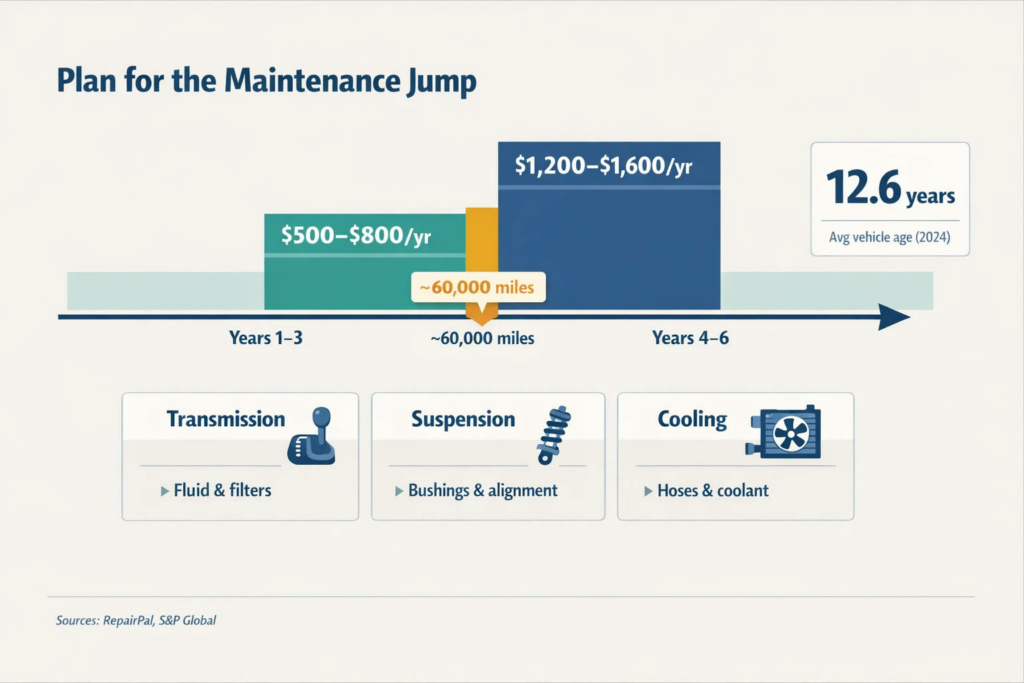
Costs often rise after 60k miles—so plan before you’re forced. This view connects the spend jump to the three systems that most influence long-term reliability.
The big three for high-mileage survival
- Transmission Fluid: This is the most overlooked and vital fluid after your engine oil. It cools, lubricates, and cleans the internal components of your transmission. While some manufacturers claim “lifetime” fluid, most expert mechanics recommend a fluid exchange between 60,000 and 100,000 miles to prevent costly failures.
- Suspension Components: Your car’s shocks, struts, and bushings quietly absorb thousands of impacts. As they wear out, you’ll notice a harsher ride, uneven tire wear, and reduced handling. A proactive inspection around 75,000 miles can catch worn parts before they cause a cascade of other issues.
- Cooling System: The radiator, water pump, and hoses are critical for preventing engine overheating, a leading cause of catastrophic failure. A coolant flush every 50,000 to 60,000 miles removes contaminants and ensures the system operates efficiently, protecting your engine from its greatest threat.
Addressing these systems proactively is the key to pushing your vehicle well past 100,000 miles. For many owners, managing the risk of these larger repairs is where exploring extended warranty options provides significant value and budgeting predictability.
What Happens to Your Lease Buyout Loan After the Purchase?
If you financed your lease buyout, the lease ends but your financial obligation does not. The buyout financing becomes an auto loan with its own principal balance, interest rate, monthly payment, loan term, and payoff amount.
Your lender will generally have a financial interest in the vehicle until the loan is repaid. This is why the lender may appear as a lienholder on the title and insurance policy. Once the loan is fully satisfied, the lien can be released according to the applicable state process.
Pay attention to the difference between your loan balance and the vehicle’s current market value. If the vehicle is worth more than the loan payoff, you have positive vehicle equity. If you owe more than the vehicle is worth, you have negative equity. That relationship becomes important if you decide to sell or trade the vehicle before the loan is repaid.
You may also encounter the option to refinance your lease buyout loan later. Refinancing replaces the existing loan with another loan, potentially with a different interest rate, payment, or term. A lower monthly payment is not automatically a lower-cost loan, however; extending the repayment period can increase total interest even when the payment falls.
When evaluating refinancing, compare the annual percentage rate, remaining term, new term, fees, total interest cost, and any effect on how long you expect to keep the vehicle.
The protection plan de-coder: what did you really buy?
During the buyout financing, you may have been offered additional protection plans. Now that you’re an owner, it’s time to verify their value and understand exactly what you paid for. This is especially true for theft protection add-ons often pitched as a “$5,000 credit.”
This credit usually only applies if your stolen car is declared a total loss and you purchase your next vehicle from the same dealer group. It’s not cash in your pocket. To determine its real value, compare it to what your comprehensive auto insurance already provides.
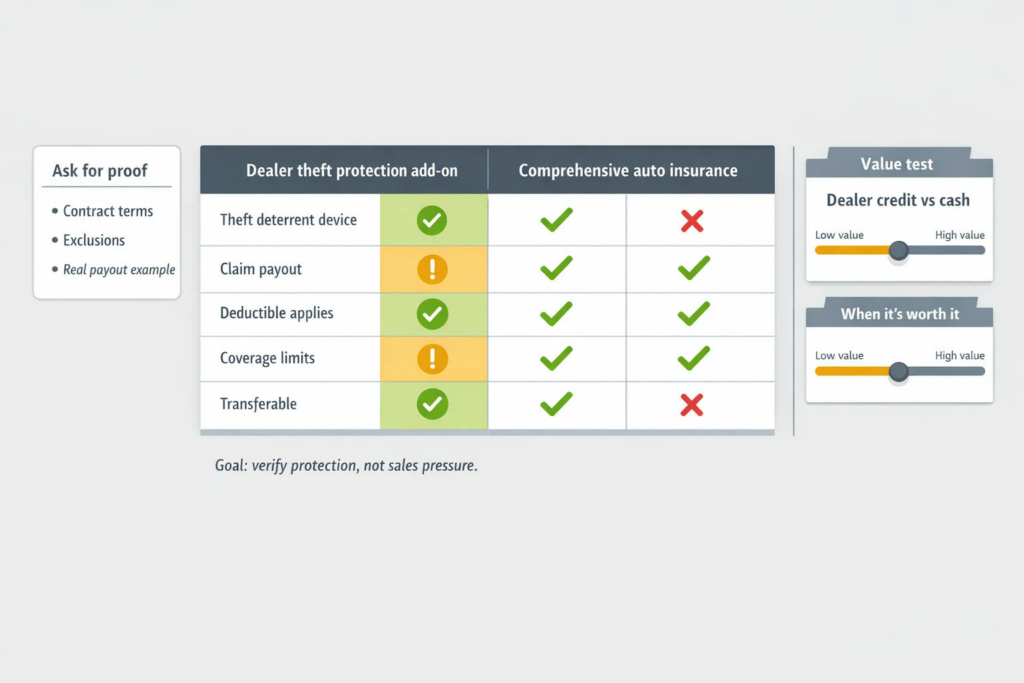
Use a neutral coverage table and a simple value test to separate real protection from expensive add-ons—especially when the pitch is framed as a “credit.”
Lease Buyout Protection: Warranty vs. Insurance vs. Add-Ons
Not every product offered during a lease buyout protects against the same risk. Understanding what each product is designed to do can help you identify overlapping coverage and avoid assuming you are protected against something your contract does not actually cover.
| Type of protection | Primary purpose |
|---|---|
| Factory warranty | Covers eligible defects or repairs according to the manufacturer’s warranty terms and remaining time/mileage limits |
| Vehicle service contract / extended protection | Pays for specified eligible repairs according to the contract’s coverage, exclusions, deductible, and claim rules |
| GAP coverage | May cover an eligible difference between an insurance settlement and outstanding loan balance following a covered total loss, subject to its terms |
| Comprehensive auto insurance | Provides insurance coverage for specified non-collision losses, which commonly include risks such as theft, subject to the policy |
| Theft-protection add-on | Provides the particular benefit described in the add-on contract and may include conditions that differ substantially from insurance |
These products are not interchangeable. A service contract is not auto insurance, comprehensive insurance is not an extended warranty, and a theft-protection benefit should not automatically be treated as GAP coverage.
Remember, the Magnuson-Moss Warranty Act, a federal law, provides important protections relating to consumer warranties. Using an independent repair facility for routine service does not, by itself, automatically void an entire vehicle warranty. However, warranty claims can depend on the circumstances, including whether required maintenance was performed and whether a particular failure was caused by improper service or an aftermarket component.
Keep maintenance receipts and service records regardless of where the work is performed. Documentation can help establish that required maintenance was completed if a future warranty question arises.
Independent repair shops may also offer different labor rates or service pricing from dealerships. Compare qualifications, warranty implications, parts quality, estimates, and reputation rather than choosing a repair facility based on price alone.
Your partner in ownership
Transitioning from a lease to ownership marks a new chapter in your automotive journey. By taking a proactive approach to maintenance, making informed financial decisions, and understanding your coverage, you can ensure the vehicle you love remains a reliable and valuable asset for years to come.
At Lease Maturity Services, our goal is to empower you through every step of the post-lease process. If you have questions about protecting your newly owned vehicle, our team is here to provide the transparent advice and trusted solutions you need.
