
Industry benchmarks show that simple document defects can turn a standard 4-week vehicle title transfer into an 18-week ordeal. For anyone looking to buy out their lease or flip it to a third party, that delay isn’t just an inconvenience; it’s a financial risk that can unravel the entire transaction.
While online calculators can give you a buyout estimate in seconds, they miss the most critical part of the process: the complex web of state tax laws, administrative requirements, and legal liabilities that stand between you and a clean transfer of ownership. This is where profitable deals stall and unexpected costs appear.
This guide provides the strategic intelligence missing from dry DMV directives and surface-level aggregator sites. We’ll break down the real-world financial traps and administrative hurdles you’ll face, from avoiding double taxation to ensuring your paperwork passes registry review on the first try.
What Is a Lease Buyout Title Transfer?
A lease buyout title transfer is the legal process of transferring ownership of a leased vehicle from the leasing company (lessor) to the lessee or another eligible purchaser after the lease buyout has been completed. Until this transfer occurs, the leasing company remains the legal owner of the vehicle.
Once the lease payoff has been satisfied, ownership documentation must be updated through the appropriate state agency before the vehicle can be legally registered, sold, refinanced, or transferred to another owner. This process typically includes title assignment, lien release documentation, odometer verification, registration updates, and tax compliance.
Although the exact requirements vary by state, every lease buyout title transfer follows the same fundamental objective: creating a legally recognized chain of ownership that documents every transfer from the leasing company to the final owner.
The title transfer chain: More than just a signature
A third-party buyout involves a clear sequence of ownership transfers: from the leasing company (the lessor) to you (the lessee), and then from you to the new buyer. Every step in this chain must be perfect. A single error, like a mismatched signature or an incorrect odometer reading, breaks the chain and sends your documents to the back of the line.
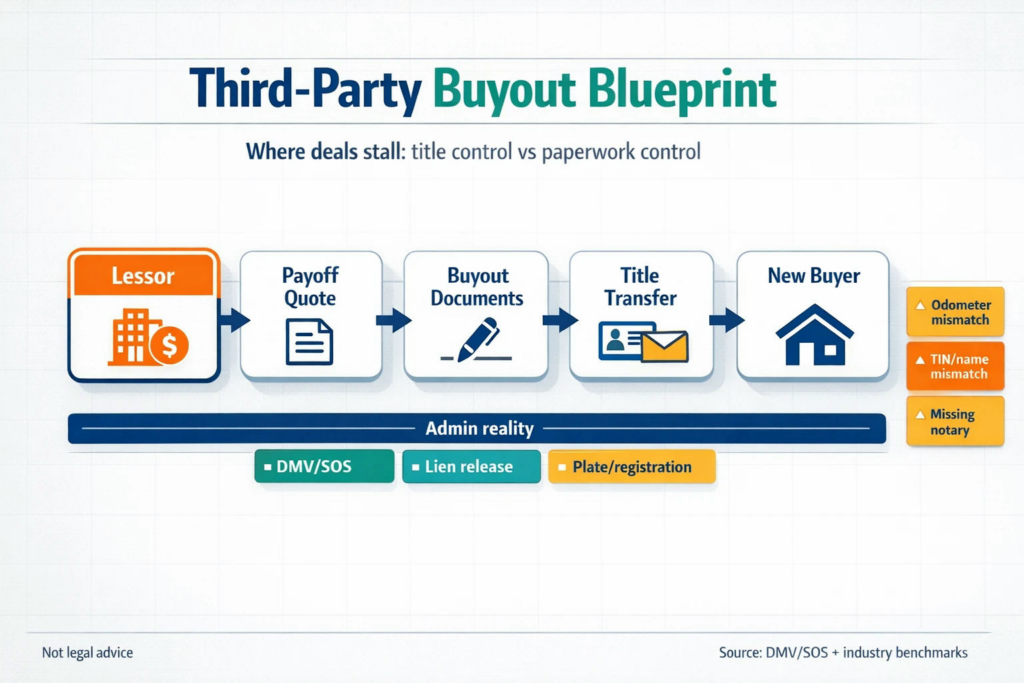
A clear title chain reduces surprises: the fastest path is a clean document set plus early checks for odometer, identity, and notarization defects.
The goal is to manage this process so the transfer is seamless, but the reality is that state requirements are unforgiving. This administrative friction is why having an expert manage the details is so important.
Understanding the Lease Buyout Process
Every lease buyout follows a series of administrative and legal steps that ultimately result in vehicle ownership transferring from the leasing company to the buyer. While individual state requirements differ, the general process remains consistent.
The process typically begins by requesting an official lease payoff quote from the leasing company. After the payoff is completed through cash or financing, the leasing company prepares title documentation and any applicable lien release forms. The buyer then submits the required paperwork to the appropriate state agency to complete registration and receive a new vehicle title.
If the vehicle will be sold immediately after the lease buyout, an additional ownership transfer occurs between the lessee and the new purchaser. Because each transaction depends on the previous step being completed correctly, delays or documentation errors early in the process often affect the entire timeline.
The financial trap you can’t afford: Avoiding double taxation
One of the biggest risks in a lease flip is the “double tax.” This happens when the state taxes both your buyout from the leasing company and your subsequent sale to the third party. This issue is a hot topic on forums like Leasehackr precisely because official guidance is so hard to find. It’s a costly mistake born from misunderstanding state-specific tax laws.
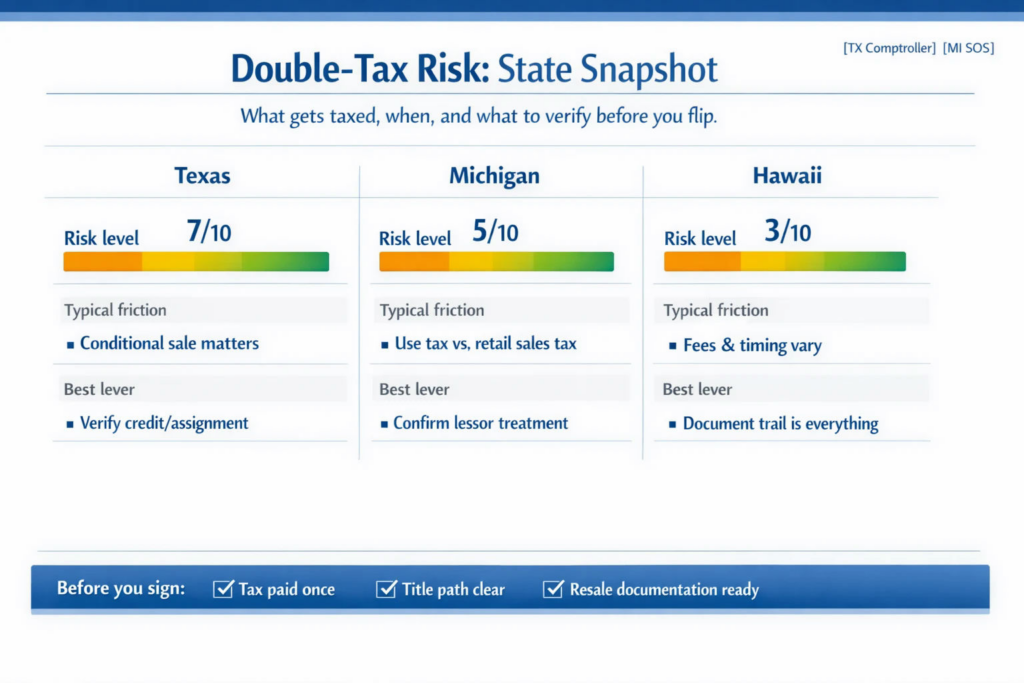
Not all states treat buyouts and resales the same. Use this snapshot to decide what to verify upfront so your flip doesn’t create two taxable events.
State-specific tax strategies
How you structure the transaction matters, and the rules vary significantly by state.
- In Texas, the risk of double taxation is high unless the transaction is handled carefully. The Texas Comptroller often attempts to tax both the buyout and the resale. Leveraging a “Lease Assignment” or proving the original lease was a “Conditional Sale” where tax was paid upfront can mitigate this, but it requires precise documentation.
- In Michigan, the distinction between the Lessor’s Use Tax and the Retail Sales Tax is critical. Mishandling this can lead to an unexpected tax bill.
Successfully navigating these rules often requires treating the transaction as a single, pass-through event for tax purposes. This is where working with a partner who has nationwide experience with [lease buyout financing options] can protect you from a surprise tax liability that erodes your profit.
Understanding Lease Buyout Taxes
Sales tax is one of the largest variables affecting the overall cost of a lease buyout title transfer. In many states, taxes are calculated using the lease buyout amount rather than the vehicle’s current market value. However, tax treatment varies considerably depending on state law, the ownership structure, and whether the vehicle will be retained or immediately resold.
Because tax regulations differ significantly between jurisdictions, reviewing applicable state requirements before completing the transaction helps prevent unexpected liabilities. In some situations, properly structuring the transaction may reduce duplicate taxation while ensuring compliance with applicable registration and title transfer requirements.
The administrative gauntlet: Why 30% of titles fail at the registry
According to 2025 industry data, 30% of title delays in lease buyouts are caused by simple mileage mismatches. This “odometer trap” is a perfect example of a small detail with big consequences. For instance, recent data showed Jeep lessees averaged 8,740 miles over their lease caps, adding an average of $2,622 to their buyout cost. If that adjusted cost isn’t perfectly reflected on all title and sale documents, the state will reject the application.
Beyond the odometer, other common errors that stall transfers include:
- Incorrect or missing notary seals
- Signature and name mismatches across documents
- Incomplete lien release paperwork from the original lessor
- Incorrect Taxpayer Identification Numbers (TINs)
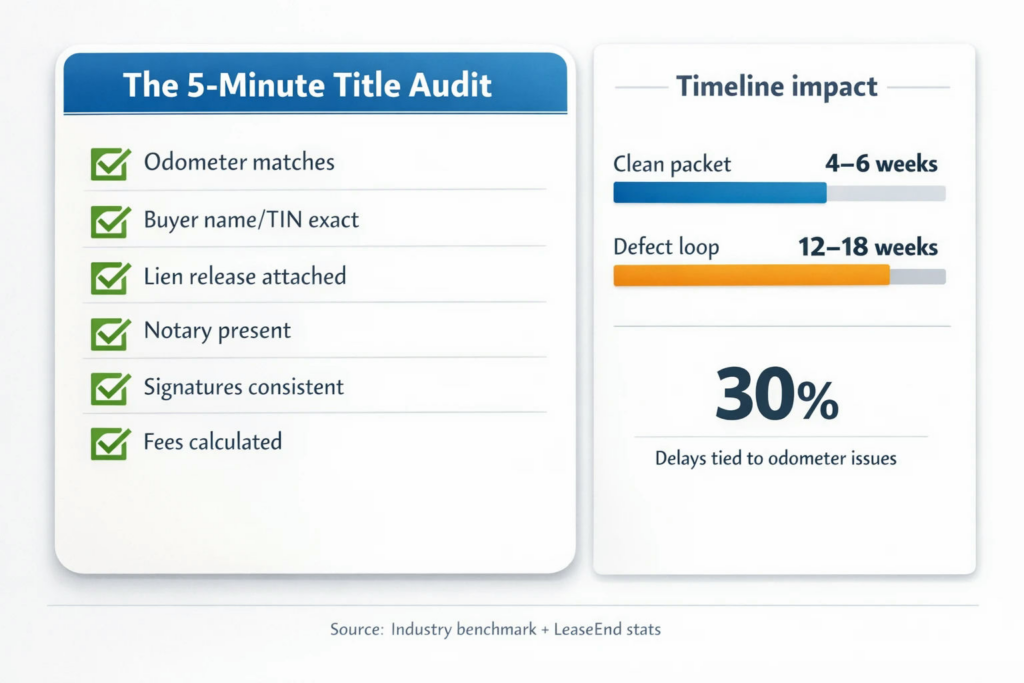
A quick document audit prevents the long defect loop. Validate identity, odometer, lien release, and notarization before submission to protect your timeline.
Each rejection adds weeks to the process, turning a 4-6 week timeline into a 12-18 week waiting game. This is why our streamlined titling and registration service manages every form and verification on your behalf, ensuring accuracy before the documents ever reach a state official.
Required Documents for a Lease Buyout Title Transfer
Although documentation requirements vary by jurisdiction, most lease buyout title transfers require several core documents before ownership can be legally transferred. Preparing these documents in advance reduces delays and minimizes the likelihood of rejected applications.
Common documentation includes the lease payoff confirmation, signed vehicle title or title assignment documents, lien release paperwork when applicable, odometer disclosure statements, proof of insurance, valid identification, registration forms, and any state-specific tax documentation required by the DMV or licensing authority.
Verifying that names, addresses, vehicle identification numbers (VINs), signatures, and dates match across every document is one of the simplest ways to prevent administrative delays during title processing.
How DMV Title Transfers Work
After the leasing company releases ownership, the completed documentation must generally be submitted to the appropriate state department responsible for vehicle titles and registration. The agency reviews ownership records, verifies supporting documentation, confirms tax payments, and issues a new certificate of title identifying the new legal owner.
Processing times vary considerably depending on the state, transaction complexity, electronic filing availability, and document accuracy. While some title transfers are completed within a few weeks, missing paperwork or verification issues can extend processing considerably.
Monitoring application status and responding promptly to any requests for additional documentation helps minimize unnecessary delays during the lease buyout title transfer process.
Beyond paperwork: Accounting and legal realities
For high-volume flippers or dealerships, the administrative process has direct financial reporting and legal implications that cannot be ignored.
For businesses: When can you actually recognize revenue?
A common question is when a sale can be officially recorded on the books. According to revenue recognition standards like ASC 606, the key factor is often the transfer of control of the asset, not necessarily when the physical title document arrives. This means you may be able to recognize revenue weeks before the state finalizes the paperwork, but only if the transaction is structured for compliance. Understanding this distinction is vital for accurate financial reporting.
Myth-busting: Why “Allodial Title” and other shortcuts are dangerous
In searching for ways to simplify the title process, you may encounter fringe legal theories like “Allodial Title.” These concepts, which claim to grant absolute property ownership free from government authority, are routinely rejected by U.S. courts. As a warning from the Washington Attorney General’s office clarifies, pursuing such strategies can invalidate your ownership claim and create serious legal complications. True vehicle ownership is secured through proper legal and administrative channels, not by attempting to sidestep them.
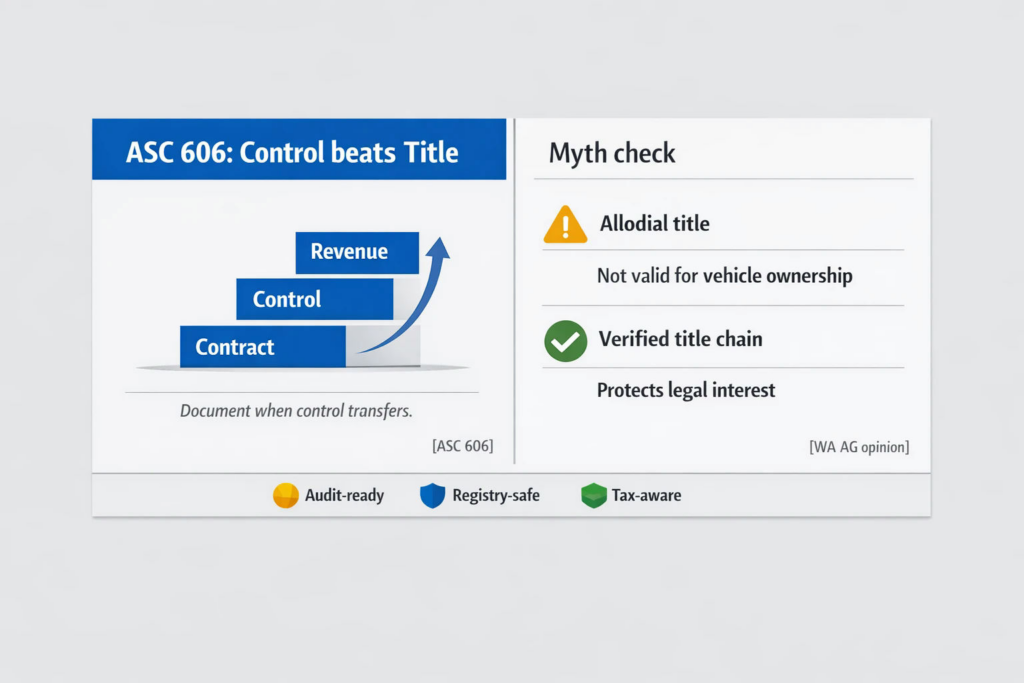
Confidence comes from the right framework: recognize revenue based on control transfer—and avoid myth-based shortcuts that can compromise ownership and compliance.
Common Title Transfer Mistakes
Many lease buyout title transfers encounter avoidable delays because of small administrative errors rather than major legal problems. Reviewing documentation before submission dramatically improves the likelihood of first-pass approval.
Common mistakes include incorrect VIN entries, inconsistent owner names, missing signatures, incomplete odometer disclosures, outdated payoff letters, unsigned lien releases, incorrect notarization, missing registration applications, and unpaid state taxes or fees.
Creating a standardized checklist before submitting documentation helps ensure each requirement has been completed correctly, reducing processing delays while protecting the overall transaction timeline.
A successful third-party buyout requires more than just an agreement between a seller and a buyer. It demands a strategic approach to tax planning, flawless administrative execution, and a clear understanding of your legal standing. The risk of doing it yourself isn’t just a longer wait; it’s the possibility of double taxation, rejected documents, and a compromised sale.
At Lease Maturity Services, we specialize exclusively in managing these complexities. We ensure your transaction is structured correctly from the start, protecting you from costly errors and delays. To see how our complete buyout process works to handle everything from financing to title delivery, let’s connect.
Lease Buyout Title Transfer Timeline
Although every state follows its own procedures, most lease buyout title transfers follow a similar sequence of events. Understanding this timeline allows you to anticipate required documents, financing milestones, and registration deadlines before they become urgent.
The process generally begins with requesting an official payoff quote from the leasing company. After payment is received, the leasing company prepares title release documents and any applicable lien releases. These documents are then submitted to the appropriate state agency for title issuance and vehicle registration. Once ownership has officially transferred, the vehicle can be retained, refinanced, traded, or sold to another buyer.
Preparing documentation before each stage significantly reduces processing delays and helps ensure the title transfer progresses as efficiently as possible.
Selling a Vehicle After a Lease Buyout
Many lessees purchase their vehicles specifically to take advantage of positive lease equity through a subsequent sale. Before advertising the vehicle, however, ownership must generally be transferred into the seller’s name unless an approved transaction structure permits otherwise.
Private-party buyers, dealerships, and vehicle retailers may all purchase a recently bought-out lease, but documentation requirements often differ depending on the transaction type. Confirming title availability, payoff completion, registration status, and lender requirements before listing the vehicle helps avoid unnecessary complications during closing.
Comparing offers from multiple buyers also provides a clearer understanding of market value while improving negotiating leverage during the resale process.
When to Use a Lease Buyout Service
While some lease buyouts can be completed independently, others involve multiple administrative and legal complexities that benefit from professional assistance. Third-party restrictions, financing coordination, title processing, tax compliance, and multi-state transactions frequently introduce challenges that extend beyond a standard vehicle purchase.
A lease buyout specialist can coordinate communication between the leasing company, lender, DMV, and purchaser while managing documentation, registration, title transfers, and funding. This centralized approach often reduces delays, minimizes paperwork errors, and simplifies the overall transaction for the lessee.
