
When your car lease ends, your main options are to return the vehicle, buy out the lease, extend the lease, or—in some situations—buy the vehicle and resell it to capture positive equity. The best end-of-lease option depends on your vehicle’s current market value compared with its total buyout cost, along with mileage, condition, potential lease-end fees, financing costs, and your leasing company’s buyout restrictions.
With many leased vehicles retaining meaningful market value, the end of your lease is no longer just a logistical deadline. It can also be a significant financial decision. If your leased car is worth more than it costs to buy, returning it without first checking its equity could mean giving up value that you may otherwise be able to capture.
Even when there is little or no positive equity, disposition fees, excess mileage, wear-and-tear charges, financing costs, and the price of replacing your current vehicle can change the calculation.
This guide compares your main end of lease options and provides a clear framework for deciding whether returning, buying, extending, or buying and then selling your leased vehicle best protects your financial interests.
What Are End of Lease Options?
End of lease options are the choices available to you when your car lease reaches its maturity date. In most cases, you can return the leased vehicle, buy it for the lease-end purchase price, request a lease extension if your lender permits one, or purchase the vehicle and later sell it to capture any available equity.
Which end of lease option is best depends on the relationship between your car’s current market value and total buyout cost, as well as its mileage, condition, potential return fees, financing costs, and the rules of your leasing company.
For example, returning the vehicle may make sense when its market value is below the cost of buying it and you have minimal lease-end charges. A lease buyout may be more attractive when the vehicle is worth more than the total purchase cost, you want to keep the car, or returning it would result in significant mileage or wear charges.
This means the end of a car lease should be treated as a financial comparison rather than simply a return date. Before deciding what to do, determine what the vehicle is worth, what it will cost to buy, what it will cost to return, and which transactions your leasing company permits.
What Happens at the End of a Car Lease?
When a car lease ends, the leasing company expects you to complete one of the options permitted under your lease agreement. If you return the vehicle, it may be inspected for mileage, condition, and excess wear before your account is closed. Applicable disposition, mileage, or wear-and-tear charges may then become due.
If you choose a lease buyout instead, you exercise the purchase option and pay or finance the amount required to acquire the vehicle. Once the purchase and title process is complete, the vehicle becomes yours rather than being returned to the leasing company.
Some lenders may also offer a lease extension, while drivers with positive equity may investigate whether purchasing and subsequently selling the vehicle produces a better financial outcome than simply returning it.
The important point is that reaching your lease maturity date does not necessarily mean you should automatically return the vehicle. Your available equity and the total cost of each option should be evaluated first.
How Do End of Lease Options Work?
Your end of lease options are determined by your lease agreement and leasing company, but the financial decision can be evaluated using four core variables: market value, buyout cost, return costs, and lender restrictions.
Market value tells you what the vehicle is realistically worth today. Your buyout cost tells you approximately what it will cost to acquire the vehicle. Return costs tell you what you may owe if you surrender it, while lender restrictions determine whether transactions such as a direct third-party buyout are permitted.
Together, these factors establish the decision framework:
Market value → buyout cost → lease equity → return costs → lender restrictions → best end of lease option
If market value substantially exceeds the total buyout cost, the vehicle may contain positive equity worth protecting. If market value is below the acquisition cost, returning the vehicle may be more attractive. When those values are close, mileage charges, wear, financing costs, replacement-vehicle prices, and your desire to keep the car become more important.
The four paths at your lease-end crossroads
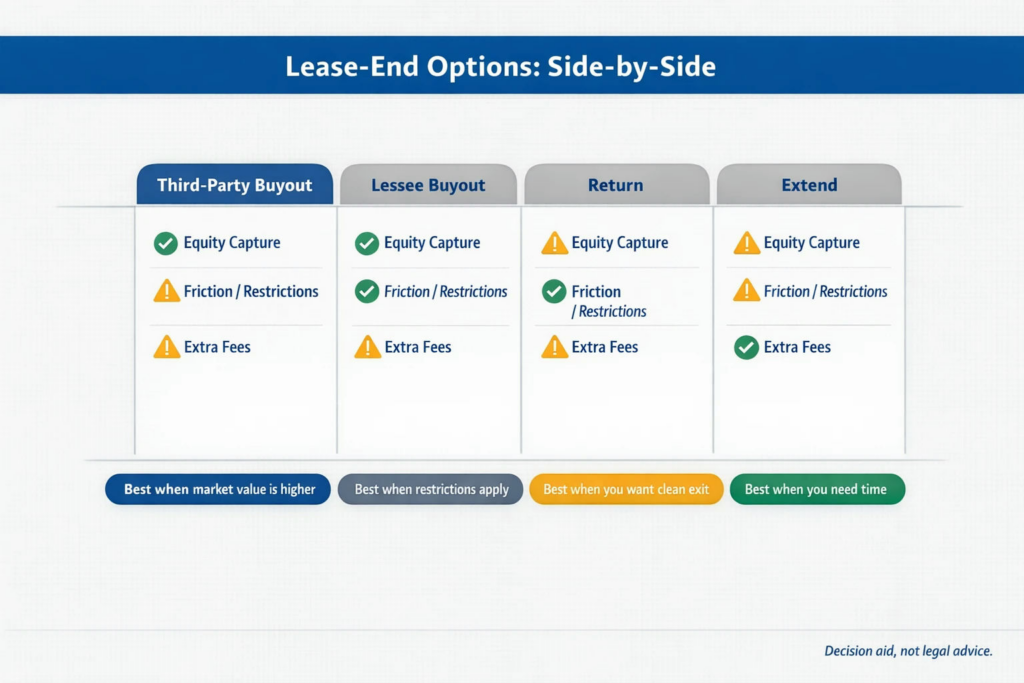
When your lease matures, you face a choice with distinct financial outcomes. You can return the vehicle and walk away, buy it for yourself, extend the lease, or work with a third party to buy out and capture its equity. Each option comes with its own set of rules, fees, and opportunities.
Before choosing, compare all four end-of-lease options against the same factors: your vehicle’s market value, total buyout cost, potential equity, lease-return charges, financing costs, lender restrictions, and whether you actually want to keep the car.
| Option | When it may make sense | Main advantage | Main consideration |
|---|---|---|---|
| Return the vehicle | The car has little or negative equity and you are within mileage and condition limits | A relatively simple exit from the vehicle | Disposition, excess mileage, and wear-and-tear charges may apply |
| Buy out the lease | You want to keep the car or its market value compares favorably with its total buyout cost | You retain the vehicle and any potential equity | Cash or financing is required, and taxes and fees may apply |
| Extend the lease | You need additional time before buying or replacing the vehicle | Delays the immediate decision | Availability and terms depend on the leasing company |
| Buy and then sell | The vehicle has positive equity but direct third-party buyouts are restricted | May allow you to capture equity instead of surrendering it | Taxes, title costs, financing, and transaction costs can reduce your net equity |
Returning the vehicle may make sense if it is worth less than the cost of buying it and you have no reason to keep it. However, check for equity and potential return charges before handing over the keys.
Buying out your lease can make sense when you already know the vehicle’s history, want to keep driving it, or can purchase it for less than its realistic market value. If you need financing, compare the total cost of the buyout loan with the cost of replacing the vehicle.
A lease extension can provide additional time if you are waiting for another vehicle or are not ready to make an immediate purchase decision. Extensions are lender-dependent, however, so confirm the payment, mileage, warranty, and eventual return or purchase terms before agreeing to one.
If your vehicle has positive equity but your leasing company restricts a direct sale to a third party, buying the car yourself and selling it after ownership is transferred may provide another route to capturing that value. The important question is whether enough equity remains after taxes, title costs, financing, and other transaction expenses.
What Determines Your Best End of Lease Option?
The best end of lease option is the one that produces the most favorable overall outcome after the vehicle’s value, buyout cost, lease-return charges, financing expenses, and your future vehicle needs are considered together.
Start with the difference between the vehicle’s market value and total buyout cost. This establishes whether there is potential equity. Then compare the costs associated with returning the vehicle against purchasing it. Finally, confirm whether your leasing company places restrictions on how the vehicle can be purchased or sold.
For example, a driver whose vehicle is worth $30,000 but costs $25,000 to acquire is in a very different position from someone whose $25,000 vehicle costs $30,000 to buy. The first driver may have equity worth preserving, while the second may have little financial reason to buy the vehicle unless keeping it provides other benefits.
Mileage and condition can change that decision. A vehicle with little positive equity may still be worth buying if returning it would create substantial excess-mileage or wear charges and the driver already intends to keep it. Likewise, apparent positive equity may disappear once taxes, fees, financing, title costs, and selling expenses are included.
This is why lease equity becomes the core financial question when comparing your options.
The core question: Is there equity in your leased car?
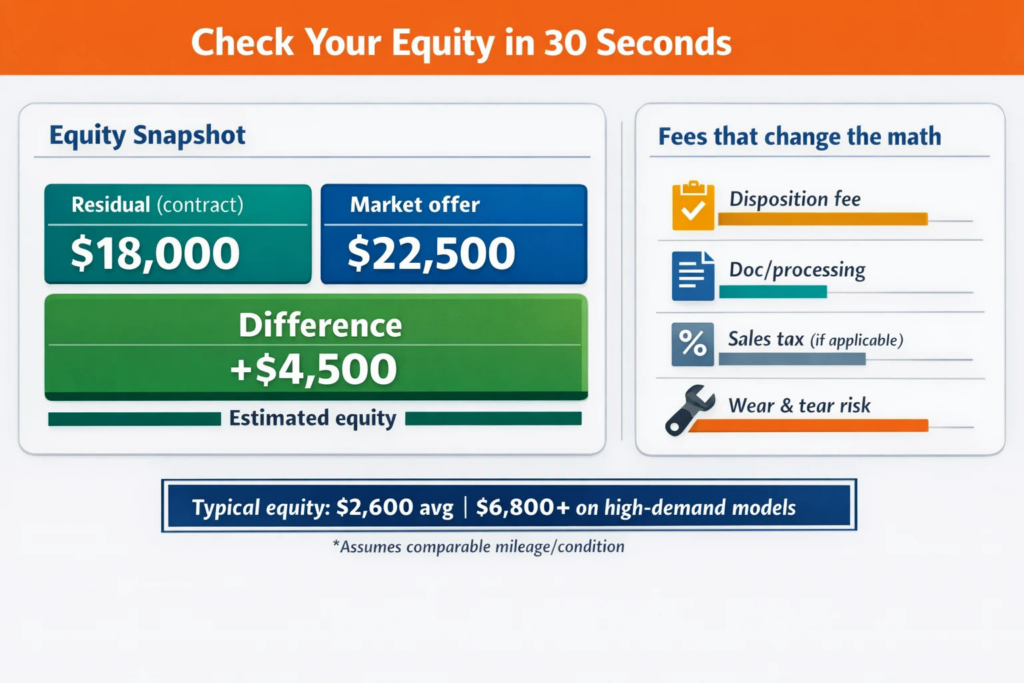
The most important factor in your decision is positive equity. Equity exists when your car’s current market value is higher than its residual value, which is the buyout price stated in your original lease agreement.
- Residual Value: The lender’s prediction of what your car would be worth at the end of the lease. This number is fixed in your contract.
- Market Value: What your car is actually worth today. This value changes based on demand, condition, and mileage.
The residual value, lease buyout price, and current payoff amount are related, but they should not automatically be treated as identical figures. Your residual value is established in the lease contract, while the total amount required to acquire the vehicle can also be affected by the purchase option, applicable taxes, fees, remaining obligations, and the timing of the transaction.
For that reason, request a current buyout or payoff quote from your leasing company before calculating your actual equity.
At its simplest:
Lease equity = current market value − total lease buyout cost
For example, if your vehicle could realistically be sold for $30,000 and your total cost to acquire it is $26,000, there is approximately $4,000 in gross equity before any additional financing or selling costs. If the same vehicle is worth only $24,000, buying it solely to capture equity would generally not make financial sense.
Market conditions can cause the actual value of a leased vehicle to differ substantially from the residual value established years earlier. High-demand vehicles, low-mileage examples, desirable trims, and vehicles in excellent condition may command stronger resale values, while depreciation or changing demand can create the opposite result.
Do not rely on a single estimate. Compare several realistic purchase or trade-in offers using the vehicle’s exact year, make, model, trim, options, mileage, condition, and location.
A more useful calculation is therefore:
Estimated net lease equity = realistic sale value − total vehicle acquisition cost − transaction and selling costs
This distinction matters because a vehicle can appear to have thousands of dollars in equity when comparing market value with residual value alone, yet provide a much smaller net gain after taxes, title costs, financing expenses, and other applicable charges are considered.
In 2026, strong demand for used vehicles means many cars are worth significantly more than their residual value. While the average equity spread is around $2,600, high-demand SUVs and trucks can have spreads of $6,800 or more, according to the 2025 Perplexity/LeaseEnd Report. Forgetting to check for this equity is like leaving a winning lottery ticket on the dealership counter.
Finding your net equity involves a simple calculation, but one where fees can make a big difference. An expert can help you navigate this process and get a clear picture of your options when it’s time to explore your lease buyout financing options.
What Is the Difference Between a Lease Buyout and a Lease Return?
A lease buyout means purchasing your leased vehicle instead of giving it back to the leasing company. A lease return means surrendering the vehicle at the end of the agreed term and settling any applicable lease-end obligations.
The main financial difference is ownership. With a buyout, you pay or finance the required purchase amount and retain the vehicle and any value associated with it. With a return, you give up the vehicle and therefore generally do not retain any positive difference between its market value and the amount for which you could have purchased it.
A return may still be the better option when the vehicle is worth less than its total buyout cost, you no longer want it, and your lease-end charges are limited. A buyout deserves closer consideration when the vehicle has positive equity, you want to continue driving it, replacement vehicles are comparatively expensive, or returning it would result in substantial mileage or wear charges.
Neither option is automatically better. The correct comparison is the total financial outcome of buying the vehicle versus the total financial outcome of returning it.
The biggest hurdle of 2026: Manufacturer restrictions
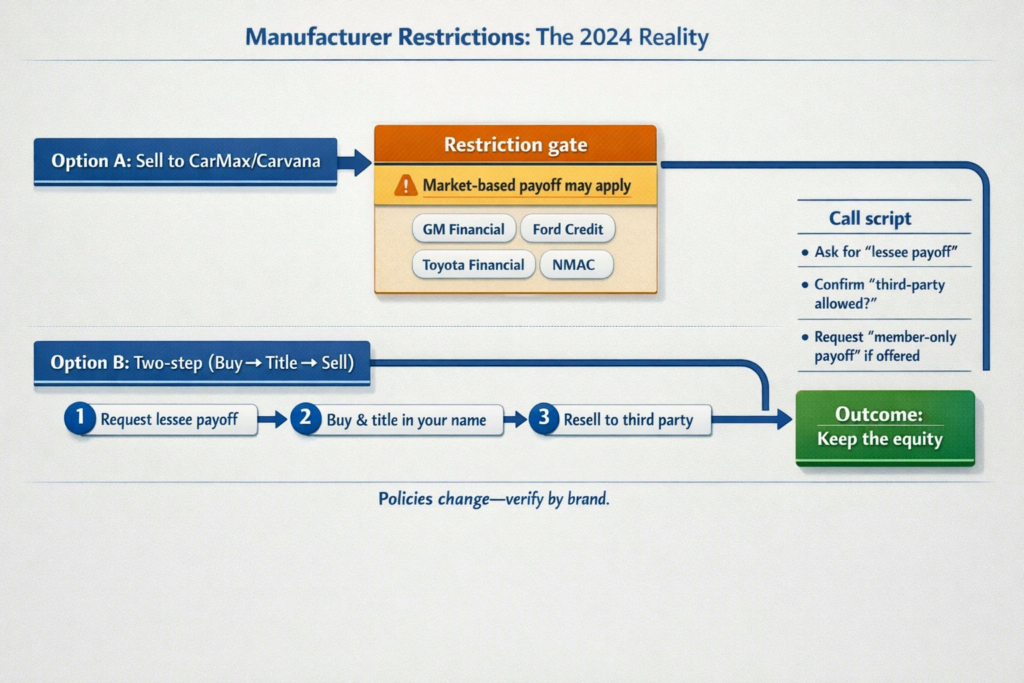
Years ago, if you had equity, you could simply have a dealership like Carmax or Carvana buy your lease directly from the financial institution. Today, it’s not so simple.
Most major captive lenders, including GM Financial, Ford Credit, Honda Financial Services, and Toyota Financial Services, now block or heavily restrict these direct third-party sales. They want to keep valuable, well-maintained used cars for their own dealer networks. To do this, they often charge third parties an inflated “market-based payoff” price, which effectively erases any potential profit for you.
This restriction is the single biggest challenge for lessees trying to recover their vehicle’s equity. Simply returning the car means the manufacturer captures that value, not you.
The workaround: A two-step playbook for equity recovery
For many drivers with restricted leases, there is still a proven path to capturing your equity: the two-step buyout. This is the strategy savvy lessees use to bypass manufacturer blocks, and it’s a process Lease Maturity Services has perfected for over 16 years.
The process is straightforward:
- You buy the car first. You secure financing to pay off the residual value directly to your leasing company.
- You receive the title and officially own the vehicle.
- You can then sell the car to any dealership or private party for its full market value, pocketing the difference.
This “Buy, Title, and Sell” method puts you in control. It’s the most effective workaround for brands like GM and Honda. At Lease Maturity Services, we handle every part of this transaction, from securing the financing to managing the paperwork, so you can focus on the outcome. We handle all the titling and registration paperwork for a seamless ownership transition.
Beyond equity: The hidden costs of returning your vehicle
Even if your car has little to no equity, a buyout can still be a smart financial decision when you factor in the costs of simply returning the vehicle.
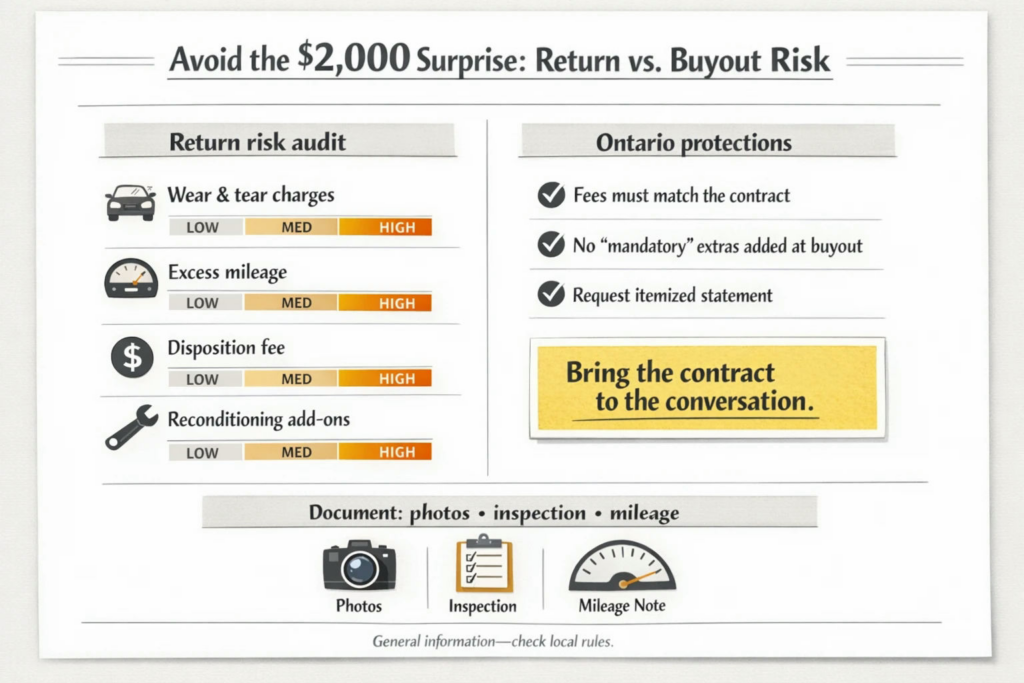
Dealers and leasing companies count on fee revenue at lease-end. These often include:
- Disposition Fee: A charge of $300 to $500 for the “privilege” of returning the car.
- Excess Wear and Tear: This is a major area of risk. Small scratches, tire wear, or upholstery stains can lead to charges that often feel subjective and can easily exceed $1,000.
- Mileage Penalties: If you went over your mileage allowance, these fees can add up quickly.
When you buy out your lease, these fees disappear. You are purchasing the vehicle as-is, which eliminates the risk of a surprise bill for minor imperfections.
Special note for Ontario lessees
If you are leasing a vehicle in Ontario, Canada, you have specific protections under the Consumer Protection Act. This law requires that all potential lease-end charges be clearly disclosed in your original contract. Dealers cannot add new, mandatory “administration” or “buyout” fees that weren’t in the agreement you signed. Always refer back to your original contract to verify any fees the dealer presents.
Make your next move with confidence
Your end-of-lease decision is too important to leave to chance or dealer pressure. By understanding your vehicle’s equity, the manufacturer’s rules, and the potential fees involved, you can turn a routine event into a smart financial gain.
The team at Lease Maturity Services specializes exclusively in this process. We provide the financing, handle the complex paperwork, and offer the expert guidance needed to make your buyout simple and profitable.
Find out your vehicle’s true equity and see if a buyout is your best path forward. Our specialists are ready to provide a clear, no-obligation analysis to help you make a confident decision.
