
A private sale often yields $3,000 to $5,000 more than a dealership trade-in, but that number doesn’t tell the whole story. The best financial decision for your vehicle isn’t always the one with the highest sticker price. It’s the one that delivers the greatest net return after factoring in tax savings, time, and transfer complexities.
Once you own your vehicle, it becomes an asset. Managing that asset correctly requires a clear exit strategy. Whether you plan to sell it for maximum profit, trade it for maximum convenience, or gift it for maximum personal impact, the right choice depends on your goals and your vehicle’s specific situation.
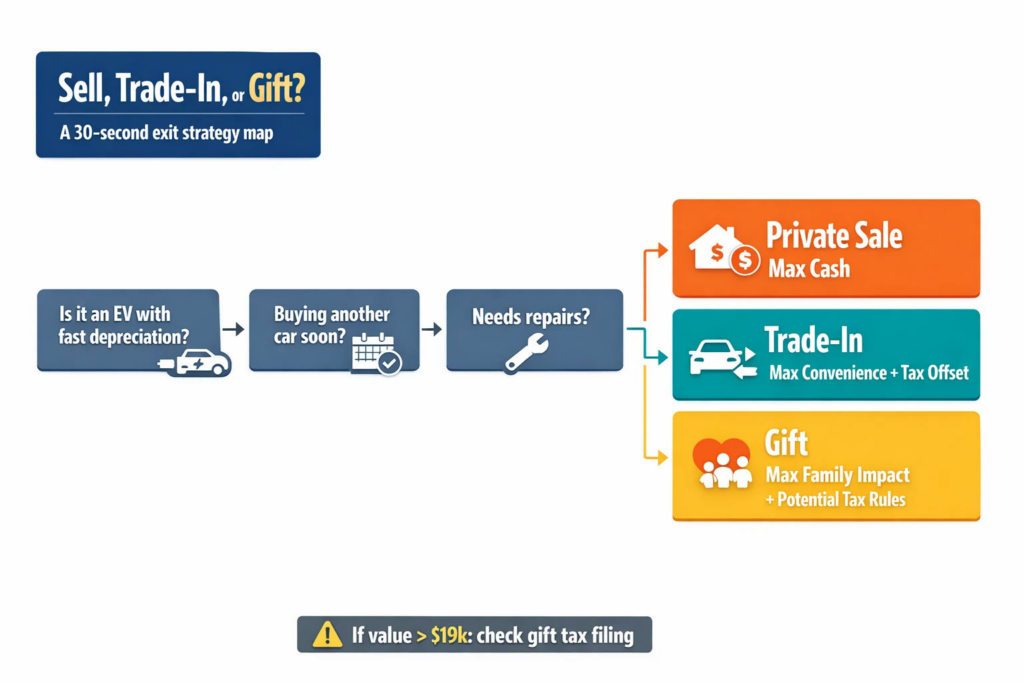
Use this quick decision map to pick the best vehicle exit path—then validate the true net outcome (cash, convenience, or impact) before you commit.
What Is a Vehicle Exit Strategy?
A vehicle exit strategy is a plan for selling, trading, gifting, or otherwise transferring a vehicle while protecting as much of its remaining financial value as possible. It considers not only what the car is worth today but also what you owe, what the transaction will cost, how quickly the vehicle is depreciating, and what legal steps are required to transfer ownership.
For most owners, there are three primary options. A private sale aims to maximize cash proceeds. A trade-in prioritizes speed and convenience and can sometimes provide a tax advantage. Gifting transfers the value of the vehicle to another person without an ordinary market sale.
The right strategy therefore depends on your objective. If maximizing cash is the priority, selling privately may make sense. If you value simplicity or need another vehicle immediately, trading can be more attractive. If your objective is helping a qualifying family member or another recipient, gifting may be the appropriate path.
Choosing your path: Sell, trade, or gift?
Most vehicle owners only weigh two options: selling privately or trading in. But a third path, gifting, offers unique financial and personal benefits that are often overlooked.
- Private Sale: This is your path to the highest cash return. You set the price and negotiate directly with buyers, capturing the retail value the dealership would have taken as profit. It requires the most effort in marketing, vetting buyers, and handling paperwork.
- Trade-In: This path offers maximum convenience. You drive to a dealership, hand over the keys, and apply the vehicle’s value directly to your next purchase. While the offer is typically lower than retail, it can provide significant sales tax savings.
- Gifting: This is the strategy for transferring value to a family member or friend. The primary goal isn’t cash but impact. When done correctly, it allows you to bypass sales tax entirely and avoid the hassles of a public sale.
The right choice changes based on your vehicle. For example, the market for used electric vehicles is especially volatile, with values dropping 20.5% year-over-year in 2024. For an EV owner, a quick trade-in might be a smart move to shield against further depreciation. For an older, reliable internal combustion engine vehicle, a private sale to a first-time buyer could be more profitable.
What Is Net Vehicle Value?
Net vehicle value is the amount of financial value you actually retain after the costs and financial effects of the transaction are considered. This is more useful than comparing private-sale and trade-in prices on their own.
For a private sale, you can think of the calculation as:
Private-sale net value = selling price − preparation costs − selling costs − transaction expenses − applicable financial obligations
For a trade-in:
Trade-in effective value = trade-in offer + applicable tax benefit − transaction expenses
Suppose a private buyer offers $23,000 while a dealership offers $20,500. At first glance, selling privately appears to leave you $2,500 ahead. But if the trade creates a meaningful tax benefit and the private sale requires repairs, detailing, advertising, and substantial time, the difference between the two outcomes could be considerably smaller.
The correct comparison is therefore not private-sale price versus trade-in offer. It is private-sale net value versus trade-in effective value.
Calculating the true net value of your decision
An offer is just a number. The true value of a transaction appears when you account for taxes, repairs, and your own time. Before you accept an instant cash offer or list your car online, map out the real financial outcome.
The trade-in tax advantage
In many regions, trading in a vehicle reduces the taxable amount of your new car purchase. In a place like Ontario, where sales tax is 13%, trading in a $20,000 car to buy a $50,000 car means you only pay tax on the $30,000 difference. That’s a direct savings of $2,600, which closes the gap between the trade-in offer and a potentially higher private sale price.
The hidden costs of a private sale
While a private sale can generate $3,000–$5,000 more in gross profit, it comes with costs. You may need to pay for detailing, minor repairs, advertising, and a vehicle history report. More importantly, your time spent answering inquiries, scheduling test drives, and negotiating has value. These factors slightly reduce the net profit but are often worth it for the higher cash return.
The financial impact of gifting
Gifting a vehicle to a qualifying family member typically eliminates sales tax for the recipient, a significant financial benefit. The value here isn’t measured in profit but in the money saved and the positive impact on the person receiving the car. It’s a direct transfer of an asset without the friction of a public market.
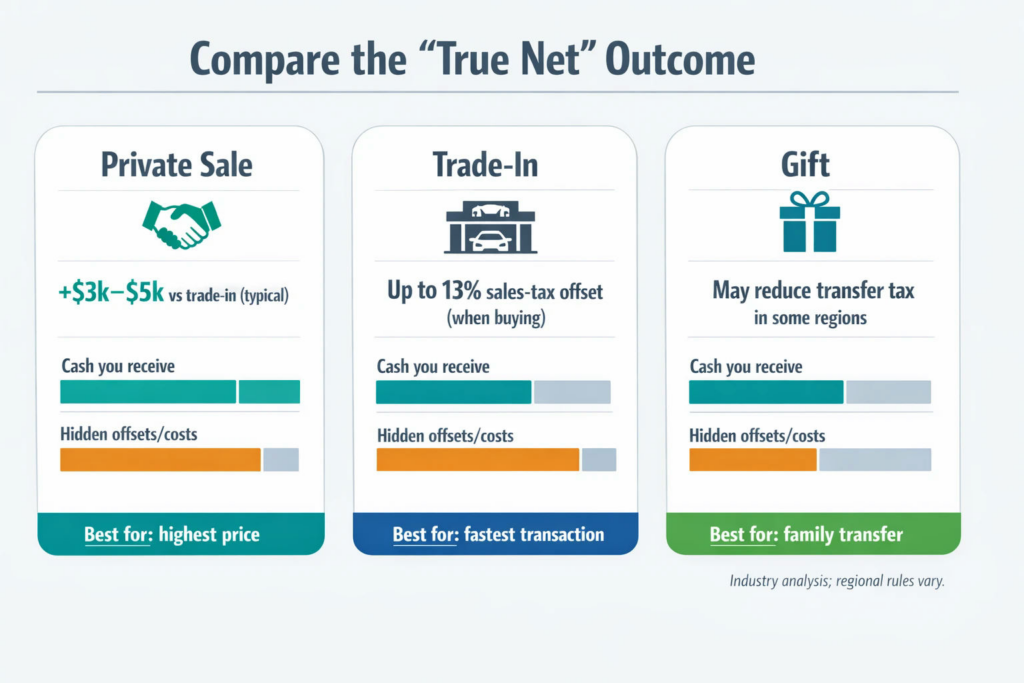
Don’t compare offers by sticker price alone—this view surfaces the real net impact once tax offsets, convenience, and transfer rules are included.
Is It Better to Sell or Trade In Your Car?
Selling privately is generally more attractive when the additional proceeds remain substantial after accounting for selling costs and your time. Trading is more attractive when convenience, transaction speed, reduced administrative burden, and any available tax benefit compensate for the lower offer.
A practical way to decide is to obtain a genuine trade-in or purchase offer first. Treat that as your baseline. Then estimate a realistic private-sale price and subtract everything required to achieve it.
If the resulting difference is small, trading may deliver greater overall value. If the private-sale premium remains substantial, taking on the additional work may be financially justified.
This also explains why there is no universal answer to “Is trading in a car worth it?” The answer depends on the spread between the two net outcomes rather than a fixed rule about which method is always better.
What Is Vehicle Equity?
Vehicle equity is the difference between your car’s current market value and the amount you still owe on a loan secured against it. It determines how much of the vehicle’s value actually belongs to you financially.
If a vehicle is worth $25,000 and its current loan payoff is $18,000, you have approximately $7,000 in gross positive equity. If it is worth $18,000 but the payoff is $22,000, you have approximately $4,000 in negative equity.
Positive equity can become cash in a private sale or credit toward another vehicle in a trade. Negative equity creates a shortfall that must generally be resolved as part of the transaction.
Can You Sell or Trade In a Car With a Loan?
You can generally sell or trade a financed vehicle, but the lender’s lien must be addressed before clear ownership can pass to the next owner.
The first step is obtaining an official payoff amount from the lender. The payoff can differ from the balance shown on your most recent statement because of interest, fees, and the date on which payment will be received.
Trading a financed vehicle is often administratively easier because the dealership can coordinate with the lender, pay the outstanding balance, and apply any remaining positive equity toward the next transaction.
A private sale can also be completed, but it may require coordination between the buyer, seller, and lender. Before accepting payment, both parties should understand exactly how the lien will be satisfied and when the title or other ownership documentation will become available.
Mastering the blind appraisal: How to secure your top value online
Whether you’re getting an instant offer from an online buyer or listing your car privately, your initial presentation sets the price. A dealer’s sight-unseen appraisal is a calculated estimate designed to leave room for downward negotiation upon inspection. You can counter this by creating a digital presentation so thorough it builds trust and locks in a higher, more stable offer.
Photography that protects your price
Your photos are your first negotiation. Go beyond simple snapshots.
- Lighting is key: Photograph your car during the “golden hour” (early morning or late afternoon) to avoid harsh shadows and bring out the paint’s true color.
- Tell a story: Take wide shots of every angle, but also include close-ups of the wheels, tires, dashboard, and odometer.
- Disclose honestly: Photograph any scratches, dings, or wear and tear. Pointing out minor flaws yourself builds credibility and prevents buyers from using them as major negotiation points later.
The power of documentation
A complete service history is one of the most effective tools for defending your asking price. Gather all your maintenance receipts, repair orders, and any information on its extended warranty plan. This documentation proves you’ve cared for the vehicle and reduces the perceived risk for the next owner. A well-documented car is a premium car.
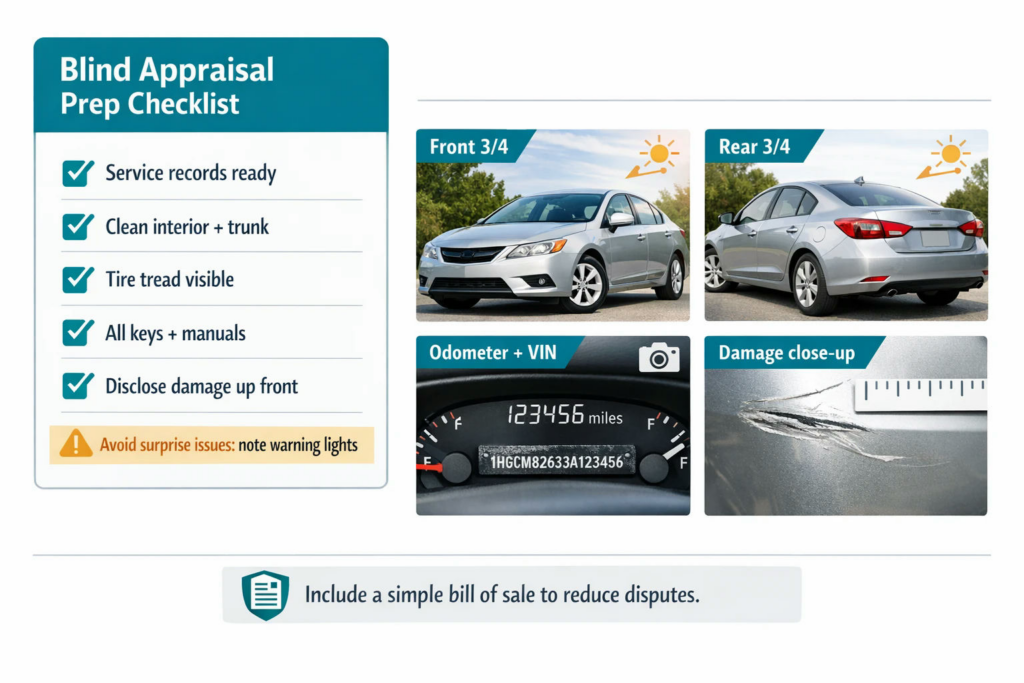
A strong digital ‘walkaround’ plus documentation builds trust and protects your price—especially for online offers and private listings.
How to Sell Your Car for the Most Money
Getting the most money for your car starts with knowing its realistic market range rather than simply choosing the highest asking price you can find online. Compare multiple valuations with genuine purchase offers and listings for vehicles that closely match yours in model, trim, mileage, condition, equipment, and history.
Preparation should also be based on return rather than appearance alone. Cleaning the vehicle and addressing inexpensive cosmetic issues can improve presentation, but expensive repairs immediately before a sale don’t automatically return their full cost. Estimate whether an improvement is likely to increase the selling price by more than you spend completing it.
Finally, create competition. A dealership offer, an online purchase offer, and an estimated private-market value give you three useful reference points. Instead of negotiating without context, you know the minimum amount you can obtain quickly and how much additional value a private sale would need to generate to justify the effort.
When Is the Best Time to Sell a Car?
There is no single mileage or age at which every owner should sell. The best time depends on the relationship between current resale value and the expected cost of continuing to own the vehicle.
Major maintenance milestones, expiring warranty coverage, increasing repair frequency, changing transportation needs, and accelerating depreciation are all useful points at which to reassess ownership. They are signals to calculate—not automatic reasons to sell.
The same principle applies to market conditions. Rather than trying to identify the perfect month, compare what the vehicle is worth now with its likely depreciation and your expected maintenance, repair, insurance, and financing costs if you keep it.
Selling Your Car Privately Without Creating Unnecessary Risk
Private sales give owners more control but also remove many of the safeguards and administrative processes a dealership normally provides. Protecting yourself means thinking about the transaction as carefully as the selling price.
Follow your jurisdiction’s requirements for test drives, insurance, plates, title or ownership documents, bills of sale, odometer disclosure, seller notification, and registration. When a prospective buyer wants to drive the vehicle, follow an appropriate process for verifying eligibility and maintaining control of the vehicle.
Payment should be independently verifiable before possession and ownership are transferred. Do not rely solely on screenshots or messages claiming that funds have been sent. The appropriate payment method varies by transaction, financial institution, and jurisdiction.
Your digital information also needs to leave the car with you. Before transferring possession, remove saved addresses, Bluetooth pairings, contacts, account logins, garage-door programming, navigation history, Wi-Fi information, and other personal data. Where supported, perform the manufacturer’s recommended infotainment or factory reset.
What Is a Vehicle Ownership Transfer?
A vehicle ownership transfer is the legal process that moves ownership or the registered interest in a vehicle from one party to another following a sale, trade, or gift.
Handing someone the keys does not necessarily complete that process. Depending on the jurisdiction, the transfer may require a signed title or ownership document, registration changes, lien releases, bills of sale, tax documentation, odometer disclosures, inspections, safety certificates, plate changes, or notification to the relevant motor-vehicle authority.
Because the requirements vary substantially by location, the legal transfer should be treated as a separate stage of the vehicle exit strategy rather than an administrative afterthought.
Navigating the paperwork: A regional guide to transferring ownership
The final step in any vehicle exit strategy is the legal transfer of ownership. This process is filled with regional nuances where a small mistake can cause major delays or tax penalties. While navigating forms can feel complicated, understanding the key requirements for your location makes the process straightforward.
For US owners: The gift tax rule you can’t ignore
If you gift a car in the United States, you need to be aware of the annual gift tax exclusion. For 2025, this limit is $19,000 per recipient. If the car’s fair market value is above that amount, you must file IRS Form 709. While you likely won’t owe taxes unless you’ve exhausted your lifetime gift exemption, filing the form is a legal requirement that many people miss.
For Ontario drivers: The sworn statement and safety standards
When gifting a vehicle to a family member in Ontario, you must complete a Sworn Statement for a Family Gift of a Used Motor Vehicle (Form 1157E). This allows the recipient to be exempt from Retail Sales Tax (RST). For a private sale, the seller must provide a Used Vehicle Information Package (UVIP), and the buyer will need a Safety Standards Certificate to register the car.
For UK drivers: DVLA updates and inheritance rules
In the UK, the seller must inform the DVLA (Driver and Vehicle Licensing Agency) immediately using the V5C logbook. You can do this online or by post. If gifting, be aware that the vehicle could still be considered part of your estate for Inheritance Tax purposes if you pass away within seven years of making the gift.
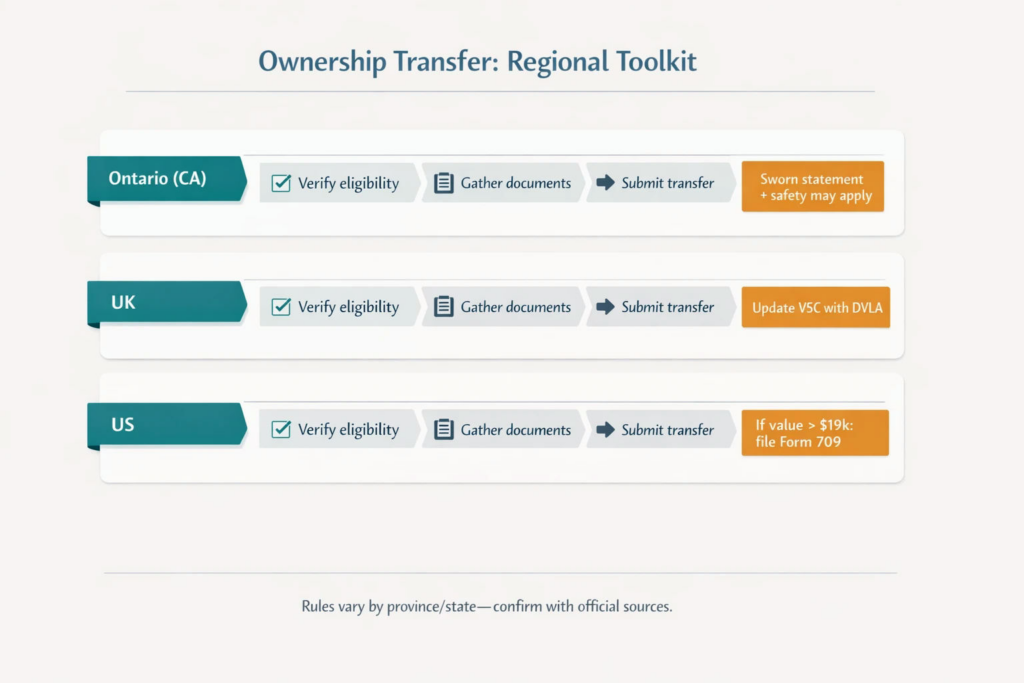
When transferring ownership, the paperwork is the risk—use these region-based steps and watch-outs to avoid delays, tax surprises, and invalid transfers.
Your next step: From decision to action
Thinking strategically about your vehicle as an asset puts you in control. By looking beyond the initial offer and calculating the true net outcome, you can confidently choose the path that aligns with your financial goals. Whether you prioritize cash, convenience, or impact, a clear plan eliminates uncertainty.
Before you can decide on your car’s future, you first need to secure its ownership. If you are nearing the end of your lease, the best first step is ensuring a simple and transparent buyout. Understanding your options for financing your lease buyout gives you the foundation to build your long-term vehicle exit strategy.
