
If your car ownership budget is still based on pre-2020 advice, it’s likely failing. From January 2019 to January 2025, average vehicle repair and maintenance costs increased 43.6%, rising from about $291 to $419, according to Cars.com’s analysis of Bureau of Labor Statistics data. That increase demonstrates why the true cost of car ownership needs to be calculated using current expenses rather than old monthly-budget assumptions.
We can think of this difference as a “Car Inflation Gap”: vehicle-related expenses can rise at a different rate from general household costs, leaving drivers who budget only for their loan payment, fuel, and occasional servicing exposed to increasingly expensive surprises.
The average repair bill alone is only one piece of the equation. The total cost of car ownership also includes depreciation, financing, insurance, fuel or charging, maintenance, tires, taxes, registration, and unexpected repairs. To manage your car as a financial asset, you need a new framework built on current data, not outdated assumptions.
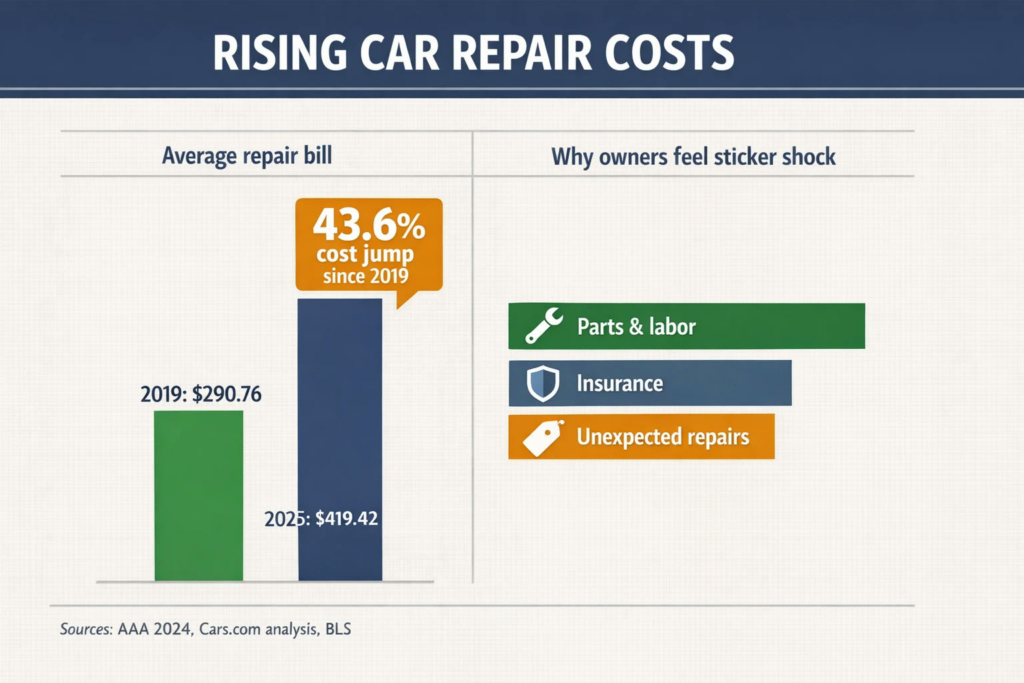
Repair costs have accelerated faster than general inflation. This benchmark view shows the post-2019 jump so owners can budget with current, not outdated, assumptions.
This guide moves beyond simple averages to provide a predictive cash flow model for your vehicle. We’ll break down the hidden costs, create a timeline for major expenses, and give you a logical framework for making high-stakes repair decisions.
What is the true cost of car ownership?
The true cost of car ownership is the complete financial cost of keeping and operating a vehicle—not merely its monthly loan or lease payment.
A useful total-cost-of-ownership model includes six major categories: depreciation, financing, fuel or charging, insurance, maintenance and repairs, and taxes or registration fees. Tires and other periodic costs should also be included when they are not already captured within the maintenance estimate.
In simple terms:
Annual Cost of Car Ownership = Depreciation + Financing + Insurance + Fuel/Charging + Maintenance & Repairs + Tires + Taxes, Registration & Fees
Monthly Cost of Car Ownership = Annual Ownership Cost ÷ 12
This calculation explains why two vehicles with similar monthly payments can have dramatically different long-term costs. One may depreciate faster, require more expensive insurance, consume more fuel, or carry higher maintenance expenses.
How much does it cost to own a car?
AAA’s latest published Your Driving Costs analysis estimates that owning and operating a new vehicle averages about $11,577 per year, or roughly $965 per month. That figure should be treated as a benchmark rather than a universal budget because actual ownership costs vary substantially by vehicle, financing rate, annual mileage, location, insurance profile, and powertrain.
The monthly payment is therefore only one line in a much larger vehicle budget. A useful ownership-cost breakdown looks like this:
| Ownership Cost | What It Includes |
|---|---|
| Depreciation | Loss in vehicle market value over time |
| Financing | Loan interest and borrowing costs |
| Fuel or Charging | Gasoline, diesel, or electricity |
| Insurance | Liability, collision, comprehensive, and other selected coverage |
| Maintenance & Repairs | Routine servicing, unexpected repairs, and mechanical wear |
| Tires | Replacement based on age, mileage, and driving conditions |
| Taxes & Fees | Registration, property taxes where applicable, and other government charges |
The best way to estimate your own cost is to replace national averages with vehicle-specific numbers wherever possible.
Mastering the hidden tax of depreciation
The single largest cost of owning a vehicle isn’t fuel or insurance: it’s depreciation. This invisible expense accounts for 44% to 52% of your total ownership costs, yet it never appears on a monthly bill. Understanding it is the first step toward smart financial management.
A 2024 analysis from Vincentric provides a clear breakdown:
- Internal Combustion Engine (ICE) Vehicles: Depreciation makes up 44% of total ownership costs.
- Electric Vehicles (EVs): Depreciation represents a staggering 52% of total ownership costs.
This difference is even more pronounced over time. An iSeeCars study found that EVs lose 49.1% of their value in five years, compared to just 38.8% for the average vehicle. While you may save on gas, that savings can be quickly erased by a faster decline in your car’s resale value.
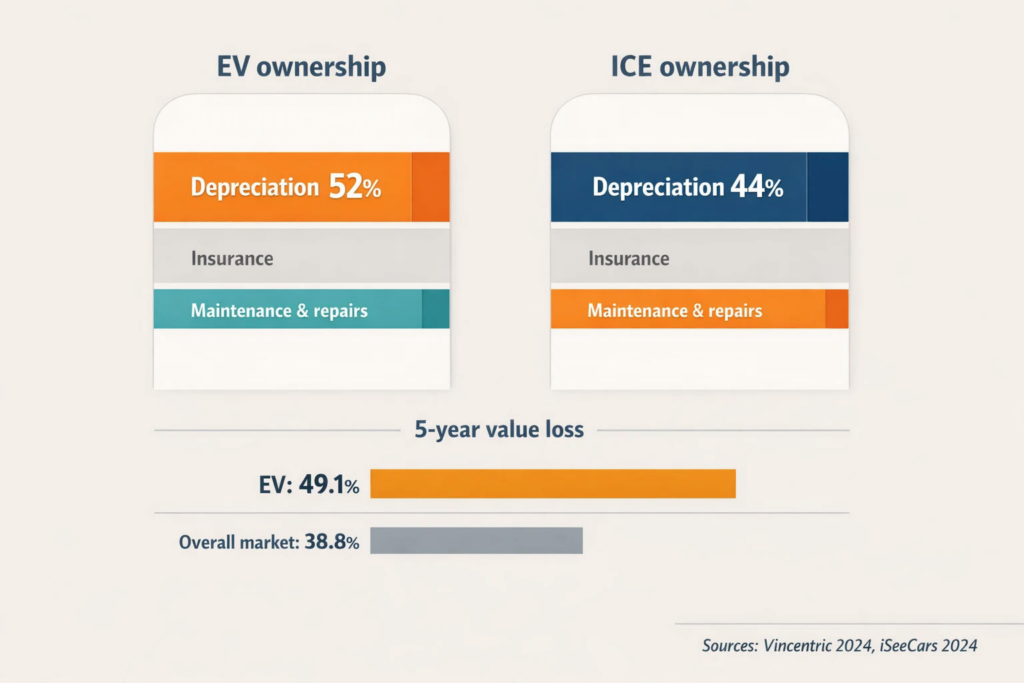
Depreciation is the biggest “hidden ownership tax.” This comparison helps owners judge whether saving on fuel or maintenance offsets resale-value risk for their vehicle type.
Treating maintenance as an investment, not just an expense, is the most effective way to combat depreciation. Keeping detailed service records and following the manufacturer’s schedule can increase your car’s resale value by 10-15%, effectively making your maintenance budget pay for itself. If you’re weighing the pros and cons of purchasing your vehicle at the end of its term, factoring in depreciation is a crucial part of the lease buyout process.
The other costs hiding behind your monthly payment
Depreciation may be the largest hidden cost, but several recurring expenses determine whether a vehicle remains affordable over time.
Insurance can vary dramatically according to the vehicle, driver, state, coverage limits, claim history, repair costs, and insurer. A vehicle that is inexpensive to finance can still be costly to own if its insurance premium is unusually high.
Fuel and charging costs depend on annual mileage, efficiency, local prices, and driving conditions. Rather than comparing vehicles using fuel economy alone, multiply realistic annual mileage by expected energy consumption and local fuel or electricity prices.
Financing also deserves separate treatment. A low purchase price can be undermined by a high APR or unnecessarily long loan term. Compare the total interest paid over the loan—not just the monthly payment—because longer financing can make a seemingly affordable vehicle substantially more expensive.
Taxes, registration, inspections, and other government fees are smaller individually but still belong in the ownership budget. Some are annual, while others occur when purchasing or renewing registration.
Together, these expenses explain why the true cost of owning a car is better measured as an annual or monthly total-cost figure rather than a loan payment plus fuel.
From average costs to predictive cash flow
Knowing the average annual maintenance cost isn’t very helpful when a $2,000 bill lands in your lap. The key is to move from reactive spending to a predictive cash flow system. Vehicle maintenance costs are not linear; they cluster around predictable mileage milestones.
We call this the 30-60-90 Roadmap. It helps you anticipate when larger expenses will hit so you can prepare for them.
- 30,000 Miles: This is typically your first major service beyond oil changes. Expect costs for engine and cabin air filters, tire rotations, and comprehensive inspections. Estimated Cost: $300 – $600.
- 60,000 Miles: This visit often includes everything from the 30k service plus replacing spark plugs, transmission fluid, and potentially brake pads and rotors. Estimated Cost: $700 – $1,500.
- 90,000 Miles: This is the most significant milestone. It often requires replacing the timing belt, water pump, and other critical components. Industry data shows this single visit can cost between $1,500 and $4,000.
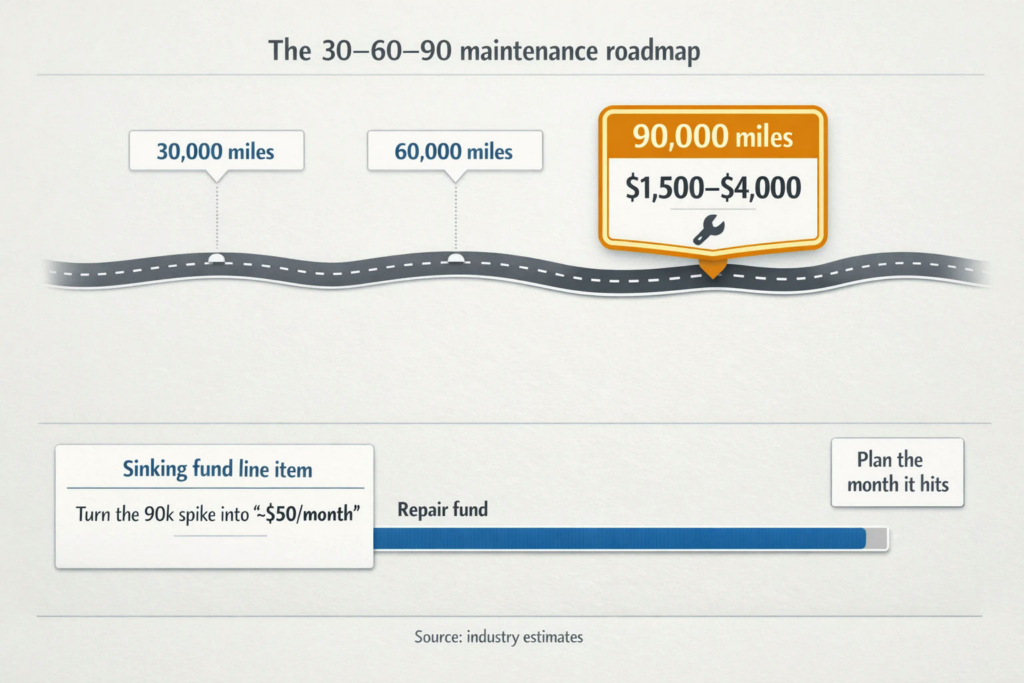
A single repair visit shouldn’t break your budget. This roadmap shows where costs cluster and how to smooth the 90k-mile spike into predictable monthly cash flow.
The repair sinking fund solution
Instead of reacting to these large bills, you can neutralize them with a “repair sinking fund.” This is a dedicated savings account where you set aside a small, consistent amount each month specifically for these milestone services.
For example, to prepare for the $1,500+ expense at 90,000 miles, you could save around $50 per month over three years. This simple strategy transforms a budget-breaking event into a manageable, planned expense, giving you control over your vehicle’s finances. You can find more financial planning resources and tools in our blog.
How to calculate your own cost of car ownership
A personalized ownership model is more useful than any national average because it reflects your actual vehicle and driving habits.
Start with depreciation. Estimate what the vehicle is worth today and what you realistically expect it to be worth at the end of your planned ownership period. Divide that loss across the years you expect to keep it.
Then calculate annual financing interest, insurance premiums, fuel or charging, scheduled maintenance, expected repairs, tires, registration, and other recurring expenses.
Your formula becomes:
Annual Cost of Ownership = Annual Depreciation + Financing Cost + Insurance + Fuel/Charging + Maintenance + Repair Reserve + Tires + Taxes & Fees
Divide the total by 12 to produce your real monthly ownership cost.
For example, suppose your annual costs are $3,000 in depreciation, $1,200 in financing expense, $1,800 in insurance, $1,600 in fuel, $900 in maintenance and repairs, and $500 in registration, taxes, and tire reserves. Your annual ownership cost is approximately $9,000, or $750 per month—even if the actual loan payment is only $350.
The repair vs. replace matrix: Making smart, high-stakes decisions
Sooner or later, every owner faces a catastrophic repair quote for something like a transmission, engine, or subframe damage. The decision to repair an aging vehicle or replace it is fraught with anxiety. Instead of guessing, use a simple decision matrix.
The core rule: If the total cost of a repair is greater than 50% of the vehicle’s current residual value, it’s time to seriously consider replacement.
Before you make a call, follow these logical steps:
- Determine Residual Value: Get an objective market value for your car from at least two sources (e.g., KBB, CarMax, or a local dealer). You can also use a lease buyout calculator to get a sense of its baseline value if you’re coming off a lease.
- Get a Second Opinion: Never accept the first quote for a major repair. Take your vehicle to a trusted independent mechanic for a second diagnosis and estimate. This validates the problem and ensures the price is fair.
- Assess Future Risk: Ask the mechanic what other major components are nearing the end of their lifespan. A $2,500 repair today might not make sense if a $2,000 timing belt job is just 10,000 miles away.
- Calculate the Ratio: Divide the quoted repair cost by the car’s residual value. If the number is above 0.50, the financial argument for repair weakens significantly.
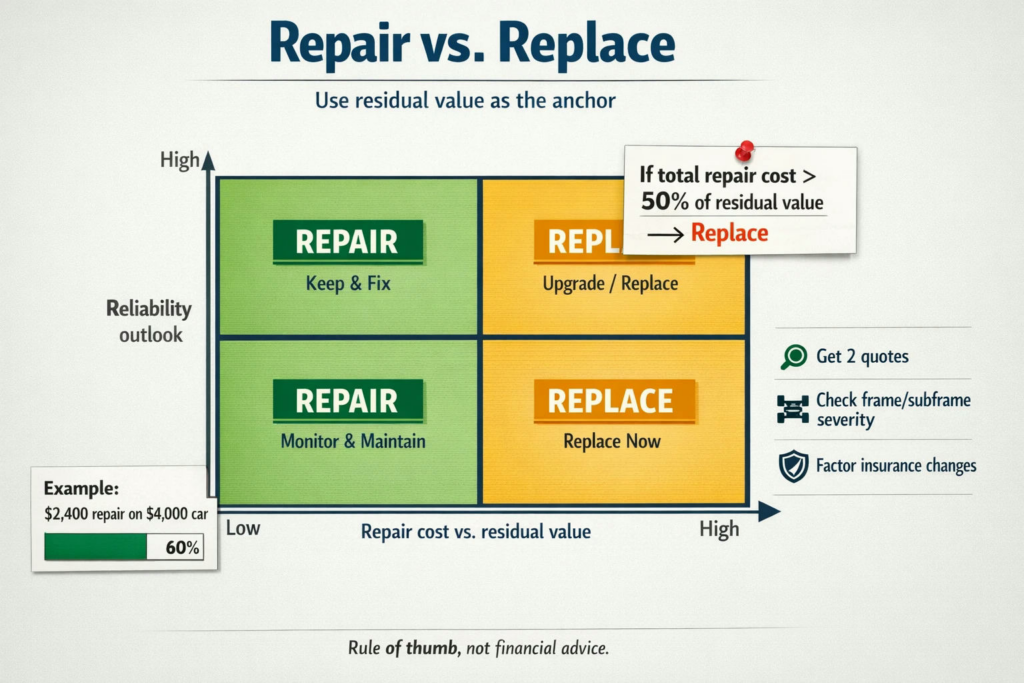
When a big quote arrives, you need logic—not guesswork. This matrix turns repair decisions into a repeatable evaluation using residual value, risk, and second opinions.
This framework removes emotion from the equation and empowers you to make a sound financial decision based on data, not distress.
How the cost of ownership affects a lease buyout decision
The same total-cost framework is particularly useful when deciding whether to purchase a vehicle at the end of a lease.
A favorable lease buyout price does not automatically make the vehicle inexpensive to own. The decision should incorporate the buyout amount, financing APR, expected depreciation, current mileage, upcoming maintenance, repair risk, insurance costs, warranty status, and how long you intend to keep the vehicle.
Start by comparing the buyout amount with the vehicle’s current market value. Positive equity can make ownership more attractive, but equity is only one component of the decision. A vehicle entering an expensive maintenance period can consume part of that advantage quickly.
Next, compare the future cost of keeping the leased vehicle with the future cost of replacing it. A car with a known maintenance history and competitive buyout price can be economically attractive even if its next few years include routine repairs—especially when replacement financing carries a higher interest rate.
This creates a useful lease-buyout equation:
Future Cost to Keep = Buyout + Financing + Depreciation + Insurance + Maintenance + Repairs
versus
Future Cost to Replace = Replacement Price + Taxes/Fees + Financing + Depreciation + Insurance + Maintenance
The better financial choice is the one that provides the required transportation at the lower risk-adjusted total cost—not automatically the one with the lowest monthly payment.
Take control of your vehicle’s financial future
Owning a vehicle in 2026 requires more than just making a monthly payment. It demands active financial management. By understanding the impact of depreciation, planning for milestone maintenance with a sinking fund, and using a logical framework for major repairs, you can protect your investment and avoid costly surprises.
Whether you are transitioning from a lease to ownership or managing a vehicle you’ve owned for years, these principles provide the foundation for financial control. At Lease Maturity Services, we specialize in simplifying the financial and administrative steps of vehicle ownership, ensuring you have the clarity and support you need.
