
The value of your leased vehicle has likely soared, with used car prices climbing over 40% since late 2021. This surge created a valuable opportunity for lessees: positive equity. But just as drivers moved to cash in, many lenders changed the rules, systematically blocking sales to third parties like CarMax or Carvana to keep that equity within their own dealer networks.
If you’ve received a great offer only to be told your lender won’t accept it, you’re not alone. This guide breaks down the complex web of restrictions, dual-pricing tactics, and state-specific rules you need to understand. More importantly, it outlines the compliant pathways available to help you unlock the equity you’ve rightfully built.
What Is a Third-Party Lease Buyout?
A third-party lease buyout occurs when an outside buyer purchases a leased vehicle before or at lease maturity. The third party may be a franchise dealership, independent dealer, online retailer, or specialized service provider authorized to facilitate the transaction.
In a traditional lease buyout, the lessee personally purchases the vehicle from the finance company. In a third-party lease buyout, another eligible entity pays the lender, obtains the title through the required process, and purchases the vehicle without the lessee becoming its long-term owner.
Drivers often explore this option when the vehicle’s market value exceeds its lease payoff amount. The difference may represent positive equity that can potentially be received as cash, applied toward another vehicle, or preserved through a structured buyout transaction.
Why Third-Party Lease Buyouts Matter
Third-party lease buyouts provide flexibility at the end of a vehicle lease. Instead of automatically returning the vehicle, a lessee may be able to compare outside purchase offers and determine whether the car’s current market value exceeds the contractual payoff.
This became especially important as vehicle values changed faster than the residual values originally written into many lease agreements. When a lease was signed, the finance company estimated what the vehicle would be worth at the end of the term. If the actual market value is higher, the lease may contain positive equity.
Accessing that value, however, depends on lender policies, payoff calculations, tax treatment, title processing, and the legal structure of the transaction.
Understanding Lease Equity
Lease equity is the difference between a leased vehicle’s current market value and the amount required to purchase or pay off the lease. When the vehicle is worth more than the applicable payoff, the lease has positive equity. When the payoff exceeds the vehicle’s market value, it has negative equity.
For example, if an outside buyer values the vehicle at $30,000 and the applicable lease payoff is $25,000, the transaction may contain approximately $5,000 in gross positive equity before taxes, fees, processing costs, or lender-specific pricing adjustments.
The most important figures to compare are the vehicle appraisal, residual value, lessee payoff, dealer payoff, remaining payments, purchase-option fees, taxes, and transaction expenses. Positive equity is not guaranteed until all applicable costs and restrictions are accounted for.
Why lenders are blocking third-party buyouts
The simple answer is that your vehicle is now worth much more than its residual value predicted three years ago. By preventing you from selling to an outside buyer, your lender or their affiliated manufacturer can achieve two goals:
- Recapture Vehicle Equity: They can direct your vehicle back to one of their franchise dealerships, who can then certify it and sell it for a significant profit.
- Control Inventory: In a market with tight new vehicle supply, high-quality, off-lease vehicles are a critical source of inventory for dealers.
This shift has made understanding your specific lender’s policy the most important first step in your lease-end journey. Policies from lenders like Honda Financial, GM Financial, and Ford Credit are now notoriously “hostile,” meaning they block nearly all third-party buyouts. Others may allow them but with significant catches.
Understanding Lender Restrictions
A lease agreement usually grants the lessee a contractual purchase option, but it does not necessarily grant every outside buyer the same right. This distinction is central to third-party lease buyout restrictions.
Some lenders permit an approved dealer or vehicle retailer to obtain a payoff and purchase the vehicle directly. Others allow only the lessee or a franchised dealership within the manufacturer’s network to complete the transaction. A lender may also change its operational policy even when the underlying lease contract remains unchanged.
Before pursuing an offer, lessees should request written confirmation of the current buyout policy, eligible purchaser types, payoff expiration date, required documents, title procedure, and any differences between the lessee and dealer payoff amounts.
The lender policy status board
To begin, you need to know where your financing company stands. Policies can change, but most lenders fall into one of three categories: Open, Restricted, or Blocked.
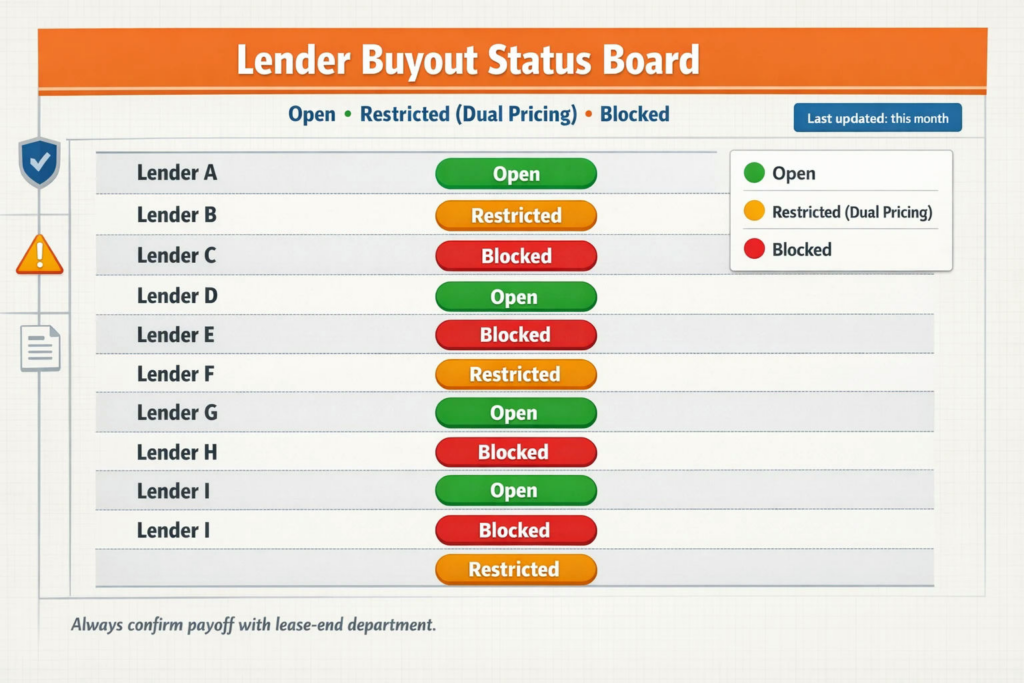
Use this status board to quickly see whether your lender is likely to allow a third-party buyout, impose dual pricing, or block it—then decide which path to pursue.
Comparing Lender Policies
Most third-party lease buyout policies fall into three practical categories. An open policy generally permits an eligible outside dealer to obtain a payoff and purchase the vehicle directly. A restricted policy permits the transaction only under specified conditions, such as a higher dealer payoff, approved buyer status, brand-specific dealership requirement, or additional documentation. A blocked policy prevents unaffiliated third parties from purchasing the lease directly.
The correct strategy depends on which category applies. An open policy may allow a direct sale. A restricted policy requires careful comparison of the dealer payoff and available equity. A blocked policy usually requires either a personal buyout followed by resale or a properly structured service that can complete the transaction within the lender’s rules.
Consumers should also confirm whether the payoff includes remaining lease payments, disposition charges, purchase-option fees, outstanding balances, taxes, or other amounts that may alter the final equity calculation.
The ‘dual pricing’ trap that erases your equity
Even if your lender seems open to a third-party sale, you may encounter “dual pricing.” This is a tactic where the lender quotes two different payoff amounts for the same vehicle:
- Lessee Payoff: The amount you, the original lessee, must pay to buy the car, based on your contract’s residual value and remaining fees.
- Dealer Payoff: A higher, “market value” price quoted to any third-party dealership.
This difference isn’t small. According to data from forums like Leasehackr, this dealer payoff can be $2,000 to $5,000 higher than your personal buyout price. A third-party buyer like Carvana will base their offer on this inflated price, which can instantly wipe out most or all of your positive equity. It’s a frustrating discovery for many who thought they had thousands of dollars waiting for them.
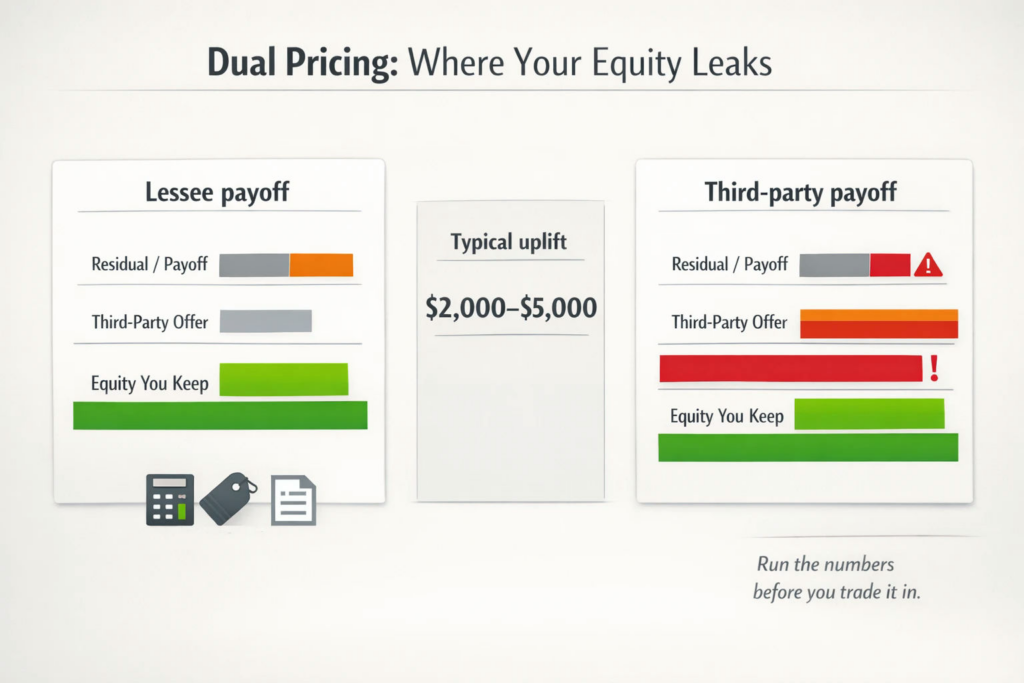
Dual pricing can wipe out thousands in equity. This visual helps readers compare payoffs and see whether the spread is worth the extra steps of a third-party path.
When you discover a significant gap, it becomes clear that selling directly to a third party is no longer an option. The path to accessing your equity requires a different approach.
Understanding Dual Pricing
Dual pricing occurs when a finance company provides different payoff amounts depending on who is purchasing the leased vehicle. The lessee generally receives the contractual purchase price outlined by the lease agreement, while an outside dealership or third-party buyer may receive a higher payoff that reflects current market conditions or internal lender policies.
The difference between these two payoff amounts represents one of the most significant variables affecting a third-party lease buyout. Consumers should avoid assuming that an online appraisal automatically reflects the amount they will ultimately receive, since the lender’s payoff policy may substantially change the economics of the transaction.
Requesting both the lessee payoff and any applicable dealer payoff allows drivers to compare offers using accurate financial information before committing to a particular buyout strategy.
Choosing your path: How to work around restrictions
When a lender blocks a direct third-party sale, you are left with two primary strategies to capture your vehicle’s value. The right choice depends on your comfort with paperwork, your state’s tax laws, and your timeline.
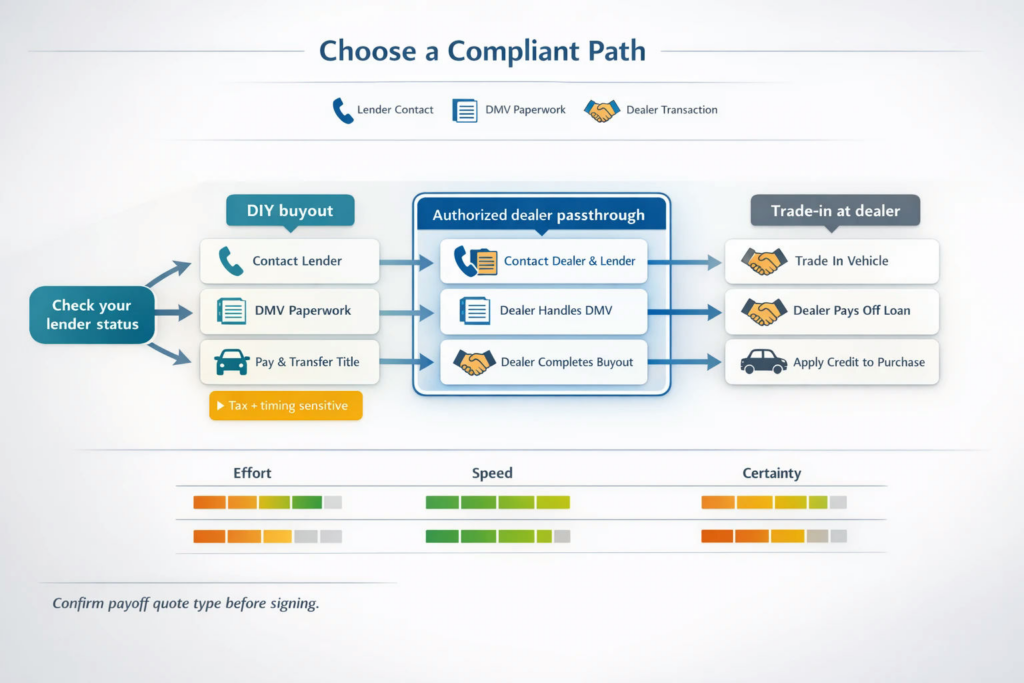
When a lender blocks third-party sales, the best move is often a compliant workaround. This flow helps readers choose the path that fits their time, risk tolerance, and equity goals.
Comparing Buyout Strategies
The best third-party lease buyout strategy depends on several factors, including lender restrictions, available equity, title processing requirements, state tax rules, financing availability, and the buyer’s preferred timeline.
A direct third-party sale generally offers the simplest process when permitted by the lender. A buy-and-flip allows the lessee to purchase the vehicle personally before reselling it but introduces additional tax, financing, and title considerations. A facilitated passthrough relies on a specialized lease buyout service that completes the transaction within the lender’s permitted structure while reducing administrative complexity for the customer.
Rather than focusing solely on the highest purchase offer, drivers should compare total transaction costs, processing time, documentation requirements, tax obligations, and the likelihood of completing the transaction successfully.
Path 1: The “Buy-and-Flip”
This strategy involves you personally buying the car from the lender at your lower lessee payoff price and then immediately reselling it to the third party who made you the initial offer. While it sounds simple, this path has two major hurdles:
- Sales Tax: You will likely have to pay sales tax on the purchase price. If your equity is $5,000 but the sales tax is $3,000, this move may not be worth the effort.
- Paperwork and Timing: You must secure financing, wait for the title from the lender (which can take weeks), and then handle the title transfer to your buyer. The market value could change while you wait.
Path 2: The Compliant Passthrough
A more streamlined approach is to use a specialized service that acts as an authorized agent to facilitate the transaction. At Lease Maturity Services, we handle this process for customers nationwide. Here’s how it works: we purchase the vehicle from the lender on your behalf at the lessee payoff price, immediately resell it to the third-party buyer, and you receive a check for the equity. This structure simplifies the process, often minimizes tax burdens, and eliminates the risk of you holding the title.
Evaluating Lease Buyout Services
Not every lease buyout service operates in the same manner. Consumers should evaluate a provider’s experience, transaction transparency, lender familiarity, customer support, documentation process, and ability to facilitate transactions across multiple states.
Questions worth asking include whether the provider has experience working with your specific lender, how funds are distributed, what fees apply, how title transfers are managed, and what documentation is required before closing. A reputable service should clearly explain each stage of the process while outlining any potential limitations created by lender policies or state regulations.
Choosing an experienced lease buyout company can reduce delays, minimize administrative errors, and improve the likelihood of completing a compliant transaction while preserving as much available equity as possible.
The importance of timing and state tax rules
For those attempting a “buy-and-flip,” state-specific laws are critical. California, for example, has a “10-day rule” that allows a buyer to resell a vehicle without paying sales tax if the resale occurs within 10 days of the purchase.
However, executing this requires perfect timing and flawless paperwork. You must have the title in hand to transfer it to the new owner, and lenders are not known for their speed. Delays in title processing are common and can easily push you past the 10-day window, leaving you liable for the full sales tax bill and erasing your profit. Managing the necessary odometer statements, title release forms, and DMV deadlines is a significant administrative burden.
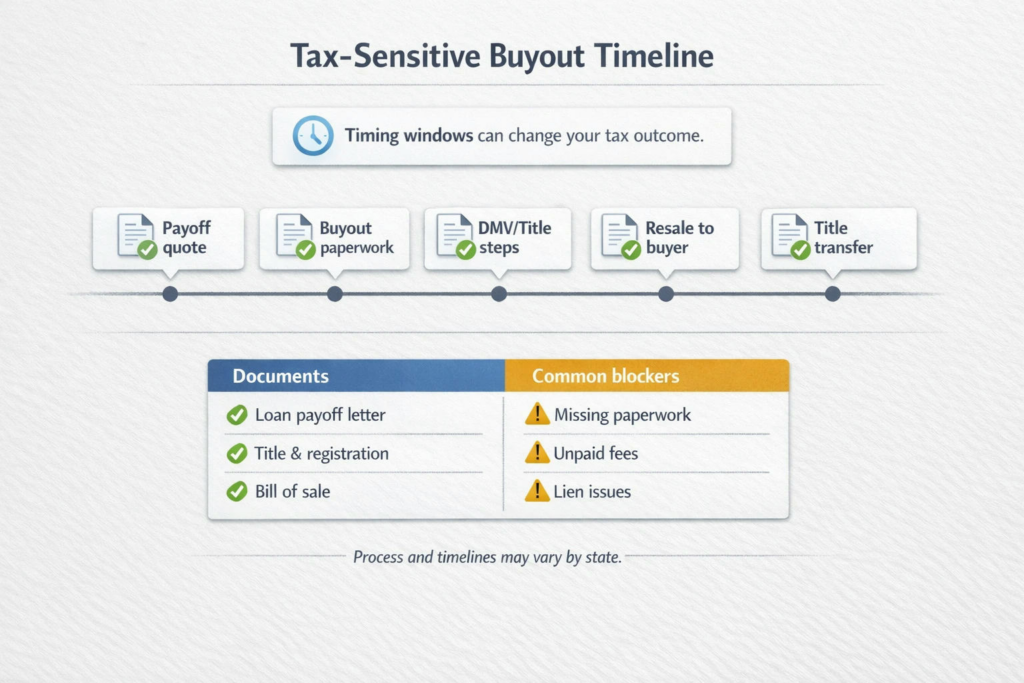
Many ‘tax hacks’ are really timing and paperwork discipline. This timeline and checklist show the key milestones and documents that can make or break a clean buyout-to-resale process.
This is why many lessees find that a facilitated passthrough is a more secure and predictable option. Handling the complexities of navigating titling and registration is a core part of our service, removing the risk and stress from your plate.
Understanding State Tax Considerations
Sales tax treatment differs significantly between states, making local regulations an essential part of lease-end planning. Factors such as title issuance, temporary registration, resale timing, vehicle ownership requirements, and documentation deadlines can all influence the total cost of completing a third-party lease buyout.
Consumers should review applicable DMV guidance, consult their state’s tax authority when appropriate, and confirm how taxes are calculated before committing to a buy-and-flip strategy. Understanding these requirements early helps prevent unexpected expenses that could reduce or eliminate available lease equity.
In addition to sales tax, buyers should consider title fees, registration costs, inspection requirements, lender processing fees, and any documentation needed to complete ownership transfers within applicable deadlines.
The clearest path to your equity
With over 16 years of experience focused exclusively on lease buyouts, Lease Maturity Services was built to solve these exact problems. Our entire process is designed to act as your authorized agent, providing a compliant and efficient bridge between your lender’s restrictions and the third-party buyer.
We handle the financing, paperwork, and fund transfers so you can avoid the DMV, sidestep potential tax liabilities, and access the equity in your vehicle without the headache. If you’re facing a restrictive lender policy, don’t give up on your car’s value. Let our team of experts manage the complexity for you.
Start by getting a clear picture of your options. Contact us today to learn how our lease buyout process can work for your specific vehicle and lender.
Common Myths About Third-Party Lease Buyouts
Several misconceptions continue to create confusion for drivers approaching lease maturity. One common myth is that every lender allows third-party lease buyouts. In reality, many finance companies have adopted restrictive policies that limit or prohibit sales to outside buyers.
Another misconception is that an online appraisal automatically represents the amount a lessee will receive. The actual proceeds depend on the lender’s payoff calculation, applicable dealer pricing, taxes, fees, and transaction costs.
Many consumers also assume that every buy-and-flip transaction avoids sales tax. Whether tax applies depends entirely on state law, transaction timing, title procedures, and other legal requirements. Finally, some drivers believe that lease buyout services simply replace the dealership. In practice, specialized providers facilitate compliant transactions by coordinating lender communication, documentation, title processing, and fund transfers within the framework permitted by the finance company.
Choosing the Best Lease Buyout Option
The right lease-end strategy depends on your lender’s policy, available vehicle equity, state tax laws, desired timeline, and willingness to manage documentation independently. Some lessees benefit from completing a personal buyout before resale, while others achieve better results through a structured third-party lease buyout or facilitated passthrough service.
Before making a decision, compare the vehicle’s market value, lessee payoff, dealer payoff, projected taxes, registration expenses, financing costs, title processing time, and administrative requirements. Evaluating the complete transaction—not simply the highest purchase offer—provides a more accurate picture of your potential financial outcome.
