
The average amount of negative equity rolled into a new auto transaction has hit a record high of $6,838. According to late 2024 data from Edmunds, this “upside-down” amount has surged by thousands in just over a year, leaving many drivers feeling trapped in their leases.
If your vehicle’s market value is less than its lease buyout price, you’re not just facing a minor inconvenience; you’re dealing with a significant financial gap. This situation, often a hangover from the inflated vehicle pricing of the early 2020s, requires a clear-eyed strategy, not wishful thinking. This guide provides a direct, data-backed blueprint for navigating negative lease equity and making the best possible decision for your finances.
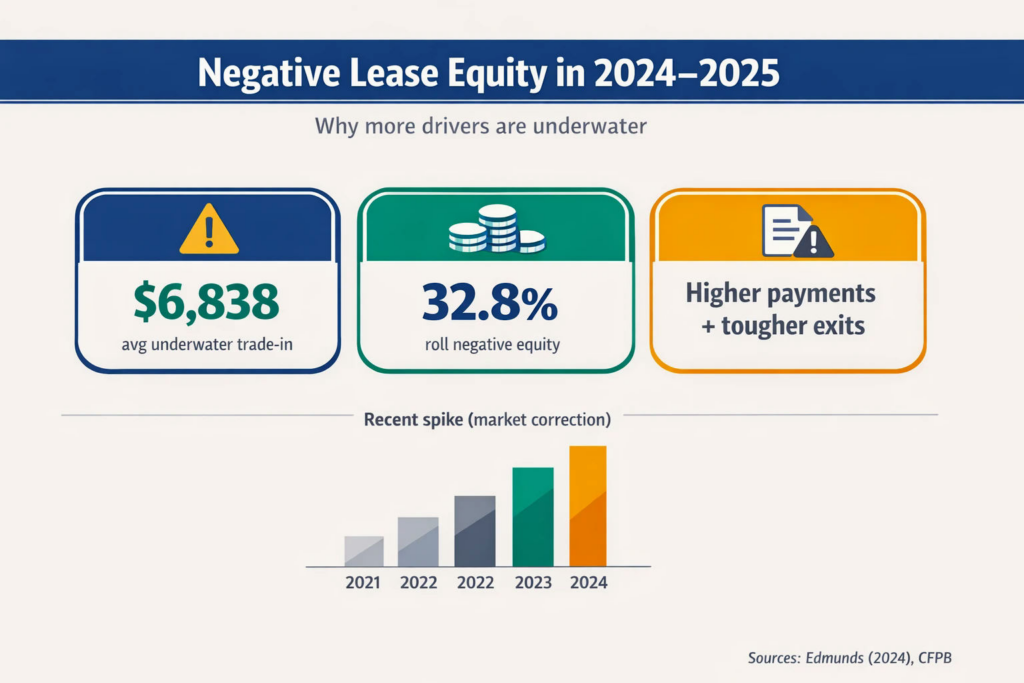
Market conditions are pushing more drivers underwater. Use these benchmark numbers to gauge how severe your gap may be before choosing an exit strategy.
First, find your exact equity gap
Before exploring solutions, you need to turn anxiety into a number. Vague worries are paralyzing, but a specific figure is a problem you can solve. Top resources like Edmunds and CarEdge succeed because they insist on mathematical transparency, and you should too.
Here’s the simple formula:
Residual Value (Lease Buyout Price) – Current Market Value = Your Equity Gap
- Find Your Residual Value: This is the buyout price stated in your original lease agreement. It’s a fixed number that doesn’t change.
- Determine Current Market Value: Use trusted sources like Kelley Blue Book (KBB), NADAguides, or get real-time offers from online retailers to find what your car is actually worth today. Be honest about its condition.
If the result is a negative number, that’s your negative equity. For example, if your buyout is $20,000 but the car’s market value is only $16,000, you have $4,000 in negative equity. You can also use our free Lease Buyout Calculator to quickly model your specific numbers and understand your financial position before making any decisions.
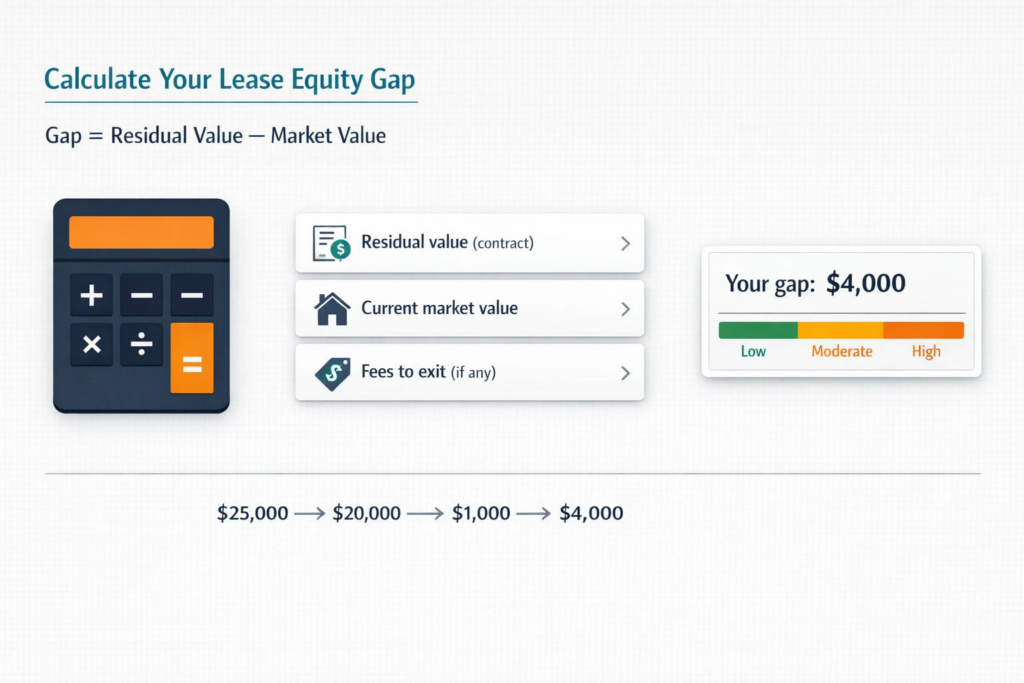
Before you pick an exit path, quantify the problem. A transparent gap calculation turns vague stress into a number you can plan around.
Strategic exit paths for an underwater lease
Once you know your gap, you can evaluate your options. Some paths minimize financial damage, while others offer a clean break at a higher cost. Nearly 32.8% of new vehicle financing deals now involve rolling over negative equity from a previous loan or lease, according to the Consumer Financial Protection Bureau (CFPB), but this isn’t your only choice. You can also check your Lease Buyout Score to get a clearer picture of where you stand before committing to a path.
Option 1: Pay the difference and buy the car
If you love the car and the negative equity gap is manageable, the simplest path is often to purchase the vehicle at the end of your lease. This involves paying the full residual value plus any remaining fees. You’ll need to cover the negative equity portion with cash or secure financing that covers the full amount. This option makes sense if the gap is small and you plan to keep the vehicle long-term, spreading the “loss” over years of future ownership. At Lease Maturity Services, we specialize in structuring lease buyout financing that can account for these scenarios.
Option 2: Roll the negative equity into a new lease
This is a common but risky strategy. You trade in your leased vehicle for a new one, and the dealer adds your negative equity to the capitalised cost of the new lease. While it gets you out of your current car with no money down, it inflates your new monthly payment and starts your next lease in an even deeper negative equity position. Lenders also have limits, often capping the loan-to-value (LTV) ratio at 110%, which might not be enough to cover a large gap.
The “EV Credit Hack”
A modern twist on this strategy involves leasing a new electric vehicle. The federal $7,500 EV tax credit, when applied to a lease, can be used by the lender to lower the vehicle’s capitalised cost. This effectively creates a large down payment that can absorb or completely erase your negative equity. It’s a powerful way to use government incentives to solve a personal finance problem, but it only works if you’re in the market for a qualifying EV. Understanding how your specific manufacturer handles buyouts is also an important factor when evaluating this strategy.
Option 3: Use a lease transfer service
Services like Swapalease allow you to transfer your lease to another person. The new lessee takes over your payments, terms, and vehicle. This can be an excellent way to exit without penalty, but there’s a catch: someone has to want your lease. If you have significant negative equity, it means your monthly payments are likely higher than what a similar new lease would cost. You may need to offer a cash incentive to make your lease attractive, which often means paying a portion of the negative equity anyway.
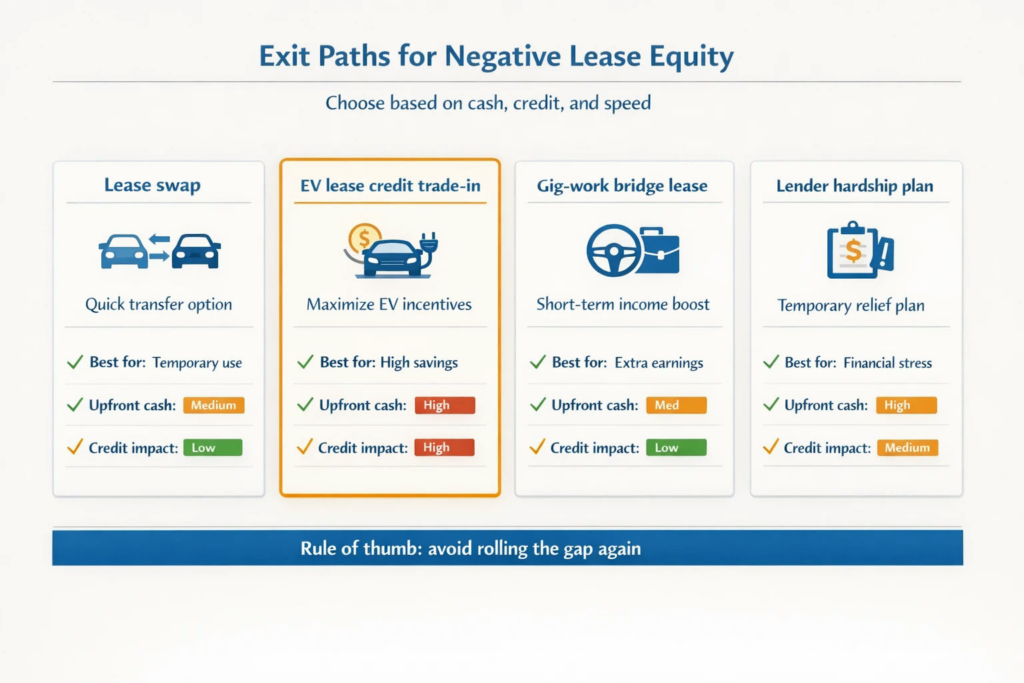
Not all exits are equal. Compare paths side by side to pick the option that matches your cash constraints, credit sensitivity, and timeline.
The bankruptcy survival guide: Chapter 13 and your lease
For those facing severe financial distress, bankruptcy may be a consideration. However, car leases are treated very differently from car loans in Chapter 13 bankruptcy. According to legal experts at Firth Law, you cannot “cram down” a lease — that is, you can’t force the lender to reduce the buyout price to the vehicle’s current market value.
You have two choices: assume the lease or reject it.
- Assume the Lease: You agree to keep the car and continue making the full, contracted monthly payments. To do this, you must be current on your payments and demonstrate that you can afford them going forward as part of your bankruptcy plan. You are choosing to keep the original agreement, including the high payments that may have contributed to your financial issues.
- Reject the Lease: You surrender the vehicle to the leasing company. This frees you from future payments, but the company can file an unsecured claim against you for damages. This claim typically includes any past-due amounts and penalties for early termination, though the amount they can claim is capped by law. The debt is then handled with your other unsecured debts in the bankruptcy process.
This decision has significant consequences for both your transportation and your finances. Rejecting the lease solves the negative equity problem but leaves you without a vehicle. Assuming it keeps you mobile but may strain your court-approved budget.
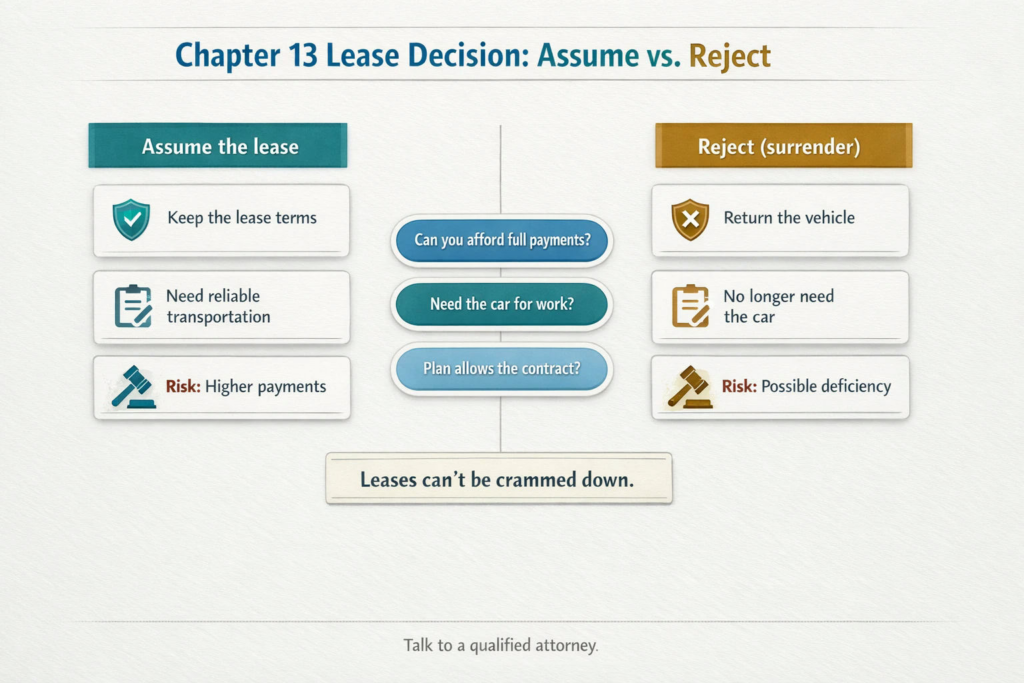
If bankruptcy is on the table, the lease choice is usually binary. This matrix clarifies what each path means and what risks to evaluate before acting.
Specialized scenarios: Gig drivers and lender relief
General advice often fails people in specific situations. Here are two that require a more tailored approach.
The gig driver’s dilemma
If you rely on your vehicle for income with services like Lyft or Uber, an underwater personal lease is a direct threat to your livelihood. Rejecting the lease in bankruptcy isn’t an option if you need a car to work. In this case, consider bridge solutions like Lyft’s Flexdrive or Hertz rentals. While more expensive per day, they have no long-term commitment and can keep you earning while you formulate a plan for your personal vehicle debt. They act as a professional stopgap to avoid making a rash decision on your personal lease.
Seeking lender hardship programs
Before taking drastic measures, contact your leasing company. Some lenders, like Santander, have historically offered hardship programs. While not always publicly advertised, it is worth asking for forbearance, a payment deferral, or other relief options. Prepare a clear explanation of your situation. A well-written hardship letter can sometimes open doors to solutions you didn’t know existed.
Make your next move with confidence
Dealing with negative lease equity is stressful, but you have more options than you think. The key is to move from a place of anxiety to one of analysis. Calculate your gap, review each exit path honestly, and choose the one that best aligns with your financial reality and long-term goals. If you have questions about the process, our FAQs page covers the most common scenarios drivers face at the end of a lease.
Whether you decide to buy out your vehicle, explore a trade-in, or need to navigate a more complex financial situation, understanding the numbers is critical. If you’re considering a lease buyout as your solution, our team has over 16 years of experience helping drivers secure the financing they need. You can speak with a lease buyout specialist to get a clear, no-pressure assessment of your options.
