
Lease mileage overage penalties are one of the most common—and expensive—surprises drivers encounter at the end of a vehicle lease. Exceeding your contracted mileage allowance can result in hundreds or even thousands of dollars in additional fees, particularly if you drive significantly more than expected over the life of your lease.
Fortunately, paying mileage penalties is not your only option. Whether you’re only a few hundred miles over your limit or facing a substantial overage, understanding how lease mileage penalties are calculated and comparing all available exit strategies can significantly reduce your total lease-end costs.
This guide explains how lease mileage overage penalties work, typical mileage rates by manufacturer, strategies for reducing lease-end fees, and when a lease buyout may provide the strongest financial outcome.
What Are Lease Mileage Overage Penalties?
Lease mileage overage penalties are fees charged when a leased vehicle exceeds the mileage allowance specified in the lease agreement. Every lease includes an annual or total mileage limit, and once that threshold is exceeded, the leasing company applies a predetermined per-mile charge at lease-end unless another agreement has been made.
Mileage limits help leasing companies estimate the vehicle’s future resale value, also known as its residual value. Higher mileage generally lowers resale value, which is why excess mileage results in additional charges for the lessee.
How overage penalties are calculated
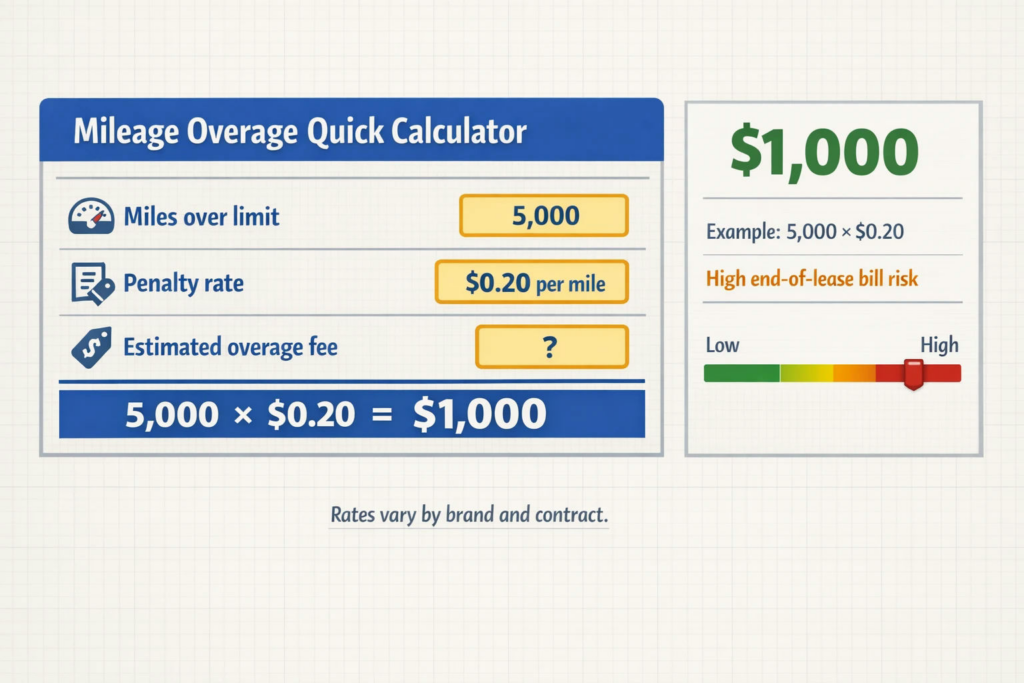
At its core, the math is simple. Your leasing company charges a set rate for every mile you drive over the limit defined in your contract. The total bill is a straightforward multiplication:
(Total Miles Driven – Contractual Mileage Limit) x (Per-Mile Penalty Rate) = Your Total Overage Cost
A few cents per mile sounds manageable, but for high-mileage drivers, the total adds up quickly. Driving 10,000 miles over your limit at a rate of $0.20 per mile results in a $2,000 bill due at lease-end.
Factors That Affect Lease Mileage Charges
Not every driver pays the same mileage penalty. Lease mileage charges vary based on several important factors, including:
Your vehicle manufacturer, leasing company, vehicle category, original lease agreement, mileage allowance selected at signing, and whether you exceeded the limit gradually or by a substantial amount. Luxury vehicles typically carry higher per-mile penalties because additional mileage has a greater impact on residual value.
Typical mileage penalty rates by brand in 2026
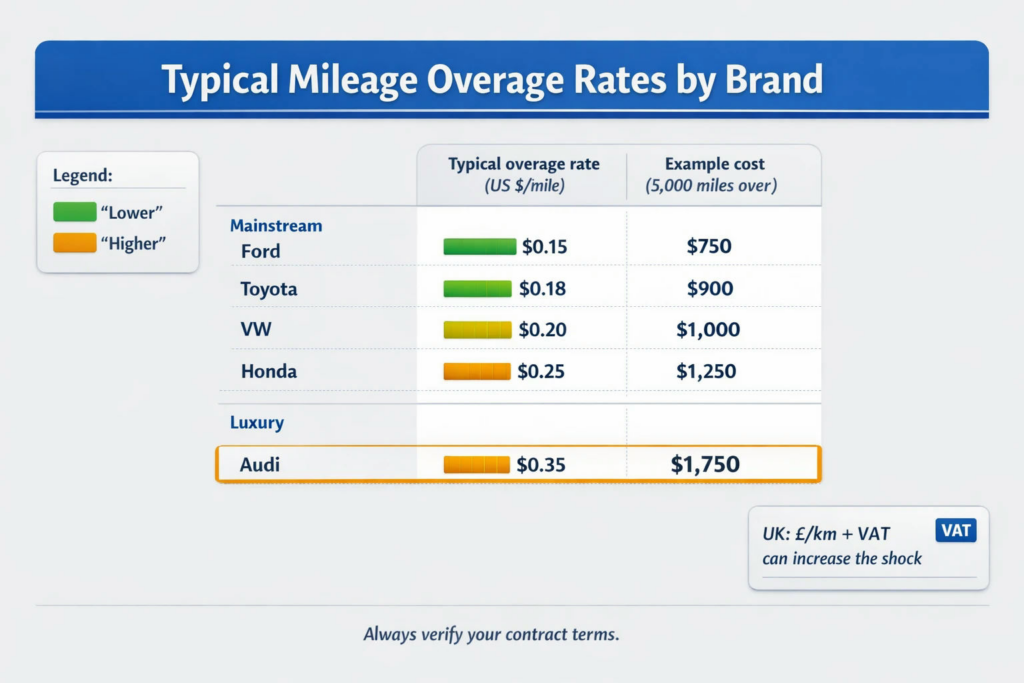
The per-mile rate isn’t universal. It varies by manufacturer, with a clear distinction between mainstream and luxury brands. Based on 2024-2025 tiered rates from major automotive lenders, here’s what you can generally expect.
| Brand Category | Example Brands | Average Per-Mile Penalty (US) | Notes |
|---|---|---|---|
| Mainstream | Ford, Toyota, Honda, VW | $0.15 – $0.20 | Rates are generally consistent but can vary by specific model. |
| Luxury | Audi, BMW, Mercedes-Benz | $0.25 – $0.30 | Higher vehicle values correspond to higher wear-and-tear costs per mile. |
A quick note for UK drivers
The situation is similar in the United Kingdom, but with two key differences. First, charges are calculated per kilometer, typically ranging from £0.10 to £0.20. Second, and more importantly, Value Added Tax (VAT) is added to the final overage bill, which can be a significant surprise for those on personal contract hire (PCH) agreements.
Can You Reduce Lease Mileage Penalties?
Yes. Many drivers assume mileage penalties are unavoidable, but several strategies can reduce or even eliminate them depending on your circumstances. Purchasing additional miles before lease-end, negotiating a replacement lease with the same manufacturer, repairing vehicle equity through a lease buyout, or selling the vehicle after purchasing it may all produce better financial outcomes than simply paying the overage fee.
Three strategic paths for managing high mileage
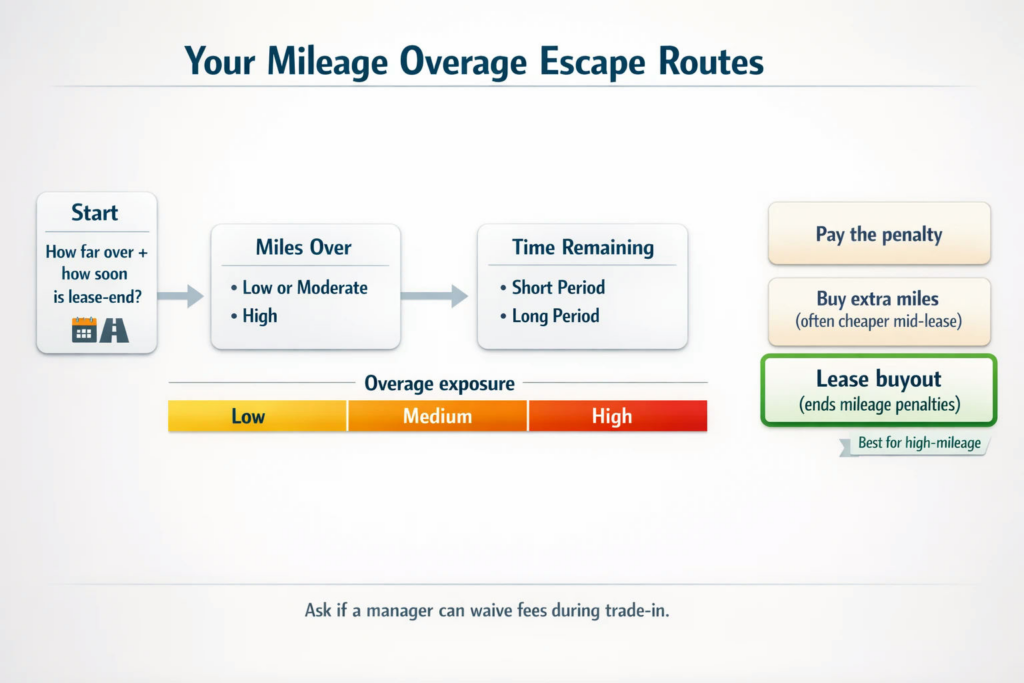
When you’re facing a significant overage, you have three primary escape routes. The right choice depends on how far over your limit you are and your plans for your next vehicle.
Option 1: Pay the penalty at lease-end
Best for: drivers with a small overage (e.g., 1,000-2,000 miles).
If your overage is minor, the simplest path is often to just pay the fee when you turn in the vehicle. The cost is predictable, and it allows you to walk away without further complication. However, for anything more than a minor miscalculation, this becomes the most expensive option.
Option 2: Buy extra miles mid-lease
Best for: drivers who realize they will go over their limit with plenty of time left in their contract.
Many leasing companies, including Ford Credit and Toyota Financial Services, allow you to purchase additional miles before your lease ends. This proactive approach can be significantly cheaper. Data shows that buying miles mid-lease can cost 20-40% less than paying the penalty rate at the end. For example, you might pay $0.15 per mile in advance versus a $0.25 penalty later. Contact your leasing company directly to see if this is an option for you.
Option 3: The ultimate penalty killer: a lease buyout
Best for: drivers facing a substantial mileage overage (e.g., 5,000+ miles).
This is the most powerful strategy for completely avoiding mileage fees. When you buy your leased vehicle, the overage penalty becomes irrelevant. Why? Because you can’t be penalized for driving a car you own. The transaction focuses on the vehicle’s residual value (the buyout price) rather than its mileage count.
This path transforms the situation from paying a penalty on a car you’re returning to making an investment in a car you know and trust. By exploring your lease buyout options, you sidestep the fee entirely and take control of the asset.
When Does a Lease Buyout Make Financial Sense?
A lease buyout becomes increasingly attractive as mileage penalties grow. However, excess mileage should never be evaluated in isolation. Drivers should also compare the vehicle’s current market value, residual value, expected maintenance costs, remaining warranty coverage, financing rates, and long-term ownership plans.
In many cases, vehicles with substantial positive equity provide an opportunity to eliminate mileage penalties while retaining an asset that may be worth more than its contractual buyout price.
The buyout math: when it becomes the smartest move
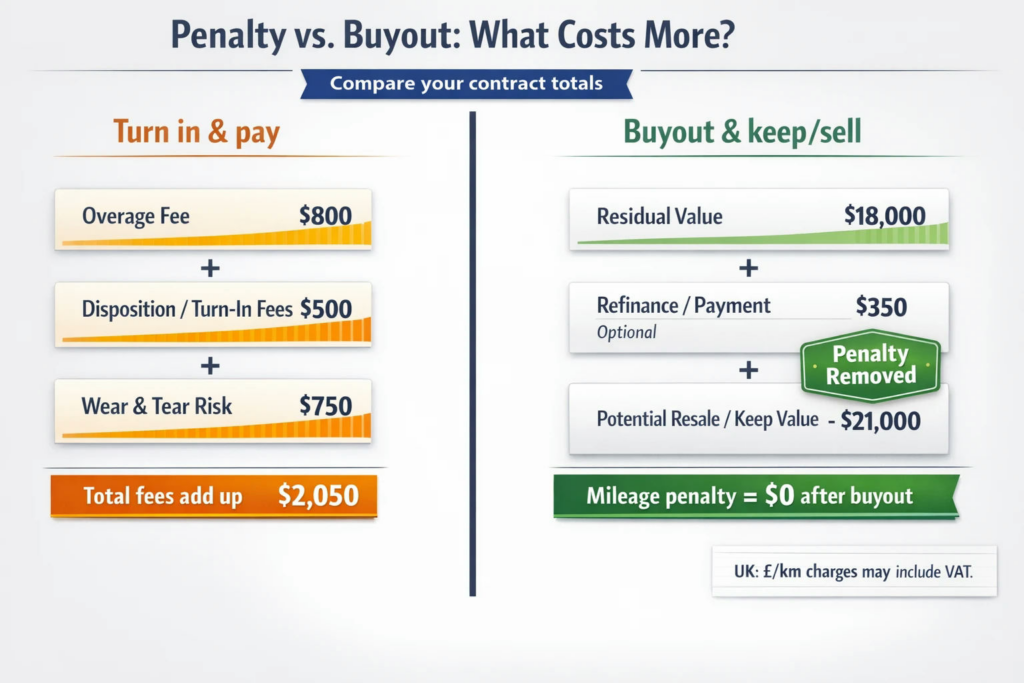
For drivers facing a penalty of $1,500, $2,000, or more, the lease buyout isn’t just an escape route; it’s often the most logical financial decision. The calculation shifts from “How much do I owe?” to “What is the better value?”
Consider this comparison:
Turn-In Cost: overage penalty + disposition fee + potential wear-and-tear charges.
Buyout Cost: vehicle’s residual price + taxes and fees.
When the turn-in costs start to approach or exceed a few thousand dollars, they essentially become dead money. You’re paying a substantial sum and walking away with nothing.
By contrast, purchasing the vehicle redirects that money toward an asset. You eliminate the penalties and now own a car whose history you know inside and out. Our lease buyout calculator can estimate your new monthly payment in seconds, so you can see exactly how the numbers compare before deciding.
Other Lease-End Costs to Consider
Mileage overage penalties are only one component of total lease-end expenses. Drivers should also account for disposition fees, excess wear and tear charges, tire replacement requirements, missing accessories, administrative fees, and any outstanding registration or parking violations.
Evaluating the complete financial picture often changes which exit strategy delivers the greatest value.
An insider’s note on dealer negotiations
If you’re considering leasing or buying another vehicle from the same dealership, you may have more leverage than you think. While official policies are rigid, industry insiders confirm that dealership sales managers often have the authority to waive some or all of your overage fees to secure a new deal. This is especially true at dedicated “Lease Maturity Centers” designed to retain customers.
However, this is only a viable strategy if you plan to get another car from them. For those who want the freedom to choose any vehicle from anywhere, the buyout remains the only guaranteed way to erase the penalty.
How to Estimate Your Lease Mileage Costs Early
Waiting until the final month of your lease limits your available options. Instead, monitor your mileage throughout the lease term and compare your projected annual driving habits against your contracted allowance. Online lease mileage calculators can help estimate future penalties long before your lease expires, allowing time to purchase additional miles or evaluate a lease buyout.
Make your next move with confidence
Exceeding your lease mileage isn’t a dead end. It’s a crossroads that requires a clear-eyed assessment of your options. While paying a small penalty or buying miles in advance can work in some cases, a lease buyout offers a complete financial reset for those with significant overages. It cancels the penalty, ends the cycle of mileage tracking, and puts you in the driver’s seat of a car you already know.
If you’re facing a high mileage penalty, the next step is to understand your buyout numbers. At Lease Maturity Services, we specialize in making that process simple and transparent, helping you secure the financing and handle the paperwork to turn a potential liability into a valuable asset. Get started here to find your lease details and see your options.
