
The used car market has fundamentally changed. A 40% surge in vehicle values since 2021 has created “accidental equity” for millions of drivers who signed leases between 2021 and 2023. Many now find their vehicle’s market value is thousands of dollars higher than their lease buyout price.
This presents a significant financial opportunity: lease flipping. The concept is simple: buy your leased vehicle and sell it for a profit.
However, the execution is where most people get stuck. Navigating manufacturer restrictions, complex tax rules, and dealer negotiations can feel overwhelming. This guide moves past the “what if” and gives you the exact technical playbook to calculate your real profit and successfully extract the cash equity locked in your lease.
What Is a Lease Flip?
A lease flip involves purchasing a leased vehicle from the leasing company before immediately reselling it to another buyer, dealership, or private party. Unlike a lease transfer, which assigns the remaining lease to another individual, a lease flip results in the lessee becoming the vehicle owner before completing the resale.
Many consumers choose a lease flip when the vehicle’s current market value exceeds the contractual lease buyout price. This difference creates positive lease equity that may be captured through a properly structured transaction.
Depending on the leasing company’s policies, a lease flip may involve a direct third-party sale, a personal lease buyout followed by resale, or assistance from a specialized lease buyout service that facilitates the transaction.
Why Lease Flipping Has Become More Popular
Lease flipping has become increasingly common as vehicle values have appreciated faster than many lease contracts originally projected. Residual values established several years earlier often underestimated future market prices, creating opportunities for lessees to realize unexpected equity at lease maturity.
At the same time, limited new vehicle inventory has increased demand for quality used vehicles. Dealers, online retailers, and private buyers frequently compete for well-maintained leased vehicles, making lease-end decisions more financially important than simply returning the vehicle to the dealership.
As lenders continue adjusting their third-party buyout policies, understanding the lease flip process has become an essential part of evaluating lease-end options.
Understanding Lease Equity
Lease equity represents the difference between a leased vehicle’s market value and the total amount required to purchase it from the leasing company. When the vehicle is worth more than the applicable payoff, the lease contains positive equity. If the payoff exceeds the vehicle’s value, the lease contains negative equity.
The amount of available equity depends on several variables, including the vehicle’s appraisal, residual value, remaining lease obligations, purchase-option fees, taxes, registration expenses, and lender-specific payoff calculations.
Before pursuing any lease flip, drivers should calculate their estimated equity using actual payoff quotes rather than relying solely on online valuation tools or generalized market estimates.
The true profit formula: what most people miss
Calculating your potential profit isn’t as simple as subtracting your buyout price from a Kelley Blue Book value. The real calculation must include the significant costs you avoid by not turning in your lease. These are real dollars that go back into your pocket.
A proper analysis uses this formula:
(Current Market Value) + (Avoided Turn-in Fees) – (Lease Buyout Price + Sales Tax + Admin Fees) = Your True Net Profit
Avoided turn-in fees are the key. This category includes:
- Disposition Fees: Typically $300 to $500, waived when you buy the vehicle.
- Excess Wear & Tear: Charges for scratches, dings, and worn tires that you won’t have to pay.
- Mileage Overage Penalties: Often $0.15 to $0.25 per mile, this can add up to thousands. For example, data shows high-mileage Jeep Wrangler drivers save an average of $2,622 by buying out instead of turning in.
When you factor in these avoided costs, the financial incentive becomes much clearer. The average equity for popular models often reaches $5,500, and a significant portion of that comes from sidestepping turn-in penalties.
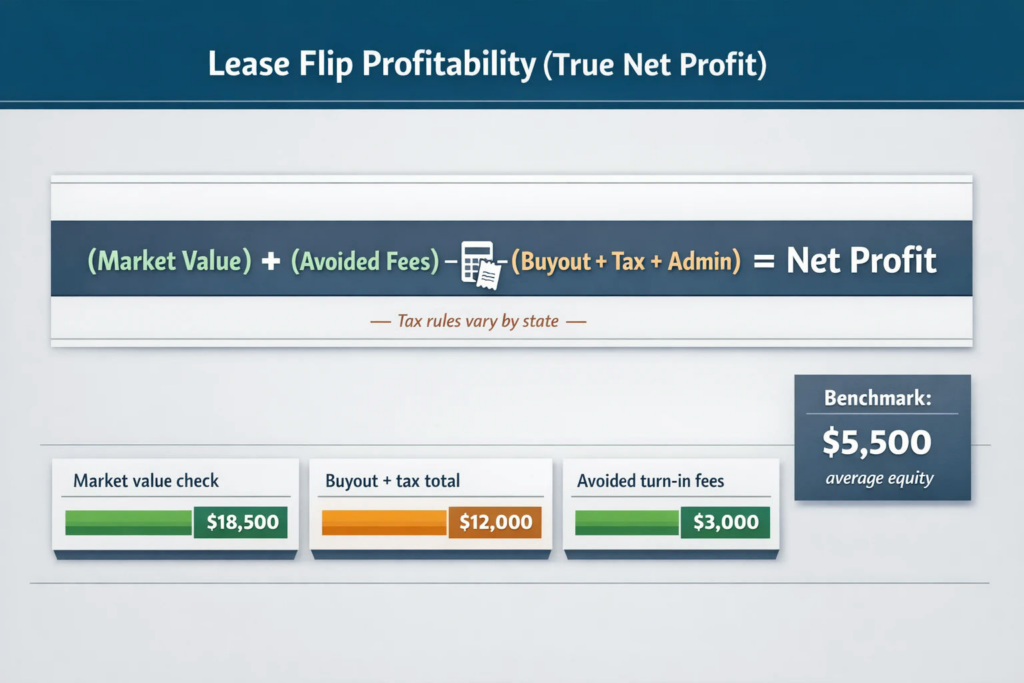
A true lease-flip profit check includes avoided turn-in fees—not just market value minus payoff—so you can see real net profit before you start the buyout process.
How to Calculate Lease Flip Profit
A complete lease flip analysis starts with obtaining an accurate payoff quote directly from the leasing company. This figure should then be compared with multiple market appraisals from dealerships, online vehicle retailers, and private-party valuation tools to establish a realistic resale value.
From there, consumers should account for taxes, title fees, registration costs, financing expenses, administrative charges, and any avoided lease-end penalties. Evaluating every component of the transaction provides a more accurate picture of potential profit than simply comparing the payoff amount with an estimated market value.
Because vehicle prices fluctuate, appraisals should be obtained close to the intended transaction date. Market conditions, seasonal demand, vehicle condition, mileage, and regional pricing differences can all affect final resale value.
The biggest roadblock: manufacturer and lender restrictions
Before you start shopping for offers, you need to answer one critical question: does your leasing company (the captive lender) allow third-party buyouts?
In recent years, many manufacturers have blocked companies like Carvana, Vroom, or other dealerships from buying your lease directly. They require you, the original lessee, to purchase the vehicle first. This single rule determines your entire strategy.
Trying to get offers without knowing your lender’s policy is the number one reason lease flips fail. You waste time getting quotes only to discover the buyer can’t complete the transaction.
Below is a reference guide for major brands. Note that these policies can change, so it’s always critical to confirm directly with your lender.
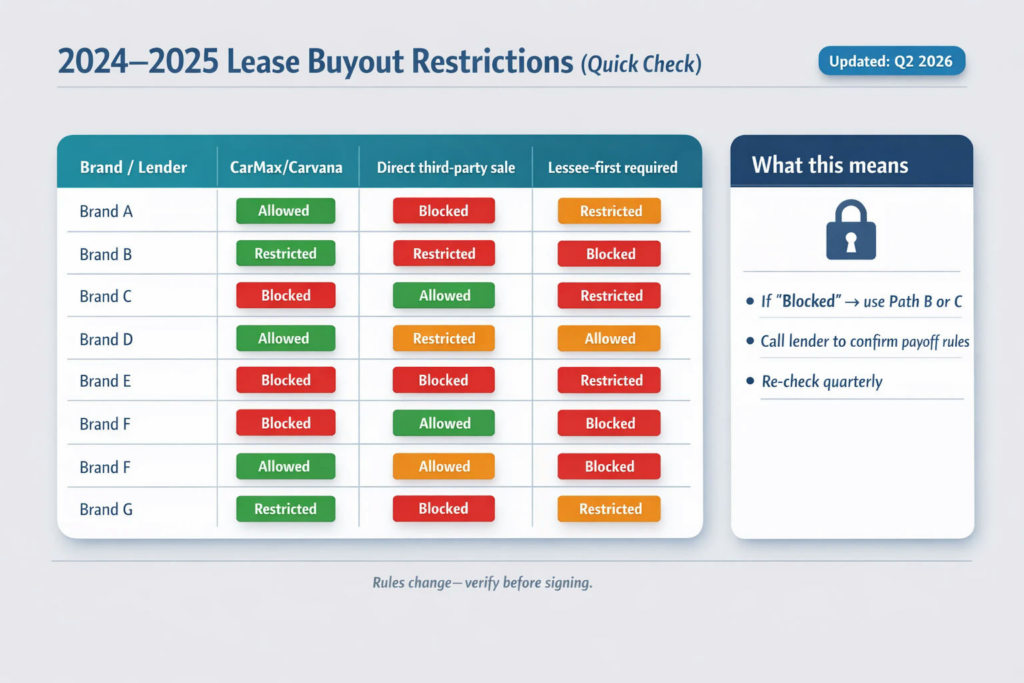
Use a restriction table before you chase offers—many flips fail because the lender blocks third-party buyouts, forcing a different (and slower) path to profit.
Understanding Lender Restrictions
A lender’s lease buyout policy establishes who is permitted to purchase the leased vehicle and under what conditions. These policies may differ from the contractual purchase option granted to the lessee and can change over time without affecting the underlying lease agreement.
Some finance companies permit unrestricted third-party lease buyouts, while others apply higher dealer payoff amounts, limit purchases to franchise dealerships, or prohibit direct third-party transactions entirely. Reviewing current payoff procedures, title requirements, and buyer eligibility before beginning a lease flip helps prevent costly surprises later in the process.
Because lender policies continue evolving, consumers should always verify current procedures directly with their leasing company before relying on historical information or online reports.
Your three paths to cashing out your equity
Once you know your lender’s rules, you can choose the right path to unlock your equity. Each has different benefits related to speed, profit margin, and complexity.
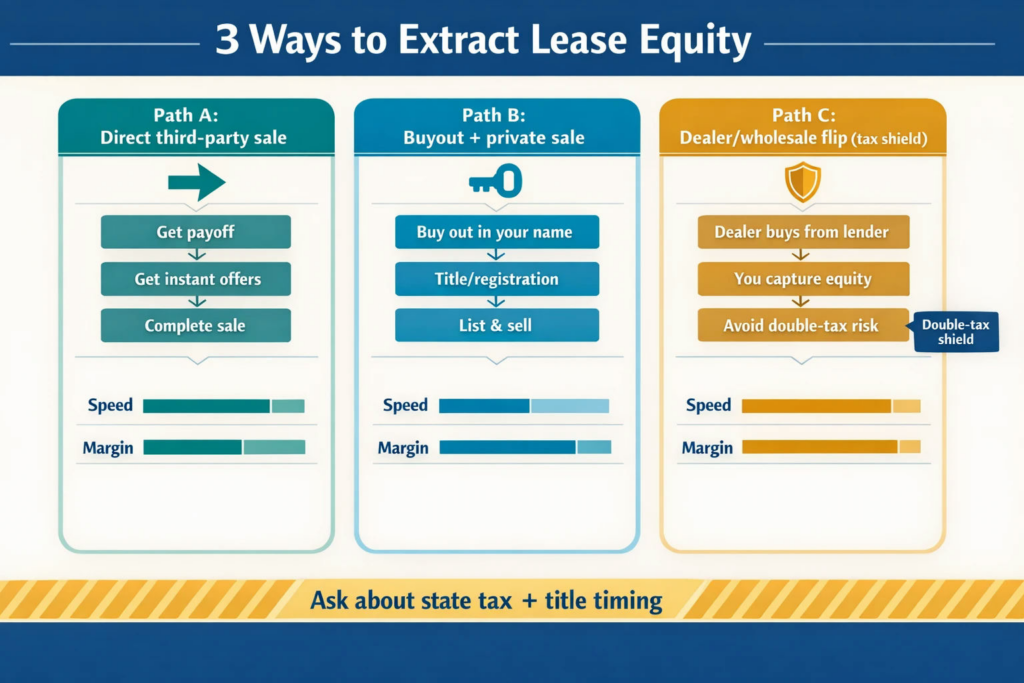
Different lender rules require different flipping routes. This side-by-side workflow shows which path is fastest, which yields more margin, and where tax friction can appear.
Comparing Lease Flip Strategies
Although every lease flip follows the same general objective—capturing positive lease equity—the process varies depending on lender policies and buyer eligibility. Some transactions allow an outside dealership or vehicle retailer to purchase the leased vehicle directly, while others require the lessee to complete the buyout before selling the vehicle.
A direct third-party sale generally involves the least paperwork because the purchasing dealership coordinates much of the transaction directly with the leasing company. A personal lease buyout offers greater flexibility but requires financing, title processing, registration, and additional documentation before the vehicle can be sold. A dealership equity trade simplifies the process for drivers replacing their leased vehicle while potentially providing tax advantages in certain states.
Comparing each strategy using total transaction costs, projected equity, taxes, financing expenses, processing time, and administrative requirements provides a more accurate basis for deciding which option offers the greatest overall value.
Path A: Direct third-party sale (The easy flip)
If your leasing company allows it, this is the simplest and fastest route.
- Who it’s for: Lessees whose lender (e.g., Toyota Financial, Lexus Financial) permits third-party buyouts.
- How it works: You get offers from online retailers like Carvana or local dealerships. You choose the best one, and they handle all the paperwork with your leasing company and pay you the difference.
- Pros: Minimal paperwork, very fast, no sales tax complications for you.
- Cons: You may not get the absolute highest price compared to a private sale.
Path B: Personal buyout and resale (The high-margin flip)
This is the required path for restricted brands like Honda, GM, and Ford. It involves more steps but often yields the highest profit.
- Who it’s for: Lessees whose lender blocks third-party sales or anyone wanting to maximize their return.
- How it works:
- You must first purchase the vehicle yourself. This involves securing financing or paying cash and paying sales tax on the buyout amount.
- You handle the titling and registration process to get the title in your name.
- Once you have the title, you can sell the car to any private party or dealer for its full market value.
- Pros: Unlocks the ability to flip a restricted lease and gives you access to the higher-priced private-party market.
- Cons: Requires more time, paperwork, and an upfront tax payment. Navigating the financing and title transfer can be complex, which is why working with a specialist like Lease Maturity Services simplifies the process by managing all the lender and DMV paperwork for you.
Path C: Dealership “equity trade” (The tax-shield flip)
This is a common strategy when you plan to lease or buy another vehicle from the same dealership.
- Who it’s for: Lessees who are already in the market for their next car.
- How it works: The dealer buys out your lease and applies your positive equity as a credit or down payment toward your next vehicle.
- Pros: In many states, you only pay sales tax on the difference between the new car’s price and your trade-in value, which can save you a significant amount.
- Cons: The dealer knows you are a captive customer. They may offer a lower value for your trade-in, effectively absorbing some of your equity into the new car’s deal.
Understanding Taxes and Title Transfers
Taxes and title processing frequently determine whether a lease flip remains financially worthwhile. Although a transaction may appear profitable based on vehicle value alone, sales tax, title fees, registration expenses, financing costs, and state-specific requirements can significantly reduce the final return.
Drivers completing a personal lease buyout should understand how long title processing typically takes, whether temporary registration is required, and what documentation must be submitted before the vehicle can legally be resold. Delays in receiving the title may postpone the sale and expose the transaction to changing market conditions.
Because tax treatment differs by state, consumers should review applicable regulations before selecting a lease flip strategy. Understanding these requirements early allows for more accurate profit calculations and reduces the likelihood of unexpected expenses during closing.
Decoding dealer offers and negotiation tactics
If you’re nearing your lease end, you’ve likely received mailers from dealers claiming they “desperately want your vehicle.” This isn’t about brand loyalty; it’s about their urgent need for used car inventory. You can use this to your advantage.
The key is to never rely on a single offer.
- Establish a Baseline: Get online offers from multiple sources (Carvana, Vroom, CarMax) to understand your vehicle’s true wholesale market value.
- Compare Apples to Apples: When a dealer makes an offer, compare it against your online quotes and your “True Net Profit” calculation. Is their offer competitive, or are they trying to capture your equity?
- Leverage Your Knowledge: Let the dealer know you have other, higher offers. This forces them to be more competitive. Remember, your equity is a tangible asset. Don’t let a dealer absorb it by undervaluing your trade-in or inflating the price of your next car.
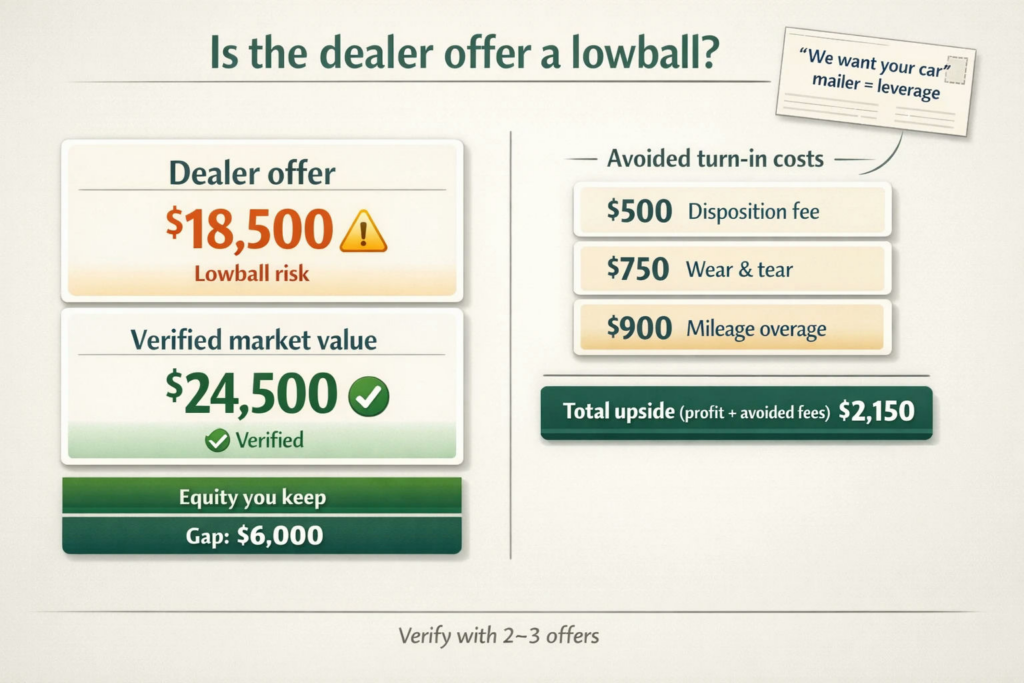
Don’t evaluate profit from payoff alone. Comparing multiple offers and adding avoided turn-in fees reveals the real upside—and gives you leverage when a dealer tries to underpay.
Negotiating the Best Lease Flip Offer
An effective negotiation begins before visiting a dealership. Obtaining independent appraisals from online retailers, local dealerships, and private-party valuation sources provides a realistic benchmark for the vehicle’s current value. These comparisons help identify whether an offer reflects actual market conditions or primarily benefits the purchasing dealer.
Consumers should evaluate offers using the complete financial picture rather than focusing solely on the proposed purchase price. Differences in payoff calculations, trade allowances, taxes, dealer fees, financing terms, and additional incentives can materially affect the final outcome of a lease flip.
Evaluating Lease Buyout Services
For drivers navigating lender restrictions, title transfers, financing, and multi-step documentation, a specialized lease buyout service can simplify the process. Experienced providers coordinate communication with finance companies, assist with required paperwork, and help ensure transactions comply with lender requirements and applicable state regulations.
When comparing providers, consumers should consider transparency, transaction experience, customer support, processing timelines, and familiarity with different lender policies. Selecting a knowledgeable lease buyout company can reduce administrative burdens while helping preserve as much available lease equity as possible.
Your next step to a profitable lease buyout
Lease flipping offers a powerful way to capitalize on your vehicle’s value, but success depends on navigating the rules correctly. The biggest hurdles—lender restrictions, sales tax, and DMV paperwork—are logistical, not financial.
At Lease Maturity Services, we specialize exclusively in this process. We provide the financing for your buyout and handle the entire titling and registration process for you, turning a complex, multi-step transaction into a simple, streamlined experience.
If you’re ready to see how much equity is locked in your lease, the first step is a no-obligation consultation. We’ll help you understand your lender’s rules and map out the most profitable path forward.
Common Lease Flip Mistakes
Many lease flips fail not because the vehicle lacks equity, but because critical details are overlooked early in the process. One of the most common mistakes is relying on a single appraisal instead of comparing multiple market offers. Without a realistic understanding of the vehicle’s value, it becomes difficult to determine whether a proposed purchase price accurately reflects available equity.
Another frequent mistake is calculating profit using only the lease payoff amount. Taxes, registration fees, title costs, financing expenses, lender processing charges, and documentation requirements can materially reduce the final proceeds if they are not considered from the outset.
Consumers also commonly assume every lender allows third-party lease buyouts. In reality, many captive finance companies restrict outside buyers, apply higher dealer payoff amounts, or require the lessee to purchase the vehicle personally before resale. Verifying current lender policies before negotiating with buyers helps prevent unnecessary delays and failed transactions.
Finally, accepting the first dealership offer without obtaining competing appraisals may leave substantial lease equity unrealized. Comparing multiple offers creates negotiating leverage and provides a more accurate measure of the vehicle’s true market value.
Choosing the Best Lease Flip Strategy
The ideal lease flip strategy depends on several interconnected factors, including the amount of available lease equity, the leasing company’s buyout policy, financing availability, tax implications, title processing requirements, and the driver’s preferred timeline. No single approach is appropriate for every transaction.
Drivers with unrestricted lenders may benefit from a direct third-party sale because of its simplicity and speed. Those facing restrictive lender policies may achieve stronger financial outcomes through a personal buyout followed by resale or by working with a qualified lease buyout service that can help coordinate the transaction within lender requirements.
Before making a final decision, compare the vehicle’s current appraisal, lease payoff amount, projected taxes, registration expenses, financing costs, title processing timeline, and anticipated resale value. Evaluating the complete financial picture rather than focusing on a single offer increases the likelihood of maximizing lease equity.
