
If you’re nearing the end of your car lease in 2026, the buyout price written in your contract feels like a sure thing. But the vehicle’s actual market value is anything but certain. After a period where nearly everyone bought out their leases for instant equity, market dynamics have flipped. Moody’s Analytics now projects lease return rates could surge as high as 80-90% as used-car prices continue their correction.
This shift means the old rules of just checking mileage and condition are no longer enough. To decide if buying out your leased car is a smart financial move, you need to understand the powerful, often invisible forces now shaping its real-world value.
Why your residual value is a moving target in 2026
The “residual value” in your lease agreement was an estimate made years ago. Today, macroeconomic conditions have created a new reality. The widespread used car price correction means many vehicles are now worth less than their projected buyout price, creating negative equity for lessees.
At the same time, fluctuating interest rates impact the total cost of a buyout loan. What might have seemed affordable a few years ago now requires a more careful calculation. These factors combined make it critical to assess your lease not against its original terms, but against today’s volatile market.
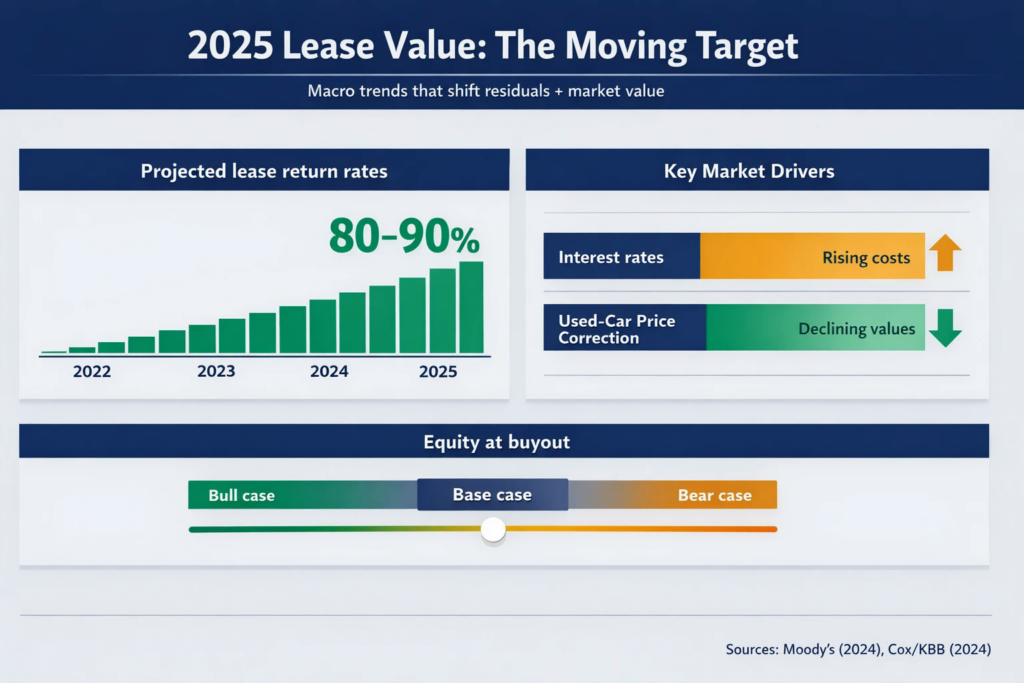
Residual values aren’t static in 2026. Use macro signals—return-rate surge, rate environment, and market correction scenarios—to estimate buyout equity risk.
The ‘future car’ factor: how new tech can hurt your car’s value
It seems logical that a car loaded with advanced technology would hold its value better. The data, however, tells a different story. According to research, electronics now account for 50% or more of a new vehicle’s value, but they also depreciate significantly faster than its mechanical parts.
This is the Tech-Value Paradox. A cutting-edge infotainment system or a suite of driver-assist features from two or three years ago can feel outdated today. Software stops receiving updates, and newer, better hardware becomes standard on other models. This accelerated obsolescence can drag down your vehicle’s market value, a risk the original residual value calculation likely didn’t account for. Before you decide to buy, consider how much of your car’s value is tied to technology that might already be aging poorly. Our end-of-lease evaluation guide walks through how to score your specific vehicle against these risk factors.
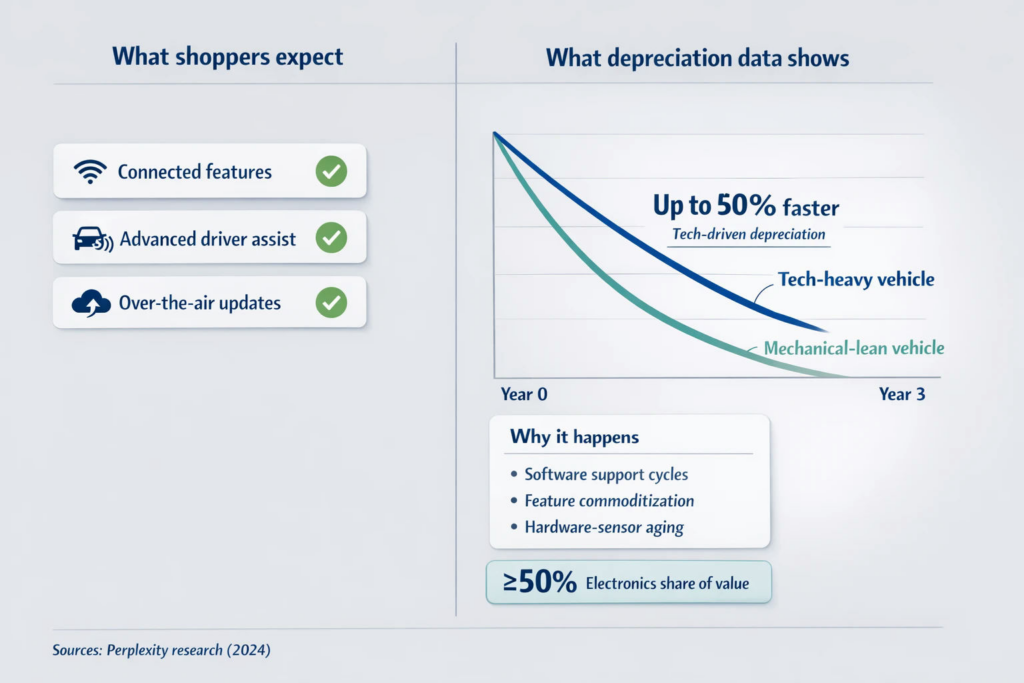
Future-proof features can still age fast. Compare expectation vs. data, then weigh software support and sensor lifecycles before trusting a high residual.
The DeLorean lesson on lasting value
Think about the 1981 DeLorean from Back to the Future. Its value is in its iconic design and cultural status: static, unchanging qualities. Now think about a luxury car from 2023. Its value was likely tied to having the “largest touchscreen” or the “most advanced” semi-autonomous features. In 2026, those digital features are no longer impressive and may even be functionally obsolete if the manufacturer has ended software support.
The DeLorean holds value because its core appeal doesn’t rely on a software update. This is a crucial lesson for modern leases: mechanical reliability and timeless design often prove to be more durable assets than a rapidly aging digital interface.
For EVs, DC fast-charging is non-negotiable
If you’re leasing an electric vehicle, one feature stands above all others in determining its future value: DC fast-charging capability. As the public charging infrastructure expands, the ability to charge quickly on the go is becoming a baseline expectation.
An EV that can only charge slowly at home or at Level 2 stations will have a much smaller pool of potential buyers on the used market. Its limited utility makes it far less attractive, severely impacting its market value regardless of its range or other features. When evaluating your EV lease buyout, consider its charging speed a primary factor in its long-term viability and worth.
How the sales model impacts your equity
Where you get your vehicle from also plays a role in its value stability. Traditional franchise dealerships have a layered system that tends to create more predictable pricing. In contrast, direct-to-consumer (DTC) brands like Tesla can adjust the MSRP of new vehicles overnight with a single press release.
This creates enormous volatility. According to a McKinsey analysis, DTC brands show three times higher residual volatility than franchise brands. A sudden price drop on a new model can instantly erase the equity in your leased vehicle, turning what looked like a great buyout deal into a financial loss.
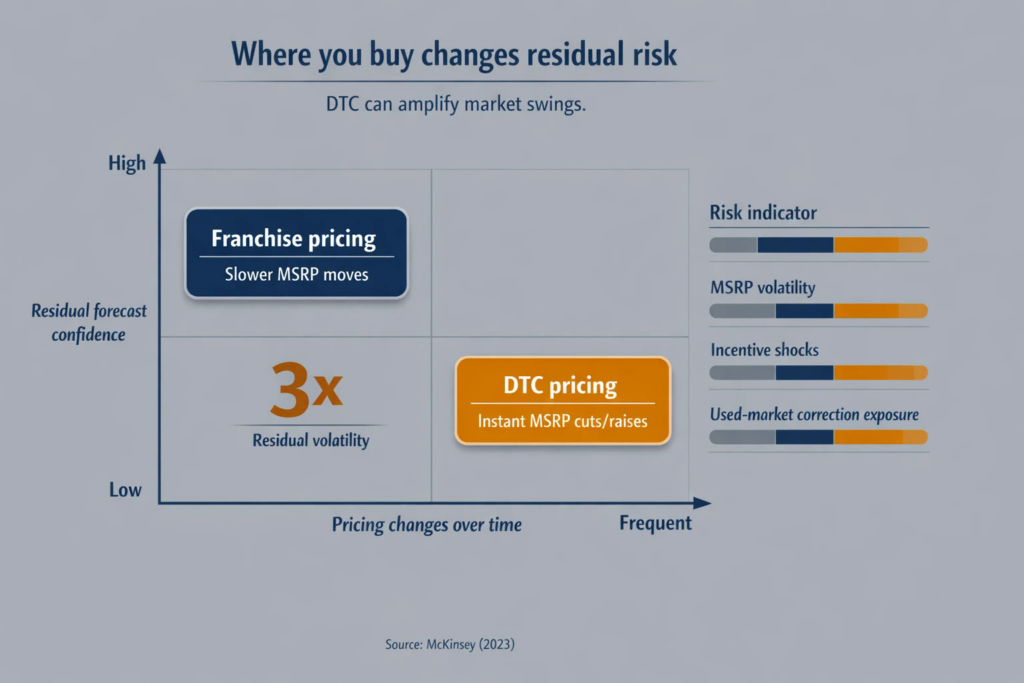
Residual forecasts depend on pricing behavior. If a brand can change MSRP overnight, treat the buyout math as a wider range—not a single number.
Your 5-point checklist before buying out your lease
Navigating these factors requires a modern approach to evaluating your end-of-lease options. Before you make a decision, run your vehicle through this five-point inspection.
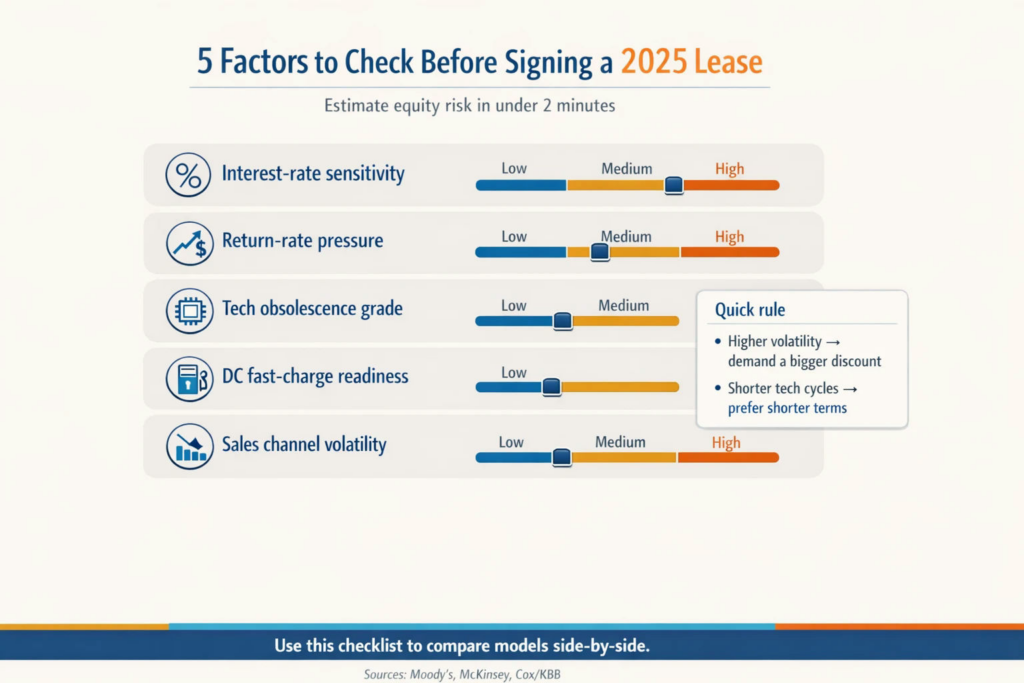
Turn market noise into a repeatable decision. Score each model on these five factors to compare lease offers and avoid surprise depreciation at buyout.
- Market Correction Impact: How does your contractual residual value compare to the vehicle’s current market value on sites like Kelley Blue Book? Is there equity, or are you underwater?
- Tech Obsolescence Risk: How much of the car’s appeal is tied to its digital technology? Is the software still supported and competitive, or has it become outdated?
- EV Charging Speed (if applicable): Does the vehicle support DC fast-charging? If not, be prepared for a significant drop in its long-term market value.
- Brand Pricing Model: Is your vehicle from a DTC brand with volatile pricing or a traditional brand with more stable values? Factor in the risk of sudden MSRP changes.
- Financing and Ownership Costs: What will be your all-in cost after securing a loan? Considering potential maintenance on an aging vehicle and whether you need an extended warranty can also inform your decision.
Making the right choice at the end of your lease is more complex than ever, but it doesn’t have to be overwhelming. By looking at the right factors, you can move forward with confidence.
At Lease Maturity Services, we specialize in helping drivers navigate this exact moment. We handle everything from securing competitive lease buyout financing to managing all the titling and registration paperwork, simplifying your path to ownership. If you’re ready to make a clear, informed decision, our team is here to help.
