
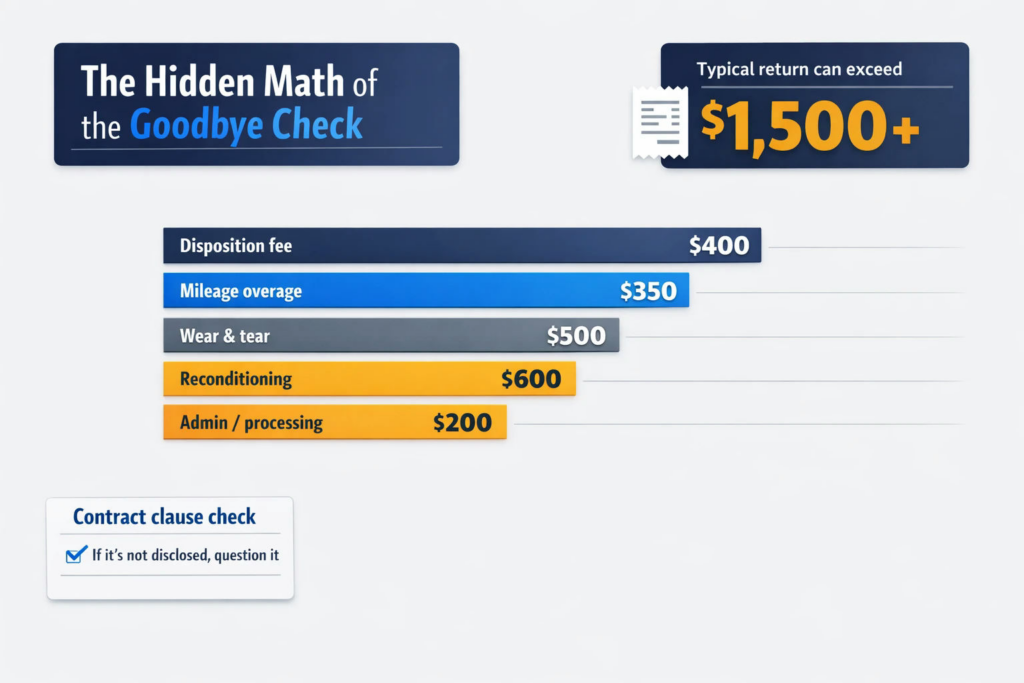
That final lease payment is gone, and you’re ready to hand back the keys. Most drivers expect a simple inspection for dings and mileage, but the reality is often a final bill that can easily exceed $1,500. The “goodbye check” you write to the leasing company isn’t just about a few scratches; it’s a bundle of standard fees, dealer-specific charges, and potential penalties that many people never see coming.
Returning your leased vehicle isn’t a simple drop-off. It’s a financial transaction where the final costs are often unclear until the very end.
For many drivers, the biggest financial decision at the end of a lease isn’t simply returning the vehicle, it’s deciding whether a lease buyout offers greater long-term value. Understanding your vehicle’s residual value, current market value, and potential equity can help you avoid unnecessary fees while making a more informed financial decision. Rather than viewing lease end as the conclusion of ownership, many consumers now see it as an opportunity to purchase a vehicle they already know and trust.
What Is a Lease Buyout?
A lease buyout allows you to purchase your leased vehicle instead of returning it to the leasing company. In most cases, the purchase price is based on the residual value listed in your original lease agreement, although taxes, registration fees, and any remaining obligations may also apply.
There are generally two types of lease buyouts. An end-of-lease buyout occurs when your lease reaches maturity, while an early lease buyout allows you to purchase the vehicle before the lease expires. Most drivers consider a buyout when the vehicle’s market value exceeds its residual value, creating positive equity that would otherwise be surrendered when returning the vehicle.
Choosing between a lease buyout and lease return requires evaluating more than monthly payments. Vehicle condition, mileage, financing options, expected maintenance costs, and future resale value all contribute to determining which option delivers the greatest financial benefit.
The big three: Deconstructing your standard end-of-lease bill
Before we get to the surprising charges, let’s cover the three costs you can almost always expect on your turn-in invoice.
1. Disposition fee
This is a flat fee charged by the leasing company to cover the costs of cleaning, inspecting, and selling the vehicle you returned. It’s written into your original contract and is nearly unavoidable if you return the car. According to 2025 industry data, these fees typically range from $300 for brands like Subaru to as high as $595 for Mercedes-Benz and Cadillac.
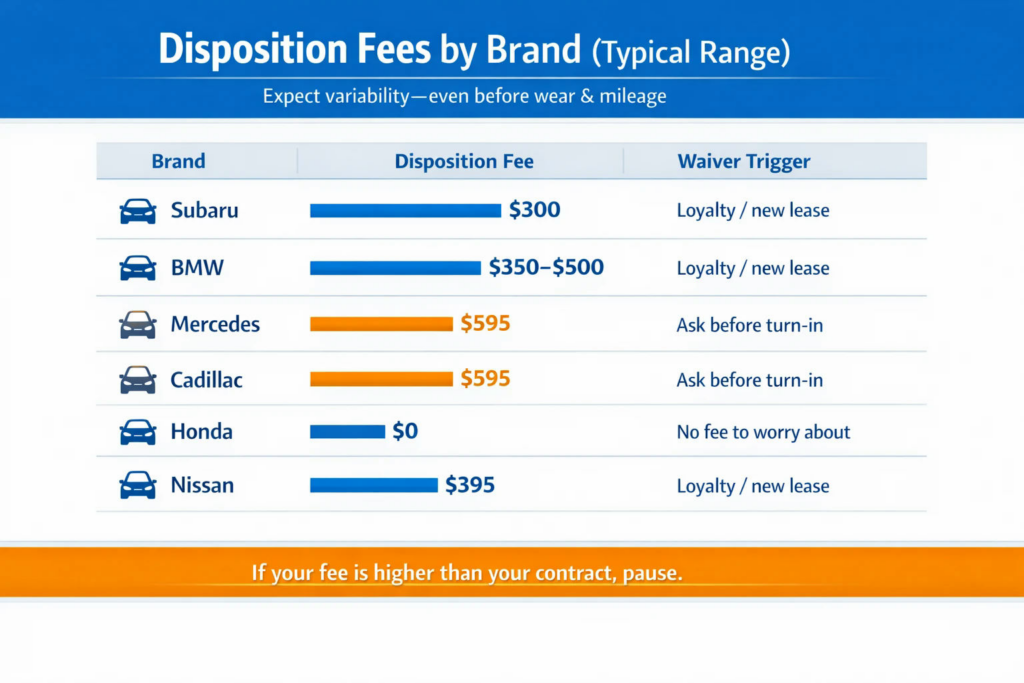
Disposition fees vary widely by brand and lender. A quick comparison helps you sanity-check your expected turn-in cost and spot outliers worth questioning.
Some brands waive this fee if you lease or purchase another vehicle from them, but this “loyalty waiver” forces you into a new deal on their terms.
2. Excess mileage penalties
Your lease contract specifies a mileage limit, usually between 10,000 and 15,000 miles per year. For every mile you drive over that limit, you’ll pay a penalty, typically between 20 and 30 cents per mile. This adds up fast. Driving just 5,000 miles over your limit can result in a $1,000 to $1,500 bill.
This is a particular risk for drivers in certain areas. For example, 2025 data shows that drivers in states like Maine and Arkansas average over 14,000 miles per year, making an overage penalty almost a certainty.
3. Excess wear and tear charges
This is the most subjective and often surprising charge. While your contract allows for normal use, the definition of “excessive” is up to the inspector. A worn tire, a stained seat, or a deep scratch can trigger reconditioning charges. Dealerships often bill between $1,000 and $4,000 for these repairs, which they say are necessary to make the car ready for resale. When you buy out your lease, these specific reconditioning charges are typically waived since you are taking ownership of the car as-is.
When Does a Lease Buyout Make Financial Sense?
Not every leased vehicle should be purchased, but there are several situations where a lease buyout may offer significant financial advantages. The strongest indicator is positive equity, where the vehicle’s current market value exceeds the residual value established when the lease began.
Buyouts also become attractive when the vehicle has been well maintained, has relatively low mileage, or would be expensive to replace in today’s used vehicle market. Because you already know the vehicle’s maintenance history, ownership costs may also be more predictable than purchasing another used vehicle with an unknown history.
Drivers who have customised their vehicles, exceeded mileage limits, or anticipate substantial lease-end penalties often discover that purchasing the vehicle results in lower overall costs than returning it.
The whistleblower’s guide to dealer-packed fees
Beyond the standard charges, a more concerning trend has emerged: dealer-added fees that may not even be in your original contract. These are often presented as non-negotiable costs during the confusing turn-in process.
Forums like Reddit and Leasehackr are filled with stories of drivers blindsided by these last-minute charges. Based on consumer reports and investigations, here are a few red flags to watch for:
- The “Double-Dip” Admin Fee: Some dealerships add their own “processing fee” or “documentation fee” on top of the leasing company’s official disposition fee. If it wasn’t in the contract you originally signed, it’s worth questioning. The Consumer Leasing Act of 1976 requires clear disclosure of costs.
- Vague “Reconditioning” Fees: Instead of itemizing specific repairs, some invoices just list a single, large “reconditioning” charge. Always ask for a detailed breakdown of what is being fixed and why.
- Brand-Specific “Gotchas”: Investigations have uncovered questionable, localized fees tacked on by certain dealer networks, such as a “Tri-State Lemon Law Fee” (reported with some Nissan dealers) or a “Mechanic-Certification Fee” (seen at some VW dealers). These are rarely official brand fees.
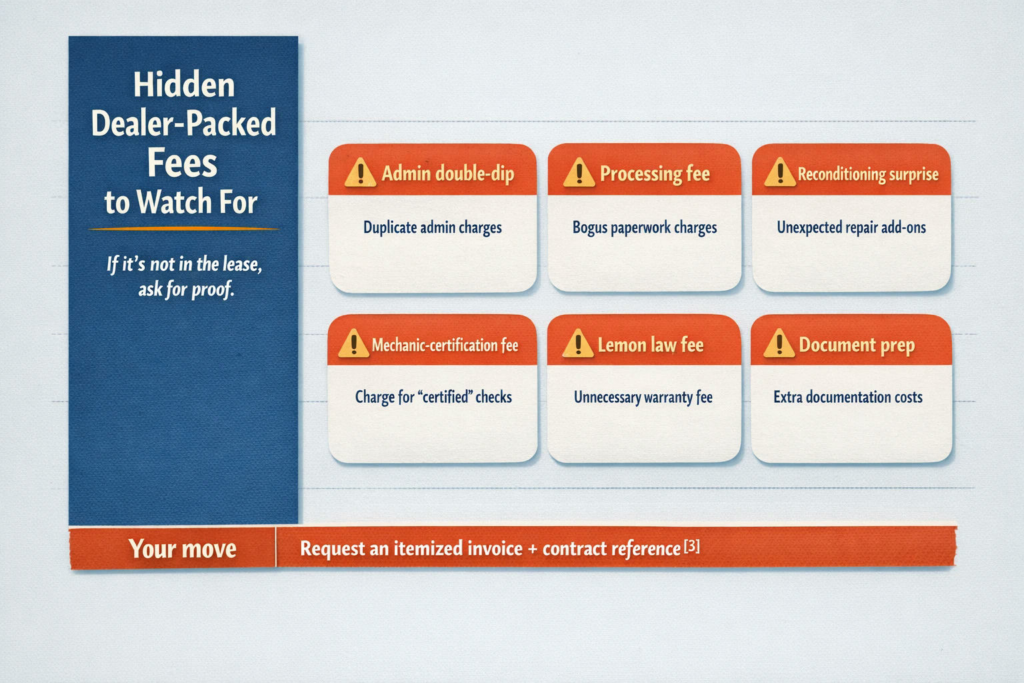
Forums are full of ‘mystery charges’ because some fees appear at turn-in, not in the contract. Use this red-flag list to demand proof and itemization.
Understanding Your Consumer Rights at Lease End
The Consumer Leasing Act requires key lease terms and many end-of-lease obligations to be disclosed before you sign your agreement. While the exact protections vary depending on your jurisdiction, reviewing your original lease contract remains one of the most effective ways to determine whether unexpected charges are consistent with the agreed terms.
If you disagree with inspection findings or additional fees, remain professional and request supporting documentation. Inspection photographs, repair estimates, mileage calculations, and copies of the original lease agreement often provide the evidence needed to resolve disputes before making payment.
Keeping organised records, including maintenance receipts, tyre replacements, repair invoices, and photographs taken immediately before vehicle return, can also strengthen your position if questions arise regarding the vehicle’s condition.
The real math: Comparing your two end-of-lease choices
When you see the costs laid out, the choice is no longer just about getting a new car versus keeping your old one. It becomes a clear financial decision. The biggest hidden cost of returning your car is often the positive equity you give away for free.
Let’s look at a common scenario.
Scenario A: Returning the vehicle
Your lease is ending on a popular SUV. Your contract’s buyout price (the residual value) is $20,000. But due to market demand, the car’s actual market value is $25,000.
- Disposition Fee: $495
- Excess Mileage (4,000 miles @ $0.25/mile): $1,000
- Wear and Tear (new tires): $800
- Total Out-of-Pocket Cost: $2,295
- Lost Equity: $5,000 (the difference between market value and your buyout price)
In this scenario, returning the car costs you $7,295 in combined fees and forfeited value.
Scenario B: Buying out the lease
You decide to purchase the vehicle for the $20,000 residual value. With a straightforward lease buyout process, you secure financing and take ownership.
- Disposition Fee: $0 (waived in a buyout)
- Excess Mileage Penalty: $0 (not applicable when you buy)
- Wear and Tear Charges: $0 (you own the car; you decide when to replace tires)
- Total Out-of-Pocket Cost: $0 in fees
- Captured Equity: $5,000
By choosing a buyout, you avoid over $2,000 in penalties and immediately gain a $5,000 asset. This is the financial pivot that most leasing companies and dealers don’t highlight. You can continue driving a car you know and trust, or you can sell it yourself and pocket the difference.
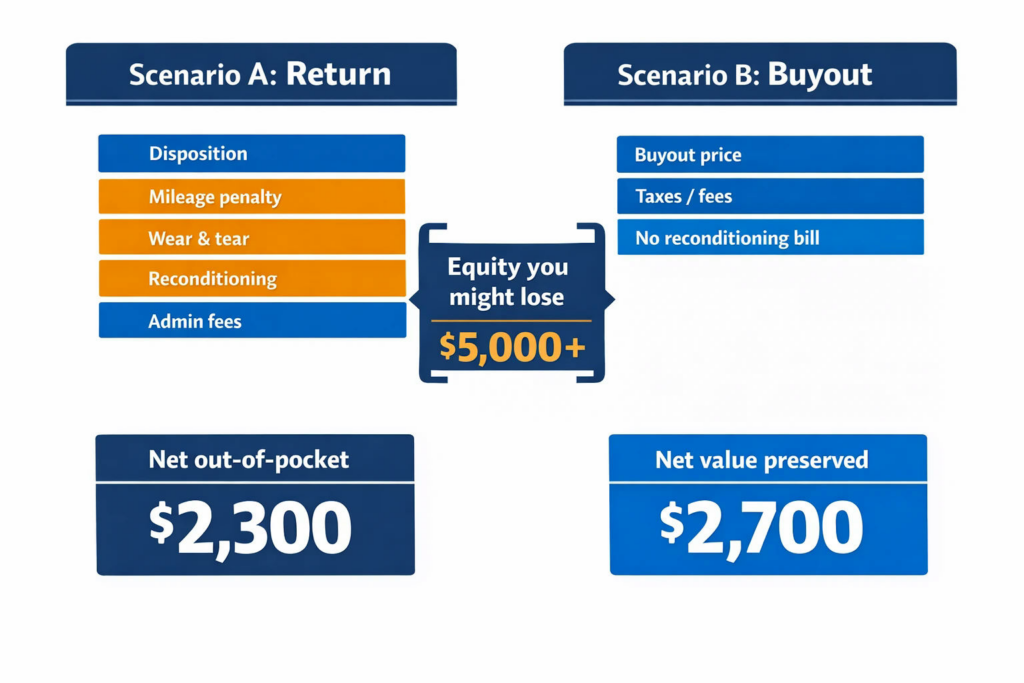
When you compare itemized return penalties against potential equity, the decision changes. This side-by-side example shows how buyout can consolidate costs and protect value.
How to Calculate Your Lease Buyout Value
Calculating whether a lease buyout makes financial sense begins with understanding four important figures: your residual value, current market value, estimated payoff amount, and total financing costs. Comparing these numbers provides a realistic assessment of the vehicle’s potential value after purchase.
The residual value appears in your original lease agreement and represents the predetermined purchase price established when the lease began. Your vehicle’s current market value can often be estimated using recognised valuation resources such as Kelley Blue Book or Black Book, together with offers from dealerships or online vehicle retailers.
If the market value exceeds your residual value, you may have positive equity. Conversely, if the residual value exceeds the current market value, returning the vehicle may represent the more economical decision depending on lease-end charges and financing costs.
Drivers should also include applicable taxes, registration fees, title transfer costs, and financing expenses when comparing total ownership costs. Looking beyond the purchase price provides a more accurate financial comparison between buying and returning the vehicle.
Understanding Vehicle Equity
Vehicle equity represents the difference between what your vehicle is worth and what it would cost to purchase it. Positive equity can become a valuable financial asset because purchasing the vehicle allows you to retain that value rather than leaving it with the leasing company.
Many drivers are surprised to discover they have accumulated equity due to stronger-than-expected used vehicle values, lower annual mileage, or favourable residual values established several years earlier. Obtaining an independent vehicle appraisal before lease maturity provides additional confidence when comparing your available options.
Even if you ultimately decide not to keep the vehicle, understanding your equity position allows you to make a more informed decision rather than relying solely on dealership recommendations.
Take control of your end-of-lease decision
Your lease end shouldn’t feel like a penalty box. By understanding the full financial picture, you can shift from a position of reacting to fees to proactively managing your assets. A lease buyout isn’t just about keeping your car; it’s a strategic move to avoid unnecessary costs and capture the value you’ve built over the term of your lease.
Instead of preparing to write a goodbye check, find out how much equity you could be keeping. With transparent financing options and a clear process, you can make the decision that’s right for your wallet.
Lease Buyout Financing Explained
For many drivers, financing makes purchasing a leased vehicle more affordable than paying the entire residual value upfront. Lease buyout financing functions similarly to a traditional auto loan, allowing qualified borrowers to spread the purchase price over predictable monthly payments.
Lenders typically evaluate several factors before approving financing, including your credit history, income, debt-to-income ratio, employment stability, and the vehicle’s value. Comparing offers from banks, credit unions, online lenders, and dealership financing providers can help identify competitive interest rates and repayment terms.
Because the vehicle is already in your possession, financing a lease buyout often eliminates many of the uncertainties associated with purchasing another used vehicle. You already understand its maintenance history, driving characteristics, and overall condition, making ownership decisions more predictable.
When Should You Buy Out Your Lease?
The best time to evaluate a lease buyout is generally several months before your lease expires. This provides sufficient time to obtain payoff information, research vehicle values, compare financing offers, and determine whether purchasing the vehicle aligns with your financial goals.
A lease buyout may be particularly attractive when used vehicle prices remain strong, your vehicle has accumulated positive equity, or replacing it with a comparable model would require significantly higher monthly payments. Drivers who have maintained their vehicles well often benefit from continuing ownership rather than starting another lease cycle.
Conversely, if the vehicle requires major repairs, has little or no equity, or no longer meets your transportation needs, returning the vehicle may remain the better financial decision. Evaluating each factor objectively helps ensure your decision reflects your individual circumstances rather than dealership sales incentives.
Common Lease-End Mistakes to Avoid
Many lease-end costs can be reduced or avoided entirely through early preparation. One of the most common mistakes is waiting until the final inspection before reviewing the lease agreement. Understanding your contractual obligations several months in advance provides more opportunities to compare options and address potential issues.
Another frequent mistake is assuming the dealership’s recommendation automatically represents the most economical choice. While dealerships often provide valuable guidance, independently comparing vehicle values, financing offers, and lease-end costs helps ensure decisions are based on objective financial considerations.
Drivers should also avoid overlooking vehicle equity. A surprising number of leased vehicles are worth more than their contractual residual value, meaning returning the vehicle without evaluating a lease buyout could result in forfeiting thousands of dollars in potential value.
Finally, failing to document the vehicle’s condition before inspection can make it more difficult to dispute excessive wear-and-tear assessments. Photographs, maintenance records, tyre receipts, and repair invoices provide useful evidence should questions arise after the inspection is completed.
