
In recent years, a major shift occurred in the auto industry. Over 90% of leases were not returned to the dealer, primarily because high used-car equity made buyouts more attractive. While market conditions fluctuate, this trend revealed a core truth: the standard lease return process is often not the driver’s best financial option.
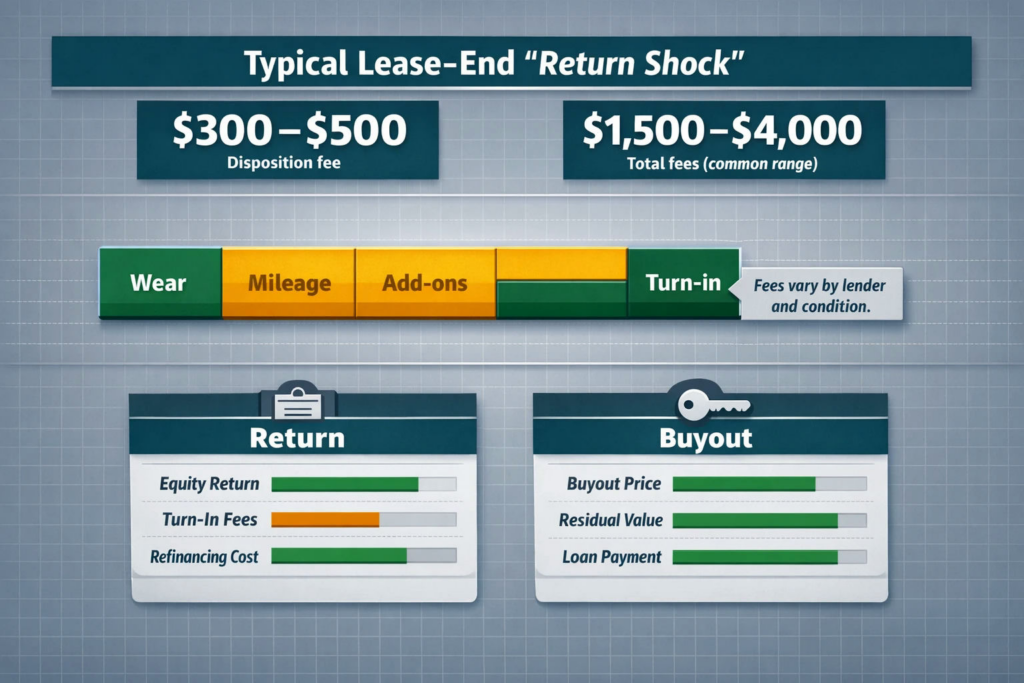
Your lease agreement is a conditional contract. It outlines exactly what the leasing company expects when you return their asset. Failing to meet these conditions can result in a “return shock,” where disposition fees of $300-$500 are compounded by wear and mileage penalties that can easily total $1,500 to $4,000.
Understanding these clauses is the first step to avoiding penalties. It gives you the power to assess your options and decide whether returning the car or buying it out makes more sense for you.
What Is a Car Lease Agreement?
A car lease agreement is a legally binding contract between you and the leasing company that allows you to drive a vehicle for a predetermined period while the lessor retains ownership. The agreement establishes monthly payments, lease duration, annual mileage allowances, maintenance responsibilities, insurance requirements, and the conditions that apply when the lease ends.
Unlike financing a vehicle purchase, leasing typically results in lower monthly payments because you are paying for the vehicle’s expected depreciation during the lease term rather than its full purchase price. At the conclusion of the agreement, you generally have several options: return the vehicle, purchase it for its residual value, or begin a new lease if available.
Because every lease agreement contains unique terms, reviewing your contract well before lease maturity allows you to understand potential fees, inspection standards, disposition charges, and lease buyout opportunities before making your final decision.
Understanding the Most Important Lease Contract Terms
Many lease agreements use financial terminology that can be confusing for first-time lessees. Becoming familiar with these terms makes it much easier to understand your contractual obligations and evaluate your available options.
Residual value represents the vehicle’s predetermined purchase price at the end of the lease. This figure becomes the basis for a lease buyout if you decide to purchase the vehicle. The money factor functions similarly to an interest rate and influences your monthly lease payment, while the capitalized cost represents the negotiated selling price used to calculate depreciation throughout the lease.
Your agreement will also specify your annual mileage allowance, disposition fee, excess mileage penalties, wear-and-tear standards, purchase options, insurance requirements, and important deadlines for notifying the leasing company of your lease-end intentions. Reviewing these sections early provides valuable time to compare costs before your lease expires.
The pre-return audit: How to objectively assess wear and tear
One of the biggest sources of anxiety for lessees is the subjective nature of the final inspection. What you see as normal use, a dealership inspector might flag as “excessive wear and tear.” To protect yourself, you need to perform your own audit using the same standards they do.
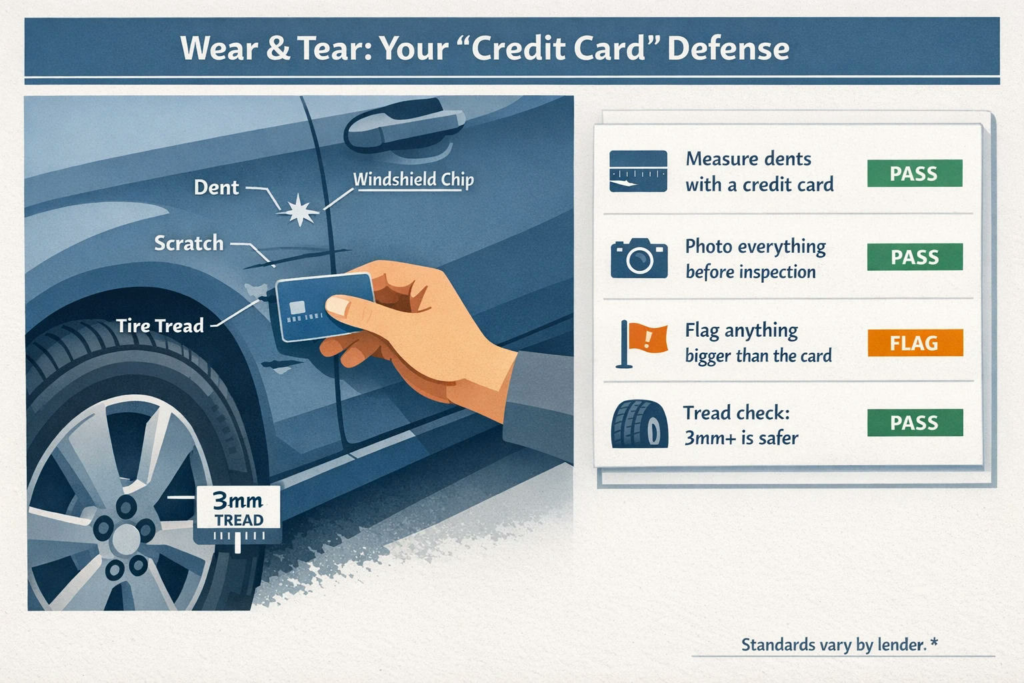
The industry gold standard is the “Credit Card Rule.” Generally, any single scratch, dent, or chip on the body of the car that can be fully covered by a standard credit card is considered normal. Anything larger is typically deemed excessive and chargeable.
Before your official inspection, walk around your vehicle and check for:
- Body Damage: Use a credit card to measure any dings, dents, or scratches on the panels, doors, and bumpers.
- Tires: Check the tread depth. Most leasing companies require a minimum of 4/32″ of tread remaining. You can easily check this with a penny; if you can see all of Lincoln’s head, your tires are likely too worn.
- Glass: Look for any chips or cracks in the windshield and windows. A small chip might be acceptable, but cracks are almost always a chargeable repair.
- Interior: Inspect for significant stains, tears, or burns in the upholstery and carpeting.
Document everything with clear photos and video. Having your own dated records creates an objective baseline and is your best defense against unexpected charges.
How to Read Your Car Lease Agreement Before Lease End
Many lease-end surprises occur because drivers wait until their final inspection to review the contract. Reading your car lease agreement several months before lease maturity provides time to understand important deadlines, inspection requirements, notification periods, purchase options, and potential fees.
Pay particular attention to sections covering excess mileage, acceptable wear and tear, disposition fees, early termination provisions, insurance obligations, and lease buyout procedures. Highlighting these clauses allows you to compare the financial impact of returning versus purchasing your vehicle before making a final decision.
Drivers should also request a current lease payoff quote and compare it with their vehicle’s estimated market value. This simple exercise helps identify whether positive equity exists and whether a lease buyout deserves additional consideration.
Calculating the real cost: Mileage penalties and fees
Going over your mileage allowance is one of the most common and costly mistakes. Your contract specifies a per-mile penalty, typically ranging from $0.15 to $0.30. While that sounds small, it adds up quickly. Driving 3,000 miles over your limit at $0.25 per mile results in a $750 bill.
But that’s rarely the only cost. When you return a lease, you face a stack of potential charges:
- Disposition Fee: A flat fee ($300-$500) for processing the returned vehicle.
- Excess Mileage Penalty: The cost for every mile over your contracted limit.
- Excessive Wear and Tear: Charges for any damage deemed beyond normal use.
These fees compound, turning what seems like a simple return into a significant expense.
The 2026 “gotcha”: Why selling your lease to a third party is restricted
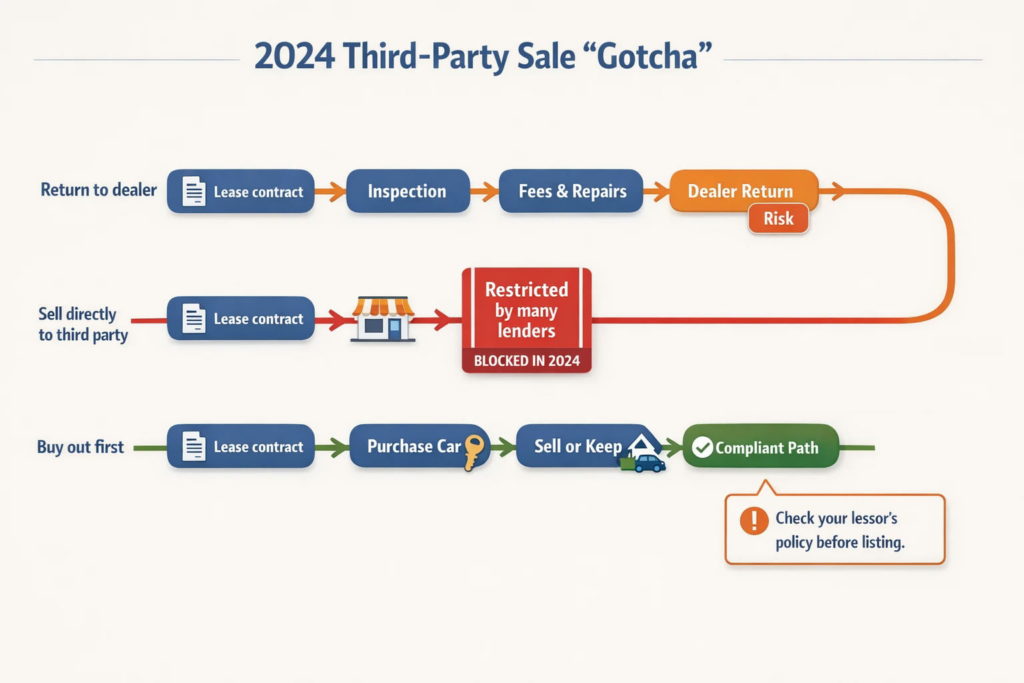
You may have heard of people selling their leased vehicle directly to a third-party dealer like Carmax or Carvana to capture its equity. While this was once a popular strategy, it’s no longer an option for most lessees.
Since 2024, the majority of auto lenders have prohibited direct third-party buyouts. They want to control their own used vehicle inventory and will not allow another dealer to purchase the car directly from them. This means any online advice suggesting this as an easy exit is now outdated.
There is a fully compliant way to access your vehicle’s equity: you must purchase the vehicle yourself first. By securing financing to buy out your lease, you take ownership of the title. From there, you are free to keep the car, trade it in, or sell it to any private party or dealership you choose. This two-step process is now the standard for unlocking the value you’ve built in your leased vehicle.
Understanding Lease Buyout Options
Most car lease agreements provide one or more opportunities to purchase the vehicle rather than returning it. Understanding these options before your lease expires allows you to compare costs, financing, and potential vehicle equity before making your final decision.
An end-of-lease buyout is the most common option and allows you to purchase the vehicle for the residual value listed in your lease agreement. Some leasing companies also permit early lease buyouts before the contract expires, although eligibility and pricing vary by lender.
Before committing to a purchase, request a current lease payoff quote and compare it with your vehicle’s estimated market value. If the vehicle is worth more than the contractual buyout price, purchasing it may allow you to retain valuable equity while avoiding common lease-end charges such as disposition fees, excess mileage penalties, and certain wear-and-tear assessments.
Vehicle Equity and Why It Matters
One of the most overlooked sections of a car lease agreement is the purchase option. While many drivers assume returning the vehicle is the default outcome, changing market conditions have made lease buyouts increasingly attractive for vehicles with positive equity.
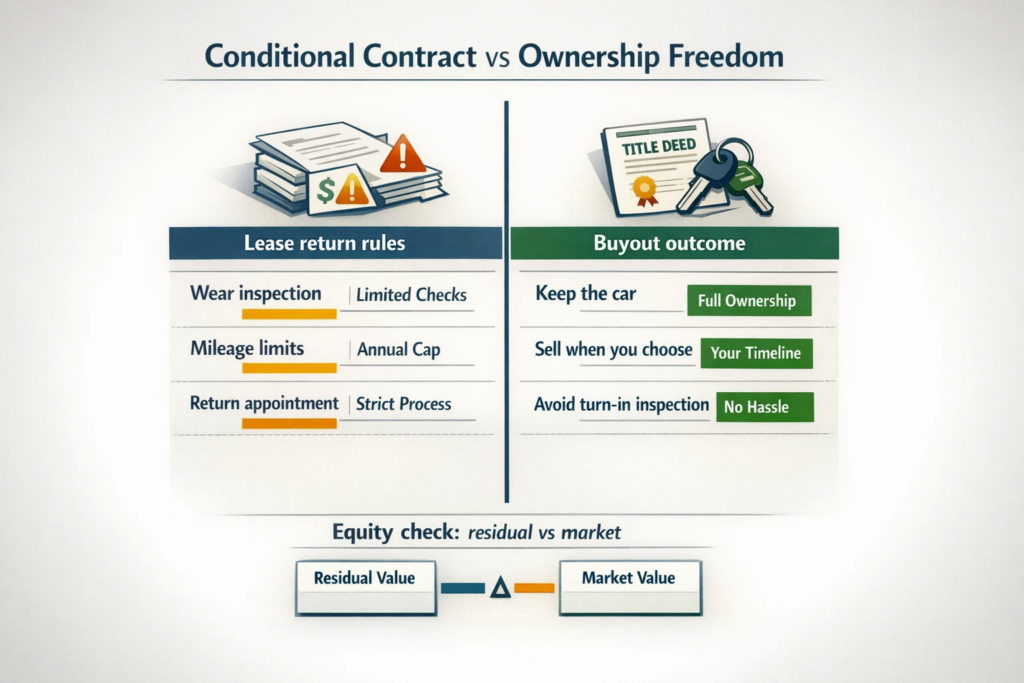
Vehicle equity is calculated by comparing your vehicle’s current market value with its lease buyout price. When the market value exceeds the residual value, purchasing the vehicle may provide immediate financial value because you are acquiring an asset worth more than its contractual purchase price.
Obtaining vehicle valuations from recognised appraisal resources or dealership purchase offers provides a more objective basis for comparing your available lease-end options. Rather than focusing exclusively on monthly payments, evaluating total ownership costs and retained equity creates a more complete financial picture.
Navigating the fine print: Advanced scenarios
A standard lease agreement also contains clauses for less common situations. Understanding them demonstrates you’re prepared for anything.
Crossing the border
Planning to drive into Mexico? Your lease agreement almost certainly requires you to get written permission from the lender first. Companies like VW Credit and Ford Credit have formal protocols for issuing a “Mexico Permission Letter.” Without it, you could be in violation of your contract and face insurance complications.
A totaled vehicle
If your leased car is declared a total loss after an accident, your standard auto insurance pays its current market value. If that value is less than what you still owe on the lease, the difference is called the “gap.” Guaranteed Asset Protection (GAP) insurance, usually included in your lease payment, covers this difference. Without it, you would be personally responsible for paying off the remaining lease balance on a car you can no longer drive.
Additional Lease Agreement Scenarios to Understand
Early lease termination
Ending a lease before the scheduled maturity date often results in early termination charges. Depending on the lease agreement, you may remain responsible for outstanding depreciation, remaining lease payments, administrative fees, or other contractual obligations. Reviewing these provisions before terminating a lease helps you evaluate whether a lease buyout or transfer offers a more economical alternative.
Lease transfers
Some leasing companies permit qualified drivers to assume an existing lease through an approved lease transfer process. While not every lender allows transfers, this option may reduce costs for drivers whose transportation needs change before the lease expires. Always confirm eligibility requirements directly with your leasing company.
Vehicle theft
If your leased vehicle is stolen and declared a total loss, your insurance company typically settles the claim based on the vehicle’s actual cash value. GAP coverage, when included or purchased separately, may help cover the difference between the insurance settlement and your remaining lease balance. Reviewing your insurance provisions before an unexpected loss helps clarify your financial responsibilities.
Relocation or military deployment
Major life events such as relocation, overseas assignments, or military deployment can affect your ability to continue using a leased vehicle. Some lease agreements include special provisions or assistance programs for qualifying circumstances, making it worthwhile to contact your leasing company as early as possible when your situation changes.
Lease Buyout Financing Considerations
If purchasing your leased vehicle becomes the preferred option, comparing financing offers before lease maturity can help reduce long-term ownership costs. Banks, credit unions, online lenders, and dealership finance departments may all offer lease buyout financing with different interest rates, loan terms, and monthly payment structures.
Approval decisions generally consider your credit profile, income, debt-to-income ratio, employment history, and the vehicle’s value. Obtaining multiple loan quotes allows you to compare the total borrowing cost rather than focusing solely on the monthly payment.
Because you have already driven and maintained the vehicle throughout the lease, financing a lease buyout often involves less uncertainty than purchasing another used vehicle with an unknown maintenance history.
The simplest path forward: Take control with a buyout
After reviewing the potential fees, restrictions, and contractual obligations, many drivers find that the traditional return process is designed to protect the lender, not them.
A lease buyout is the most direct way to eliminate these variables.
When you choose to buy your vehicle, you effectively “delete” the final inspection. There are no arguments over scratches, no penalties for extra miles, and no disposition fees. You simply pay the residual value stated in your original contract to take ownership. This gives you two powerful advantages:
- Certainty: You avoid the financial risks and subjective assessments of the return process.
- Equity: You gain the freedom to keep a vehicle you know and trust or sell it to capture its full market value.
Instead of navigating a complex return, a buyout gives you control over the outcome.
Preparing for Lease End: A Practical Checklist
Preparation is one of the most effective ways to avoid unexpected lease-end expenses. Reviewing your car lease agreement several months before maturity provides enough time to understand your obligations, compare your options, and address any issues before the official inspection takes place.
A practical lease-end review should include confirming your remaining mileage allowance, inspecting the vehicle for excessive wear and tear, gathering maintenance records, requesting a lease payoff quote, researching your vehicle’s current market value, and comparing lease buyout financing options if ownership is being considered.
Drivers who prepare early are generally in a stronger position to negotiate repairs, obtain competitive financing, and make informed decisions without the pressure of approaching lease deadlines.
Common Car Lease Agreement Mistakes
Many lease-end costs result from misunderstandings rather than unexpected events. Becoming familiar with the most common mistakes can help drivers avoid unnecessary expenses and make better financial decisions throughout the lease term.
One of the most frequent mistakes is failing to read the lease agreement beyond the monthly payment section. Important provisions covering mileage limits, wear-and-tear standards, disposition fees, insurance requirements, and purchase options are often overlooked until the lease is ending.
Another common error is waiting until the final inspection to evaluate the vehicle’s condition. Completing a personal inspection several weeks in advance allows time for affordable repairs that may cost significantly less than dealership reconditioning charges.
Many drivers also underestimate the value of positive equity. Comparing the vehicle’s current market value with its residual value before returning the vehicle can reveal whether a lease buyout offers greater financial benefits than simply handing back the keys.
Finally, relying exclusively on dealership recommendations without reviewing independent vehicle valuations, financing offers, or your original lease agreement may limit your available options. Taking time to compare each alternative helps ensure your decision reflects your financial goals rather than convenience alone.
Your lease is ending, but your journey with your car doesn’t have to. If you’re concerned about fees or want to keep your vehicle, a buyout is often the smartest financial move. We specialize in making that process simple, handling everything from securing competitive financing to managing the title and registration paperwork. Explore the lease buyout process and see how easy it can be to take control of your vehicle’s future.
